


Areas We Cover
Categories

WHY THE FILM EVERYONE IS REVIEWING IS NOT AVAILABLE WHERE YOU LIVE
by Connor McCormick | August 22, 2026
in Extras, Film
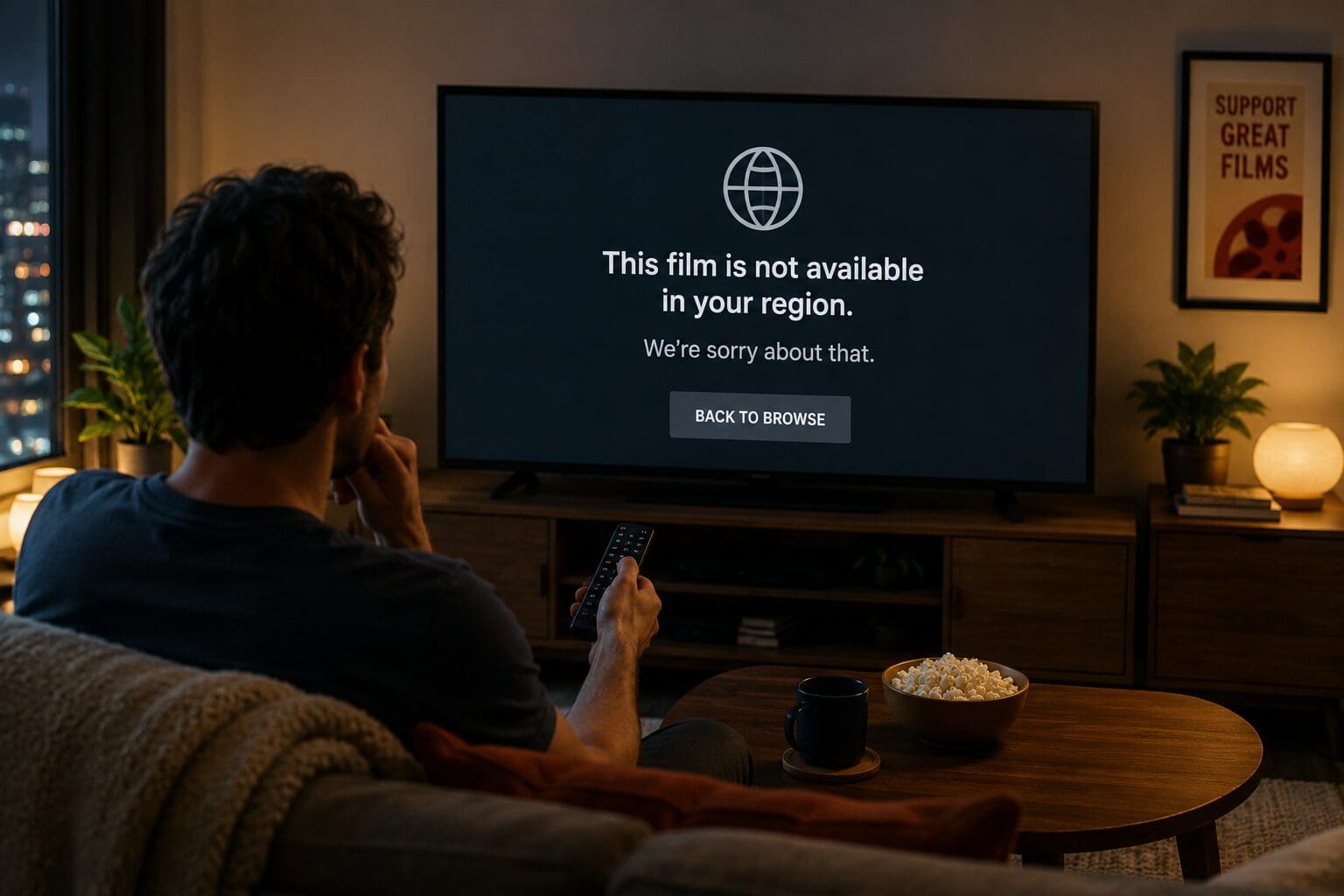
A festival review lands, the film sounds essential, and then comes the familiar part. You look for it and find nothing. Not on the service the review mentioned, not on any of the others, and sometimes not even a rental. The film exists. It is simply not licensed to reach you.
Readers ask about this constantly, and the answer is more interesting than a shrug about streaming rights. It is worth understanding, because it explains a lot about which films get seen and which quietly disappear.
Rights are sold by territory, not by film
A finished film is not one product. It is a bundle of territorial rights sold separately, often years apart and often to companies that have no relationship with each other. A distributor buys France, another buys the German speaking territories, a third takes North America. Each of them then decides how and when to release it.
That is why a documentary can premiere at a festival in September, reach cinemas in one country in March, arrive on a streaming service in another the following autumn, and never appear at all in a third. Nobody is withholding it out of spite. There is simply no buyer in that territory, or the buyer is sitting on it waiting for a slot.
What that looks like from a sofa
- A title listed on a service in one country and absent from the same service elsewhere
- A festival streaming pass that only works for viewers inside a particular region
- A trailer that plays but a film page that returns nothing when you try to watch
- Different cuts in different territories, occasionally with different running times
- A film that vanishes from a service after a licence window closes, sometimes with no notice
The last one catches people out most. A title you bookmarked is not yours in any sense, and watchlists are full of entries that quietly stopped being available.
How people work around it, and what that costs
The common approach is to make the connection appear to come from a country where the film is licensed. Some viewers use a VPN. Others use a static residential proxy, which routes the request through a fixed address registered to an ordinary internet provider in that country and therefore looks like a normal household rather than a server.
Two honest caveats. The first is that every major service treats this as a breach of its terms, and enforcement ranges from a polite error message to a closed account. The second is that it does nothing for the film itself. A viewer who watches this way is not counted in the territory where the film needed an audience, and a distributor deciding whether to buy the next one is looking at exactly those numbers.
The legitimate routes are better than they used to be
- Festival streaming passes, many of which now sell to viewers outside their home region
- Distributor direct platforms, where smaller labels sell or rent their own catalogue worldwide
- Library services, which carry a surprising amount of arthouse and documentary work at no cost
- Physical media, still the only reliable way to own a specific cut of a specific film
- Repertory cinemas and touring programmes, which is how most of these films were meant to be seen
Asking the distributor directly works more often than people expect. Small labels answer their email, and a message asking when a title will be available in your country occasionally produces a date, and occasionally produces a screener link.
Why it matters beyond one film
Territorial licensing decides which films build word of mouth and which do not. A picture that opens everywhere at once gets one conversation. A picture that trickles out over two years gets several small ones, none of which reach critical mass, and the reviews that might have carried it are published a year before most people can watch it.
That is a structural problem, not a viewer problem. But it is worth knowing why the gap exists, and worth remembering that the most useful thing a reader can do for a film they want to see is watch it through a route that actually counts.
FAQ
Why can I read the review but not watch the film?
Press screeners and festival access are handled separately from distribution rights. A critic sees the film through the festival or the sales agent, often long before any territory has been sold.
Is it illegal to watch from another country?
In most places it is a breach of the service terms rather than a criminal matter, but that distinction will not help you if an account is closed. Check the terms you agreed to.
Will the film ever reach my country?
Often yes, and often quietly. Festival documentaries in particular tend to surface on a smaller platform a year or two later without any announcement.
What is the best way to find out?
Follow the distributor rather than the film. They announce their own slate and usually answer direct questions about territories.
