


Areas We Cover
Categories hhhh

Theater Review: ADOLESCENT SALVATION (Theater Wit / Chicago)
by C.J. Fernandes | August 29, 2026
in Chicago, Theater
TEENAGE WASTELAND
Growing up is hell in Tim Venable’s funny,
disturbing and morally murky gearshift play
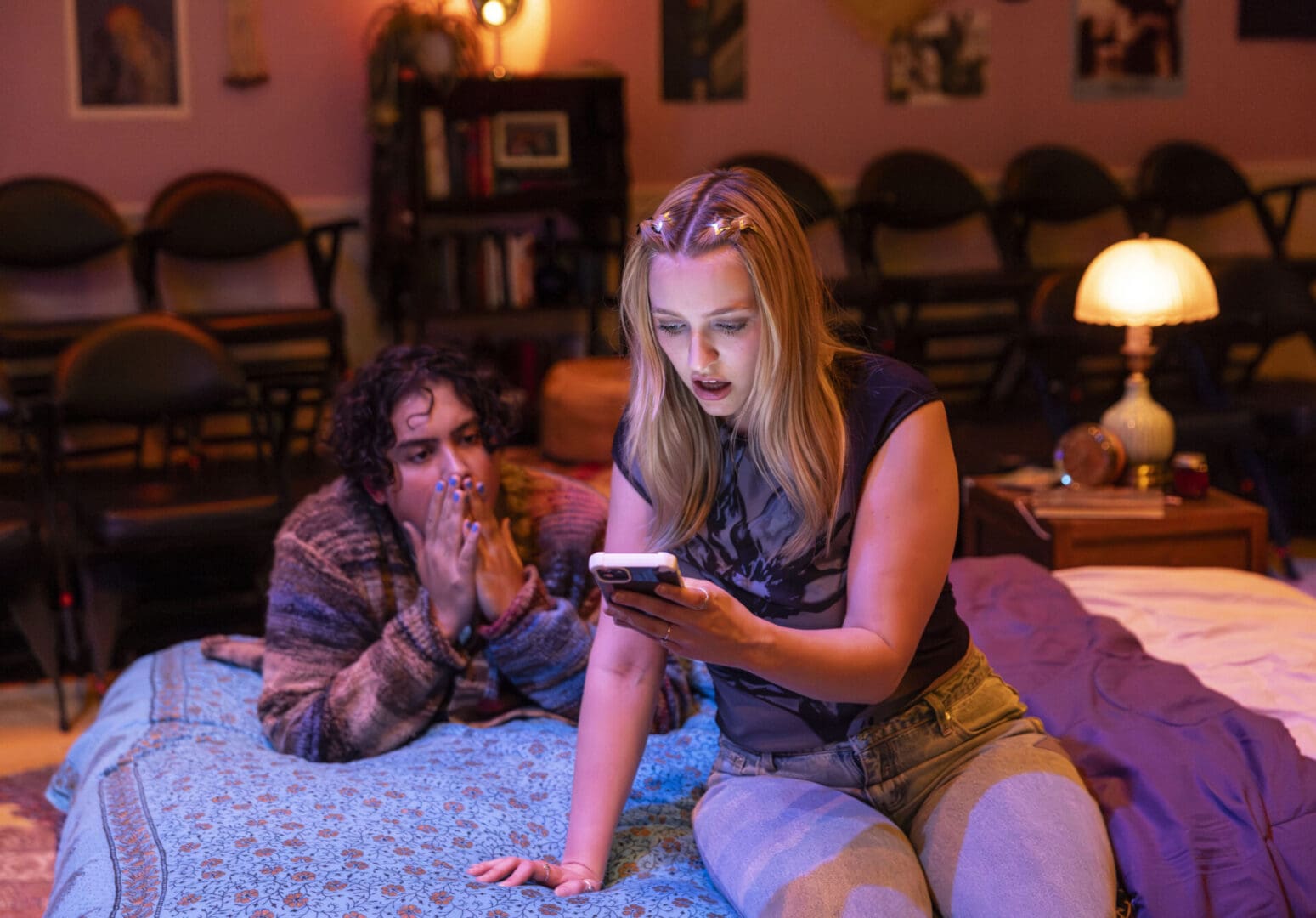
One night, through a haze of tequila, texting, and Taylor Swift, three teenagers banter, bicker, and push each other to the edge — with consequences that could prove lethal. Jordan Levene (foreground) and Brandon Joseph Acosta are “The Taylors” in Theater Wit’s Chicago premiere of Tim Venable’s Adolescent Salvation
In the late 1990s, filmmaker P.T. Anderson coined the term “gearshift movie” to describe a film that switches up its tone/theme in an instant. If we were to extend that term to the theatre, Tim Venable’s Adolescent Salvation would be an exemplar of a “gearshift play,” changing its tone on a dime, not just once, but multiple times.
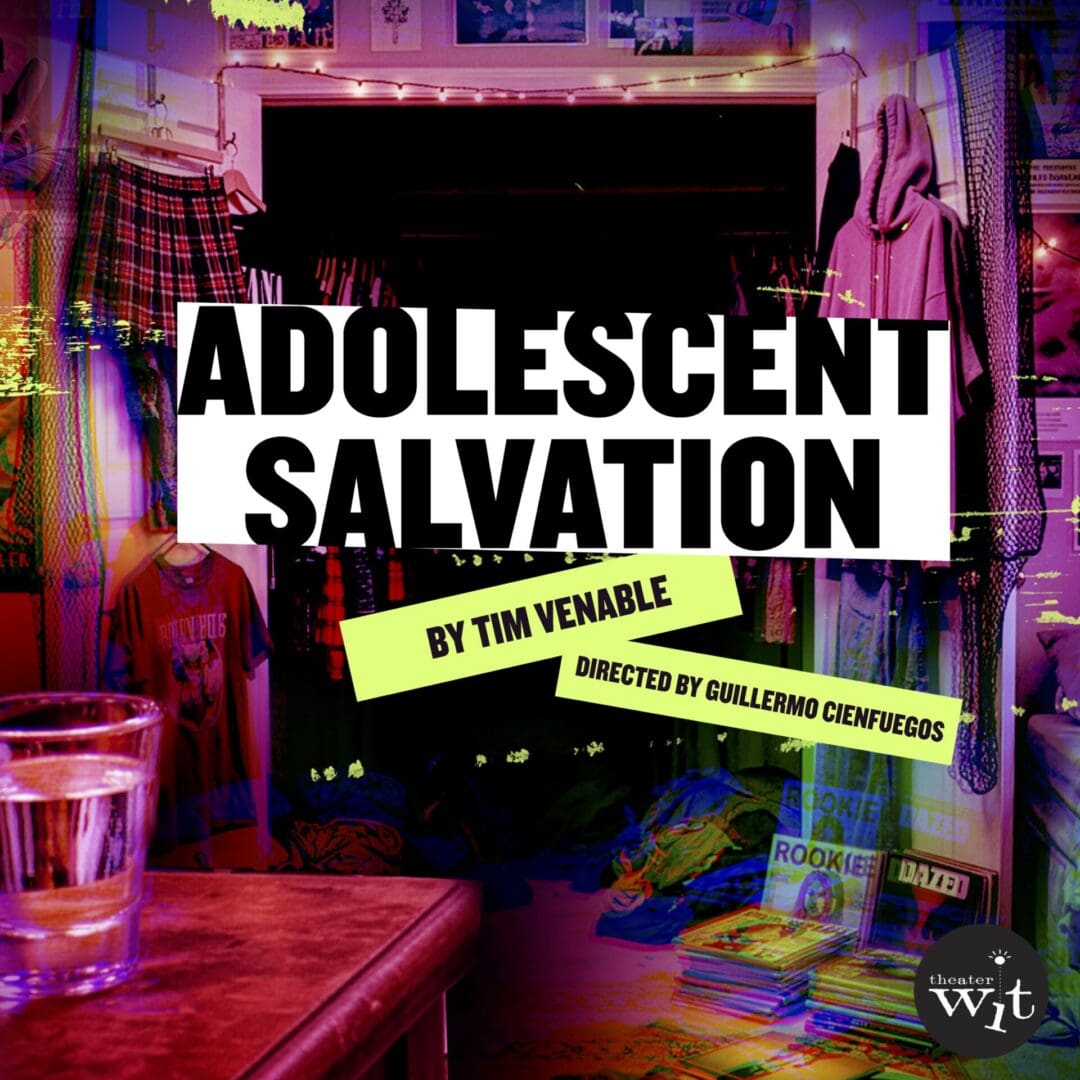
The manipulation begins even before the play does; eschewing a standard entryway, the anteroom of Theatre #3 at Theater Wit on Belmont Avenue has been reconfigured into a bedroom closet. Through this closet the audience proceeds, brushing aside coats and assorted clothing and stepping over sneakers to emerge into the performance space and Jonathan Berg-Einhorn’s gorgeous, immersive set. It’s a weirdly intimate and intrusive way to enter, making us feel more like voyeurs hidden within the room. Posters of notable female singer-songwriters adorn the walls. Fairy lights are festooned from the ceiling. Brightly patterned blankets and throws in primary colors are everywhere, as are curious anachronisms: a lava lamp, a memoir by rock legend Patti Smith, an excessive number of what I’d call “granny lamps,” a crate of vinyl LPs, and so on. This may be a teenage girl’s bedroom, but it’s a teenage girl who is pointedly out of step with her generation.
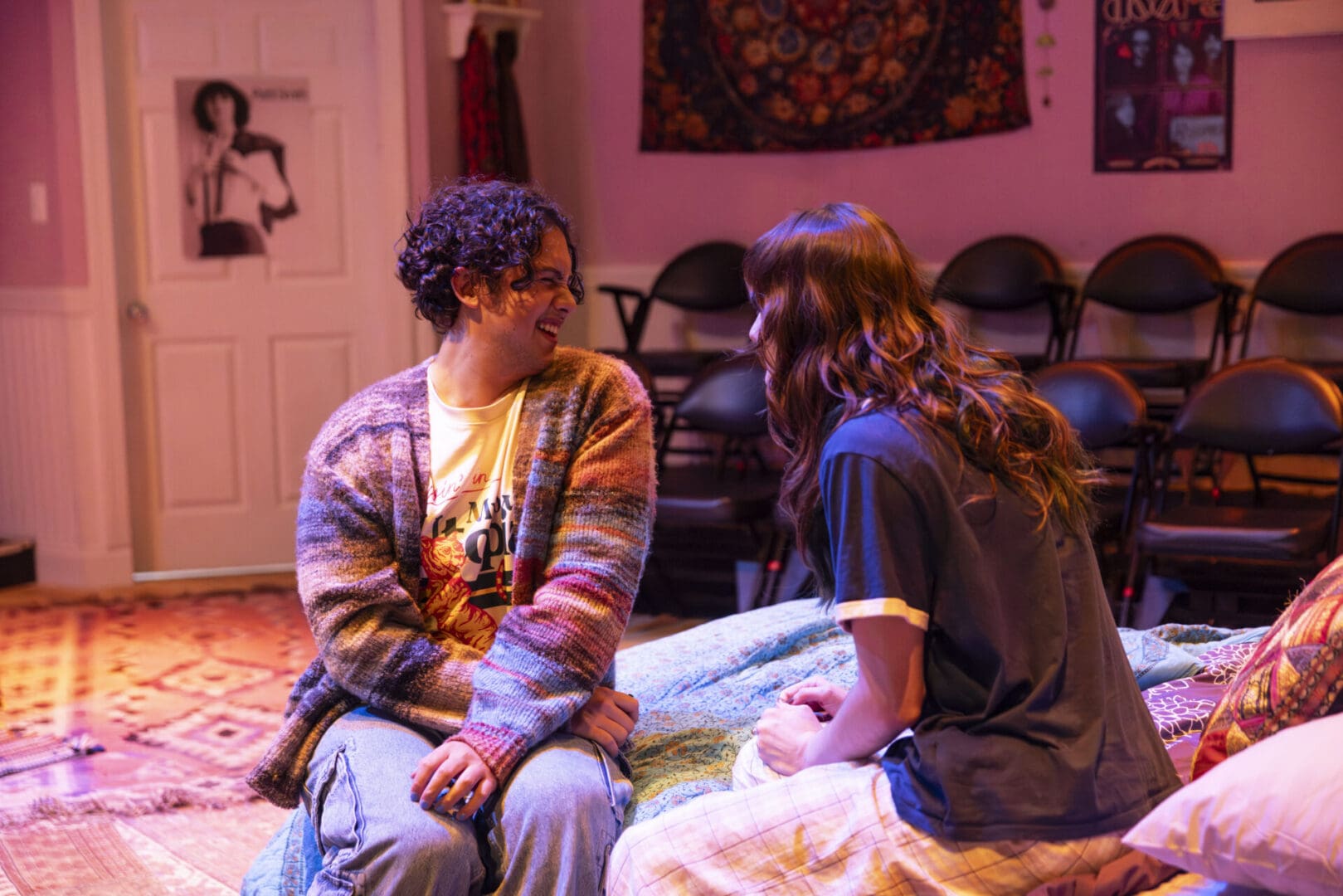
Brandon Acosta (left) as Taylor M and Piper Jean Bailey as Natasha
Adolescent Salvation unfolds over a single night in Natasha’s bedroom. Natasha (Piper Jean Bailey), the fifteen-year-old daughter of divorced parents, has been forced into a sleepover situation with Taylor (Jordan Levene). Their mothers want a drunken night out on the town, and the teens have been asked to keep each other company. The sophisticated, hip, and fashionable Taylor is resentful and has brought along her best friend, a gay classmate also named Taylor (Brandon Acosta), to keep her company. For ease of comprehension, I’ll refer to them as Taylor(F) and Taylor(M), respectively.
In the first of many beautifully—and cleverly—lit scenes by lighting designer Ellie Fey, the play opens in near darkness with our three characters sprawled on the floor, their faces lit by the blue glow of their phone screens. Natasha is messaging furiously and Taylor(M) is scrolling through videos when Taylor(F) lets out the whine—delivered with impeccable vocal fry—that has persisted since teenagers were invented: “I’m bored.”
Cue Taylor(M): “Maybe you should kill yourself.”
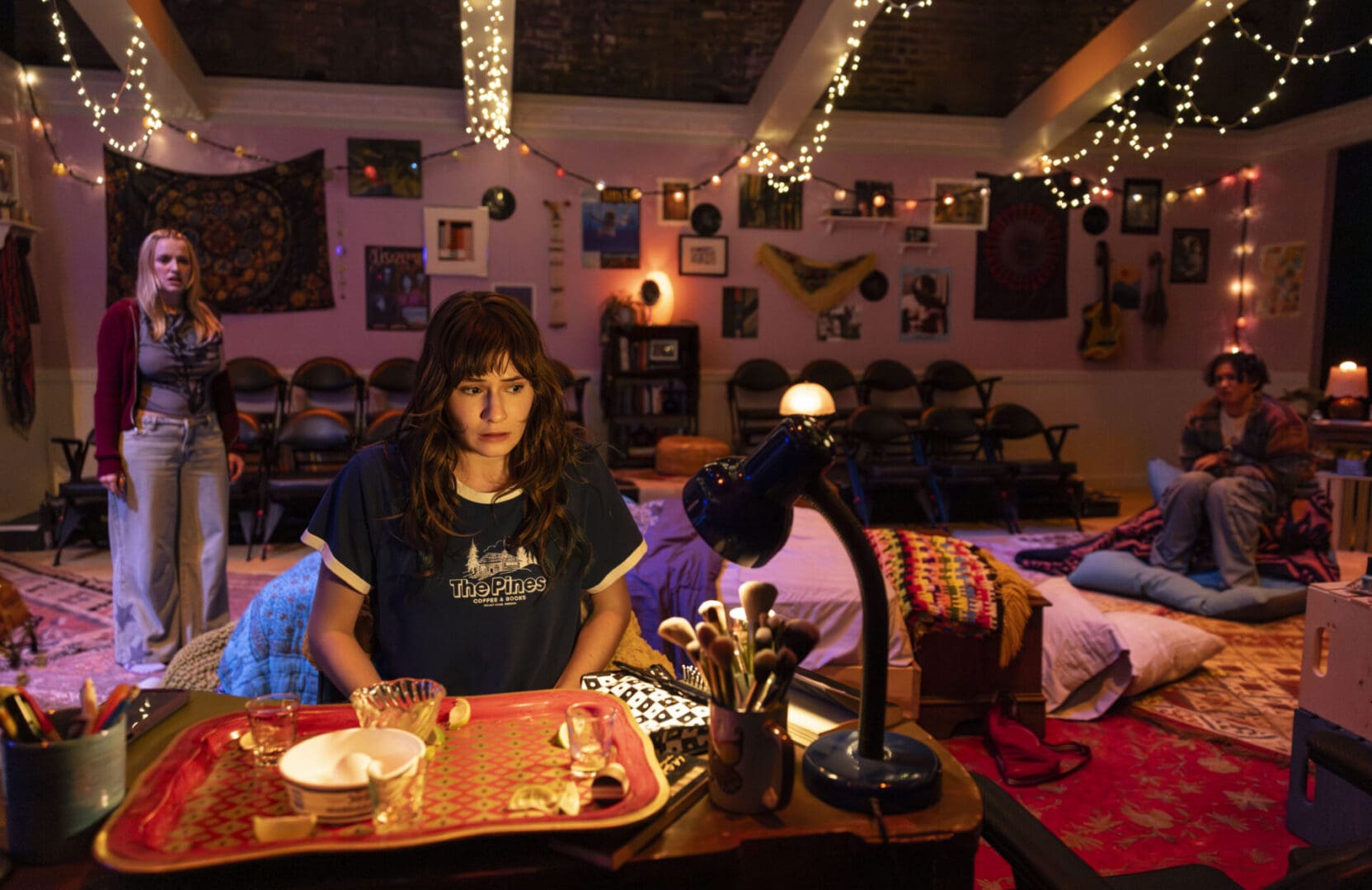
Jordan Levene as Taylor (F), Piper Jean Bailey as Natasha and Brandon Joseph Acosta as Taylor (M)
That exchange firmly establishes the gravitas, or lack thereof, of the play that follows. Events follow predictably—at least at first—from there, as Taylor(F) and Natasha warily circle each other, probing, seeking information and control, with the lovable Taylor(M) caught in between. The nerdy, awkward Natasha with her love of Patti Smith and her ignorance of Taylor Swift songs—this is where you’ll need your suspension-of-disbelief powers—would seem to be easy pickings for the cool, popular, and confident Taylor(F), and you may be forgiven for assuming that you’re in for Mean Girls: Redux, but Venable is smarter than that: Natasha may be unworldly and sheltered relative to her classmates, but she has a strong sense of self and pushes back, surprising and frustrating Taylor(F) with her tenacity and endearing herself to Taylor(M) in the process. As the two girls do battle, pot is smoked—out on the roof, of course—and a bottle of tequila is produced. The Taylors teach Natasha how to do shots, and as the trio get more drunk, their defenses loosen up.
And then it all goes to hell.
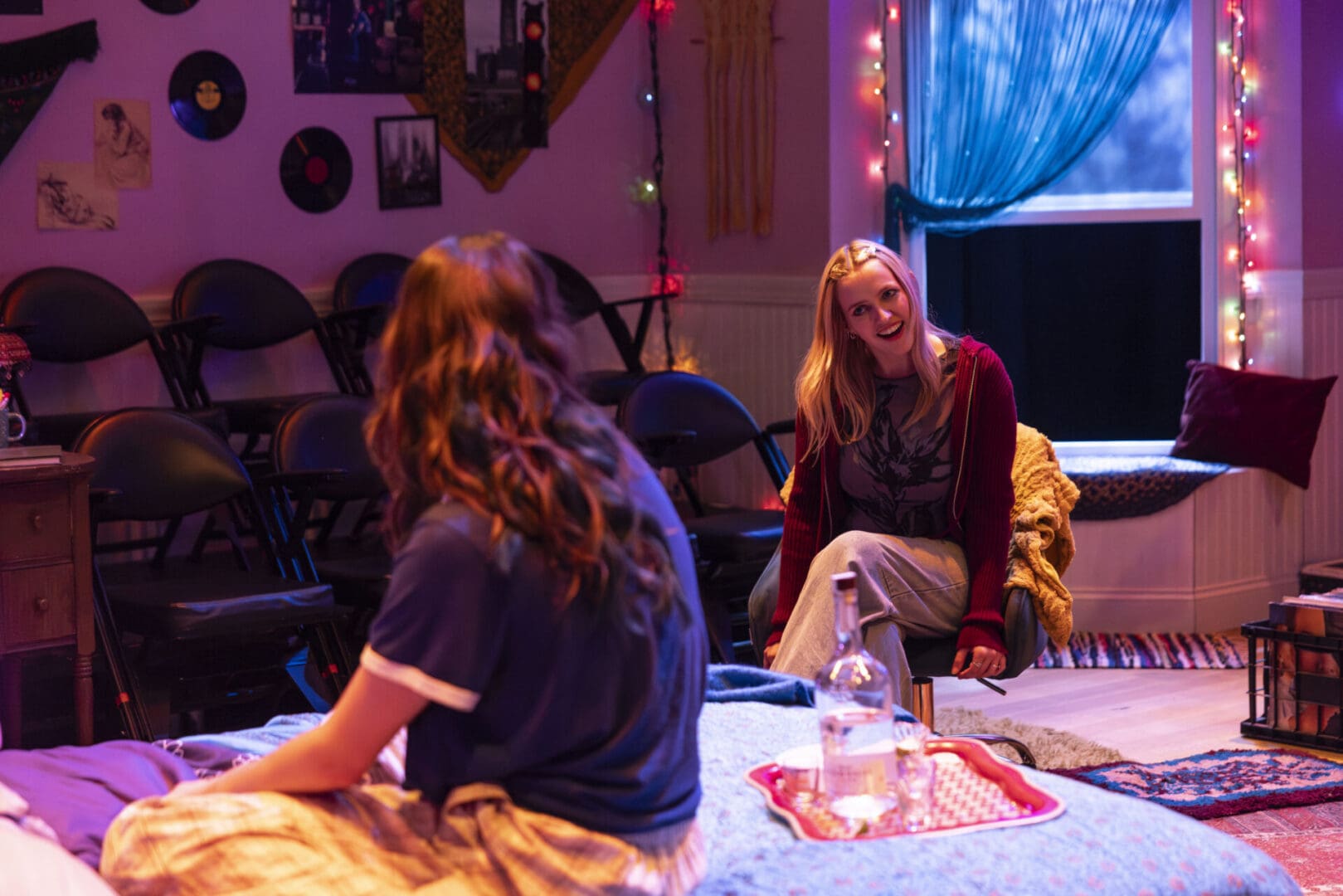
Jordan Levene (right) as Taylor (F) and Piper Jean Bailey (back to camera) as Natasha
Adolescent Salvation premiered in Los Angeles in 2025 under the direction of Guillermo Cienfuegos and makes its Chicago premiere with the same hand at the tiller, which is a wise, wise move. Cienfuegos’s direction is exquisite and exquisitely controlled. It has to be for a play with these many twists to work. As the play repeatedly shifts between comedy, thriller, and domestic drama, the transitions never seem forced or abrupt. It’s a masterful balancing act from the director, and he gets considerable help from the sharp script and his trio of actors.
Venable, who is a recent transplant from L.A. to Chicago—welcome to Chicago, Tim; dress in layers in the winter and avoid deep-dish pizza—has a gift for dialogue, replicating the rhythms and whiplash-inducing emotional shifts in teen speak with remarkable precision. Taylor(F) and Natasha hate each other until they don’t. They bond, bicker, make up, and deliver vicious broadsides that would make adults stagger, and then they’re doing body shots and giggling. But what I loved best about the script is the little gems of insight dropped throughout, as when Natasha, describing her father’s personality change before the divorce, says of her mother, “She took up so much space that there wasn’t much left for him.” She’s not only demonstrating her maturity, but also her inability to recognize that that same lack of space is what’s turned her inwards as well. All that information in less than 20 seconds. And it’s a great line to boot.
Venable’s other deft achievement is that the plot corkscrews, as shocking as they are, make perfect logical sense, and that’s no easy task.
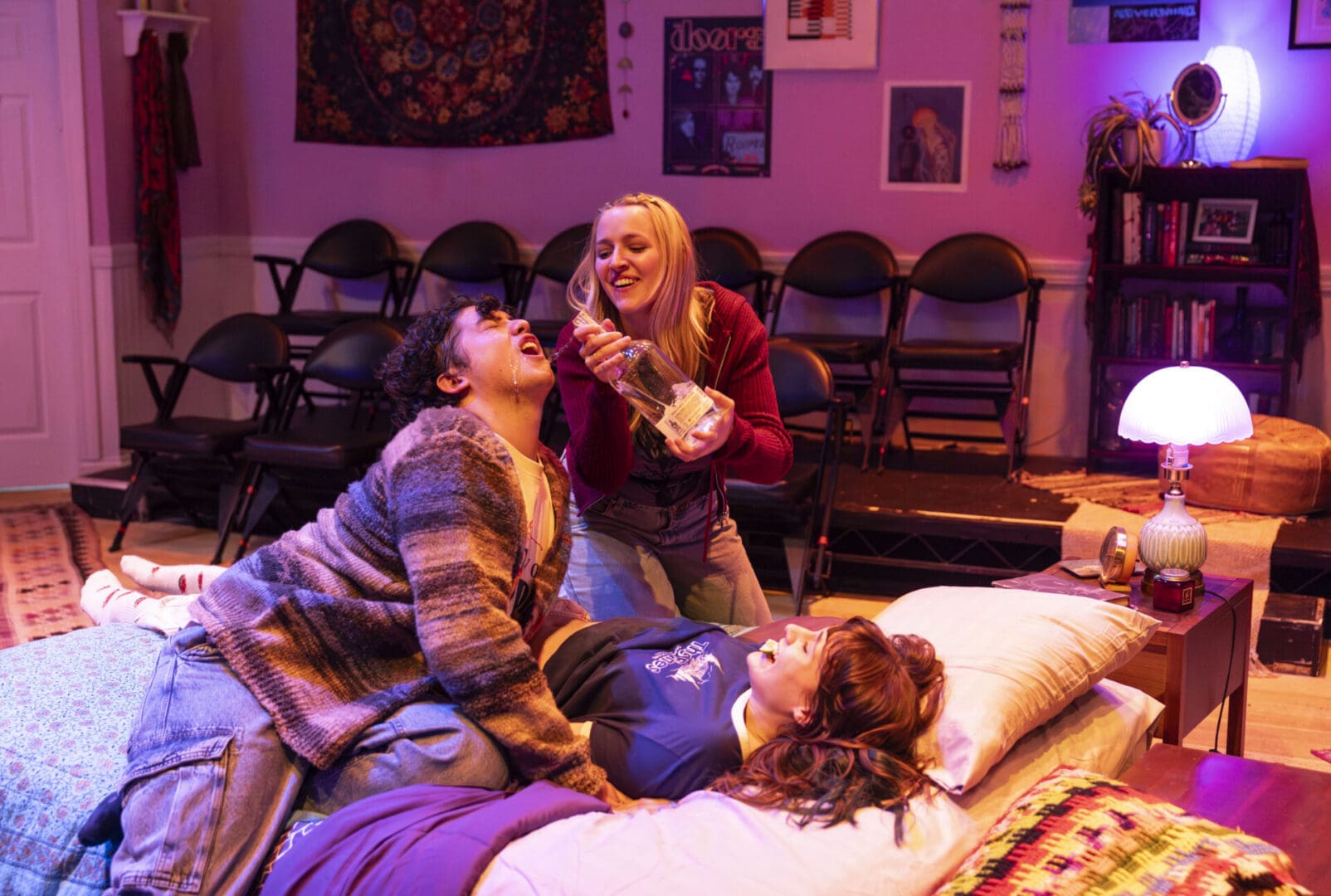
Brandon Joseph Acosta as Taylor (M), Jordan Levene as Taylor (F) and Piper Jean Bailey as Natasha
The three actors are superb. Acosta is adorable as the sweet, gay bestie. It’s the least of the three roles, as it functions mostly as comic relief, but even there the character reveals depths as the play goes along, and his Pollyanna personality makes perfect sense given his coming-out story. Acosta plays Taylor(M) with a gratifying lack of sentimentality, which only accentuates the melancholic underpinning of his character. Taylor(F) is the trickiest part in the play, and Levene’s performance is fascinating. The delivery is crisp and acidic, and her timing is flawless, but what’s most striking is the fury that is bubbling under her nastiness and her petulance. Taylor(F) is the plot-driving agent of the show, and when she explodes, Levene is a white-hot ball of rage: her two friends are powerless before it. Venable never explicitly states the reason for the anger, but Levene’s performance strongly hints at its foundation. Of all the different elements in the play, in its aftermath, the one that lingered most was the untold Taylor(F) story.
Ultimately, this is the Piper Jean Bailey show. As Natasha, she has to carry the show through every tonal and emotional shift, and the actor is more than equal to the task. It’s a fearless performance. Venable and Cienfuegos ask a lot of her—especially in the darker portions of the play—and she never falters. It’s a star-making performance and one of the best of the year to date.
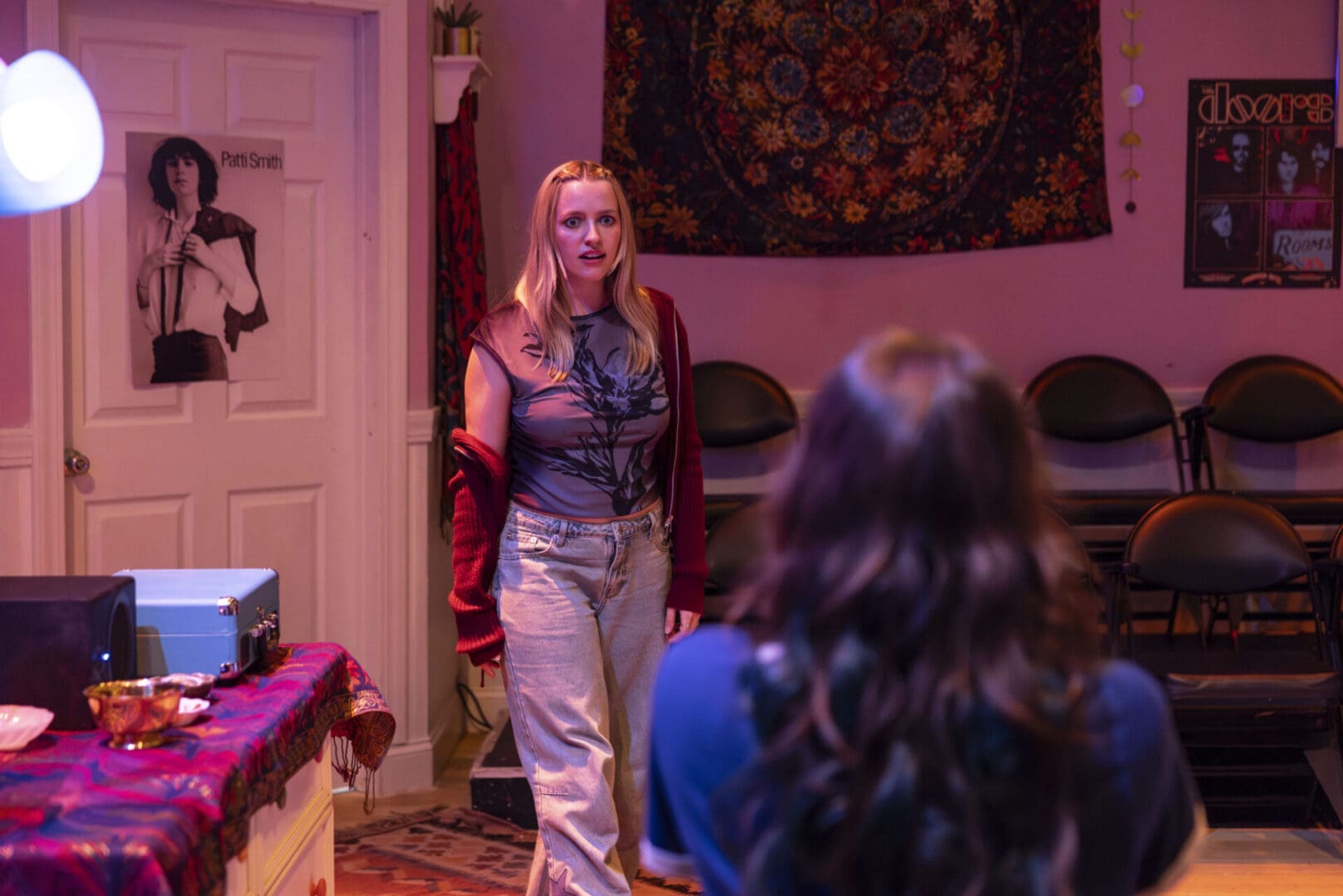
Jordan Levene as Taylor (F) and Piper Jean Bailey (back to camera) as Natasha
Adolescent Salvation falters a bit in its final stretch with the introduction of Natasha’s mother, Victoria. Victoria is a barely sketched-out character, and it’s hard to imagine this self-pitying shambles of a person as ever occupying too much space, even in a past presumably more glamorous life. Maura Kidwell gives a fine performance in the part, but the character is too underwritten and expository to make any sort of impact.
Apart from Victoria, there’s not much wrong with Adolescent Salvation; it is one of those rare scripts which gets more impressive in hindsight. It’s not easy for adults to write about teenagers, but Venable nails the messiness and contradictions of that wretched phase of life without ever condescending to the characters. The warmth and affection for these three young people provides a solid foundation for the plot machinations, grounding them even as the absurdity of the situation increases. It’s necessary because Adolescent Salvation treads extremely murky moral ground and further ratchets up the difficulty by throwing gallows humor into the mix. I was almost ashamed of myself for giggling uncontrollably at an extremely distasteful off-stage sound effect—the excellent sound design is by Daniella Brown—late in the proceedings, but that’s how effectively this cast and crew draw you in. This is a sharply observed, disturbing, morally ambiguous play that also happens to be absolutely hilarious.
✦ ✦ ✦ ✦ ✦ ✦ ✦ ✦ ✦ ✦
photos by Boris Martin
Adolescent Salvation
Theater Wit
Theater Wit, 1229 W. Belmont Ave. in Chicago
Thu–Sat at 7; Sun at 2
ends on October 3, 2026
running time: 90 minutes, no intermission
for tickets ($18–$46), call 773.975.8150 or visit Theater Wit
for more shows, visit Theatre in Chicago
✦ ✦ ✦ ✦ ✦ ✦ ✦ ✦ ✦ ✦
