


Areas We Cover
Categories

Theater Review: SHANE (City Lit Theater / Chicago)
by C.J. Fernandes | September 4, 2026
in Chicago, Theater
CITY LIT SADDLES UP A WINNER
A terrific central trio and striking stagecraft
make Mark Pracht’s world-premiere
adaptation a winner
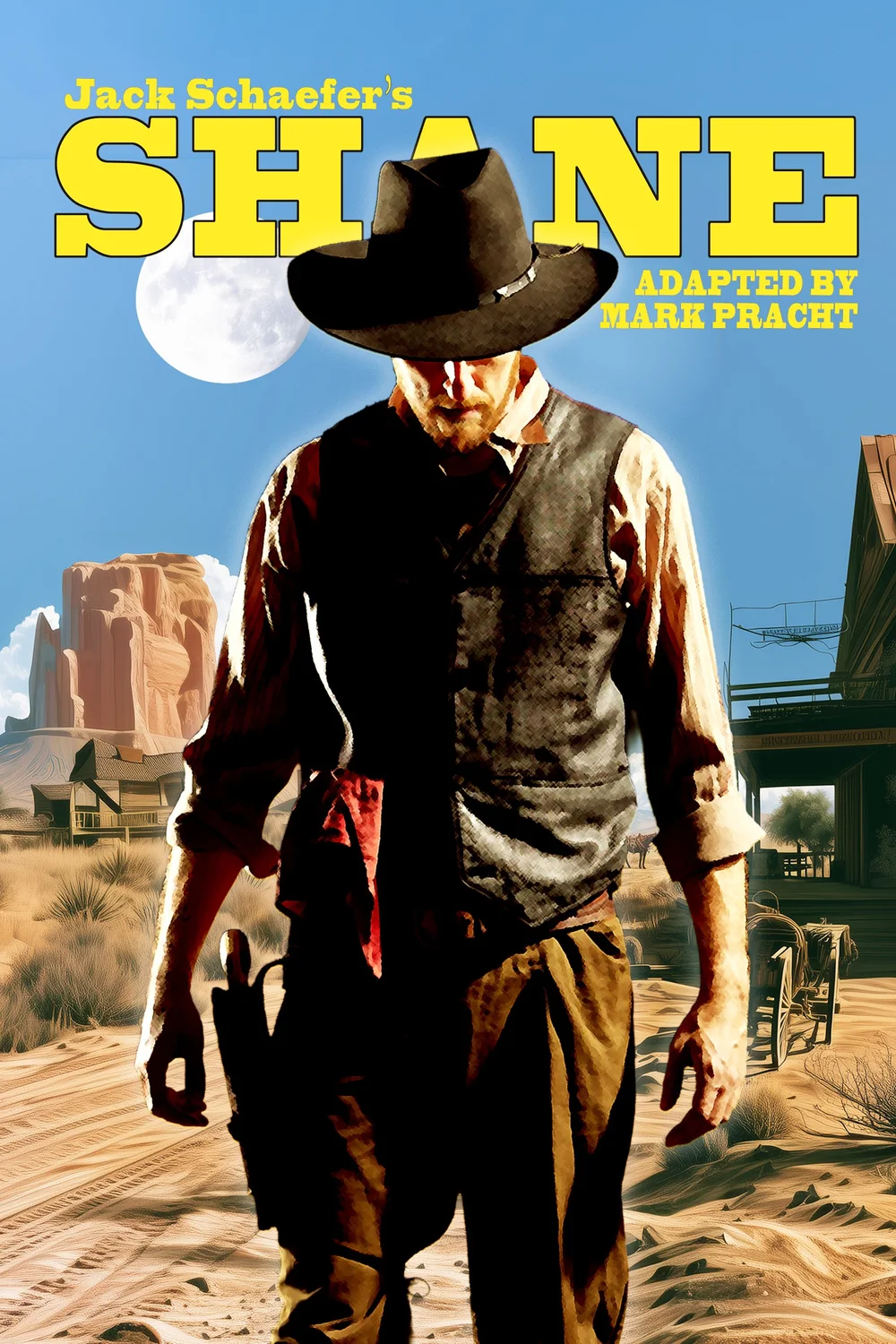
The venerable City Lit opens its 46th season with Shane, a world premiere from multi-hyphenate Mark Pracht. Based on the novel by Jack Schaefer, which was previously adapted into a highly regarded 1953 film with Alan Ladd in the title role, Shane is a classic of the Western genre, populated with taciturn men, weary but tough women, and sweeping vistas where laws are merely suggestions to be followed arbitrarily, if at all.

Michael B. Woods
A classic Western is a curious choice for the small City Lit space, given the wide-open expanses that are a visual hallmark of the genre, but Jeremiah Barr’s plain but beautiful set—all pine and rough-hewn wood—and clever, evocative projections by G. “Max” Maxin IV, with artwork by Jim Terry, do much to set the mood. Add to that a gorgeous score by Petter Wahlbäck, and the immediate effect is so transporting that I almost expected a tumbleweed to roll across the stage floor.

Bruce Holtman
Narrated by eleven-year-old Bob Starrett (Bruce Holtman), Shane opens in the late 1800s in the Wyoming Territory. Joe Starrett (Josh Odor) and Marian Starrett (Whitney Minarik) are homesteaders running a small farm on acreage they could legally claim from the government. Along with several other small farmers and ranchers, their homestead claims have infuriated Luke Fletcher (Sean Harklerode), an open-range rancher who resents the small farms because they limit the grazing land for his cattle. Then one day, a mysterious man (Michael B. Woods) rides onto the Starrett farm. His name is Shane, and he’s been riding from parts unknown. After the warm-hearted Starretts invite him to stay, Shane and Joe form a bond that eventually puts him squarely in the battle between the farmers and Fletcher, who is determined to get rid of them by any means possible.
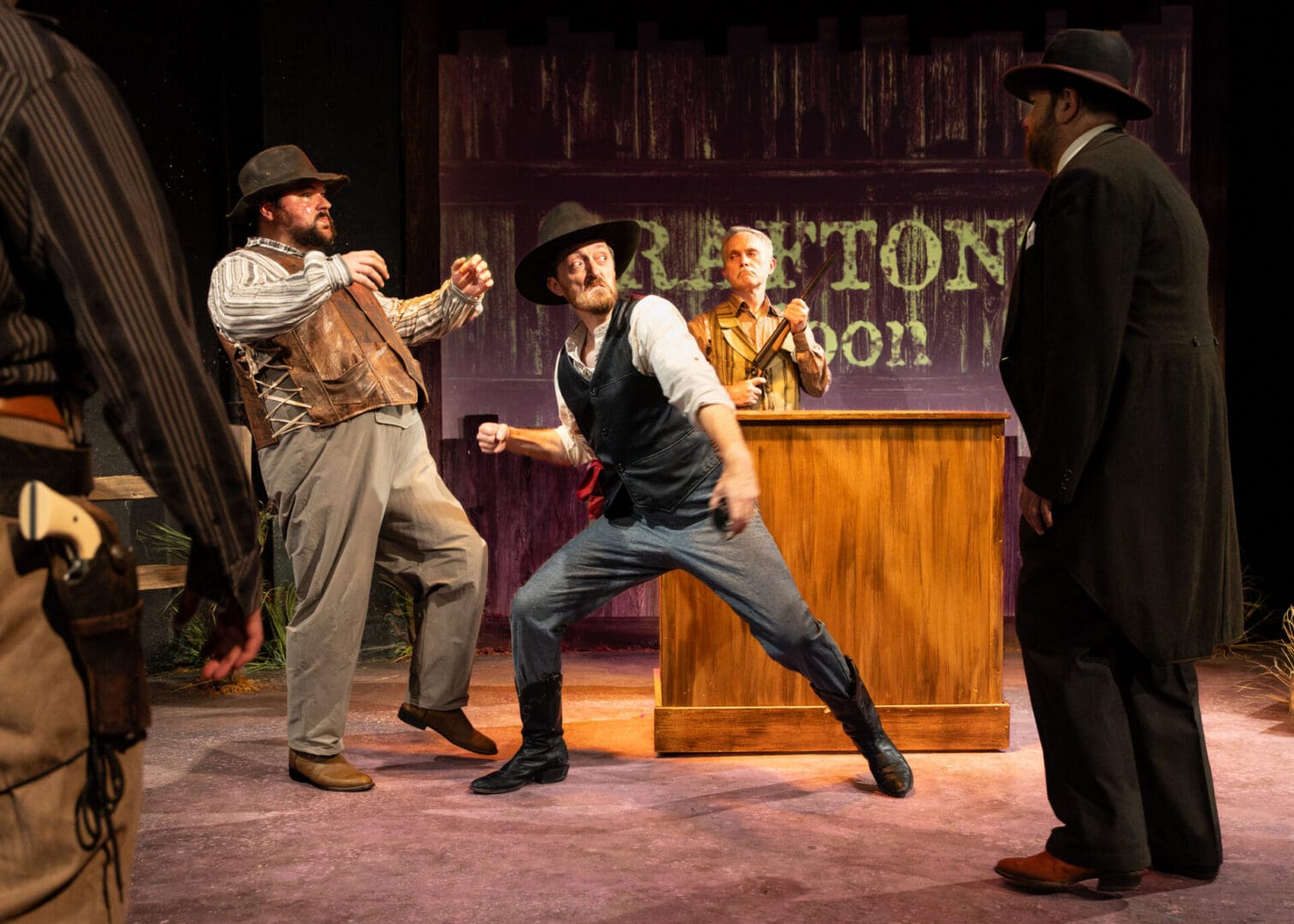
Ross Childs, Michael B. Woods, Chuck Munro, and Sean Harklerode
It’s a gripping story; not for nothing has it been adapted multiple times. It’s always a risky proposition retelling a story for the stage when the screen version is so beloved, but Pracht pulls it off for the most part, finding nuance in unexpected places and shading his characters beautifully. Where he falters is in the narration, both in the writing and in the direction. Narration works far better on screen than on stage, where it needs to be utilized sparsely. There’s a lot of it here, and it doesn’t help that Holtman goes through it at high speed, frequently tripping over himself verbally in his rush to get through it and into the scene. The gaps between the narration and the scenes could also use a few extra beats; the transitions are jarring. It’s not easy for an adult to play a child, but this is a stiff performance; his hands are clenched into fists at his sides or clasped in front of him at all times, and his shoulders are so visibly tense that it’s distracting. I assume opening-night nerves were at play, and he’ll relax into the role through the run.
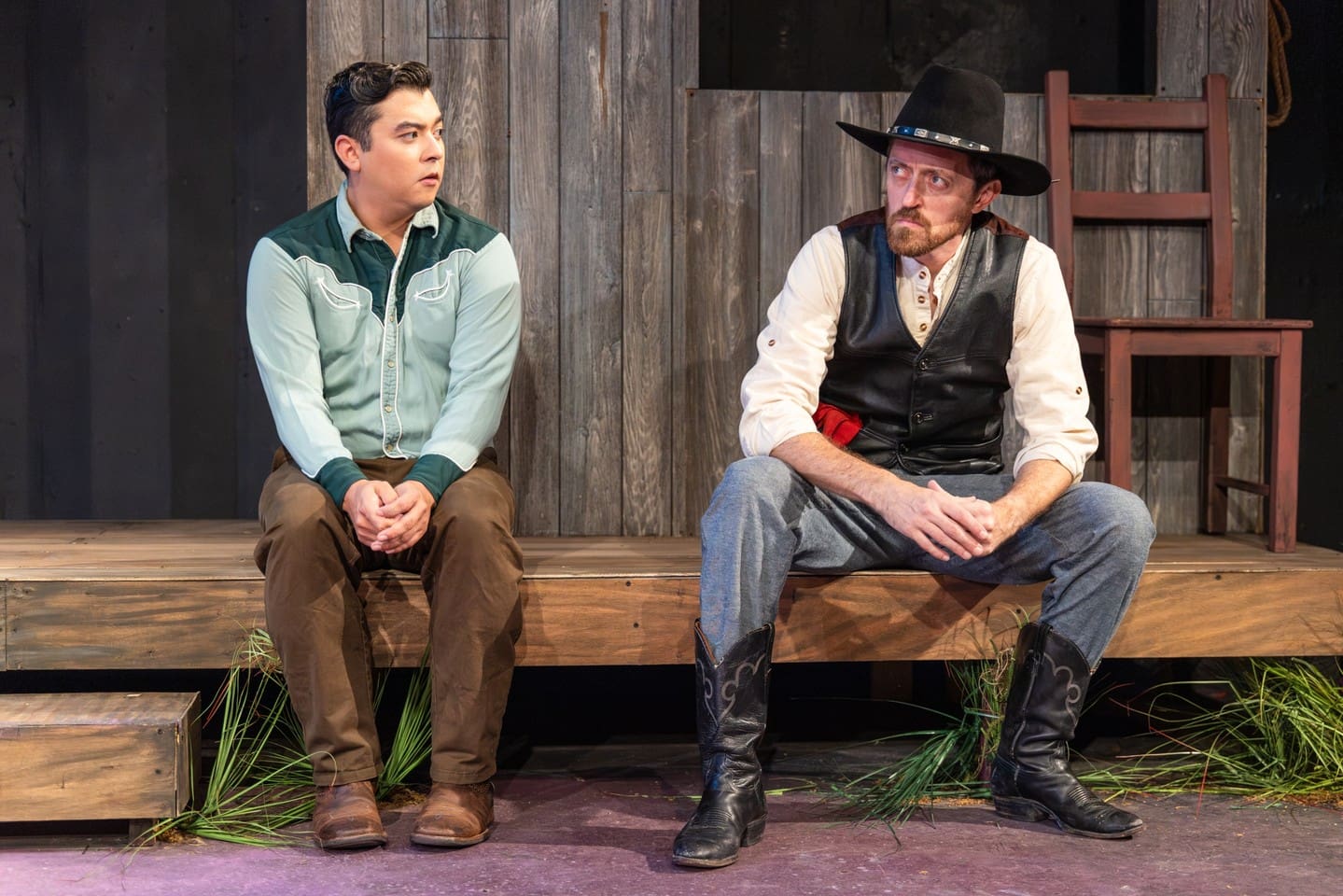
Bruce Holtman and Michael B. Woods
Where Shane soars is in its central trio of performances. Woods is just wonderful as the title character, his large, soulful eyes communicating his shame and guilt over his past in a way that reams of dialogue never could. Minarik is splendid as an overworked, fierce wife who didn’t sign up for the life she’s been handed but is determined to make the best of it no matter what. My favorite scene in the play is her first meal with the men, where she badgers Shane into telling her about the latest women’s fashions in the cities. As Shane reluctantly yields—Woods’ slightly dazed acquiescence to the force of Marian’s personality, followed by his slow smile as he realizes how happy he’s making her, is a marvelous bit of acting—Minarik’s delight lights her up, letting us see the frivolous girl Marian once was before the labors of homesteading wore her down. It’s a quiet, seemingly insignificant moment, but the loveliness of the scene conceals its importance; for Shane to work, we have to understand why Shane would go to the lengths he does for these people, and this exquisitely written, directed, and performed moment does all of that in just a few minutes.
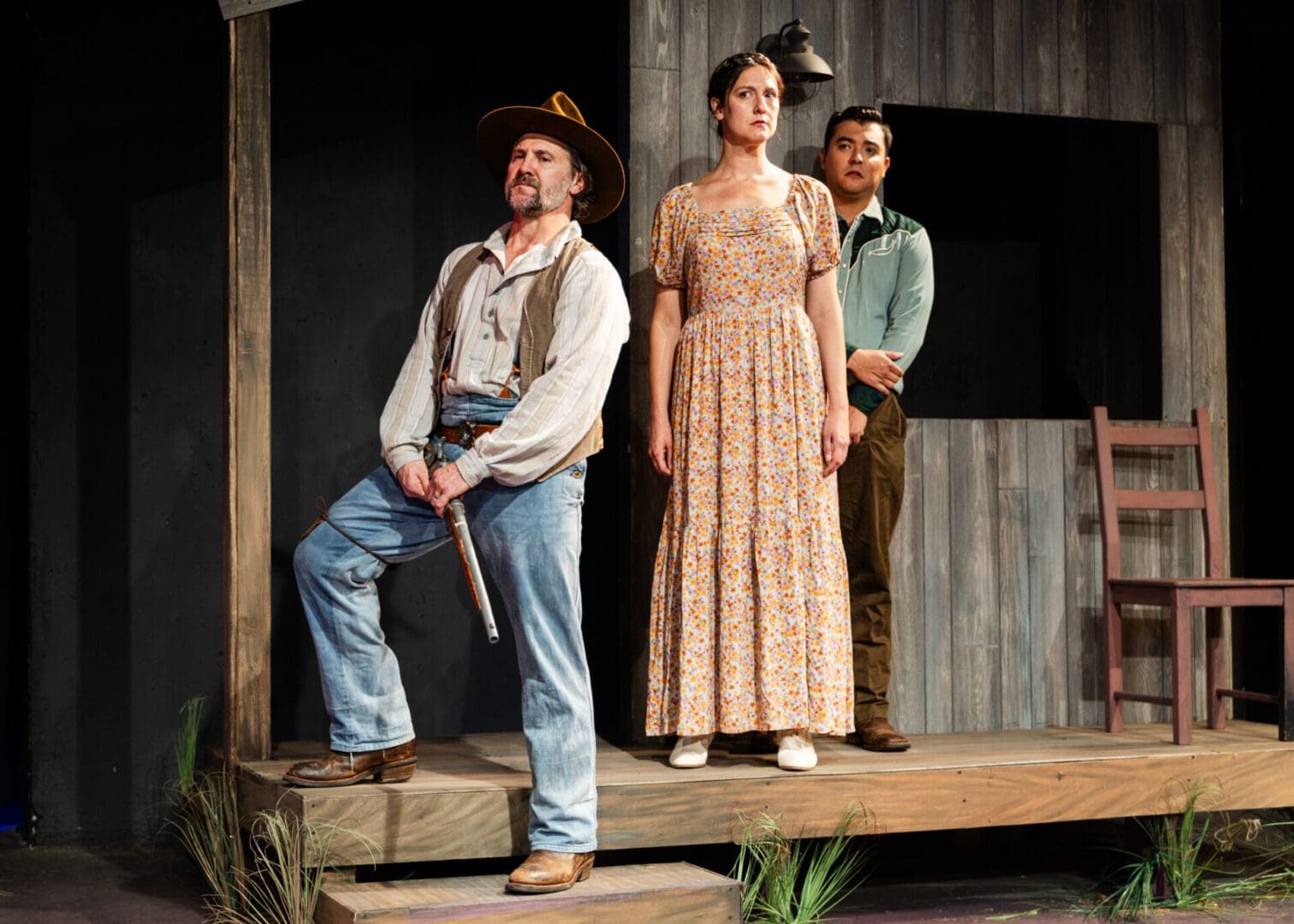
Josh Odor, Whitney Minarik, and Bruce Holtman
Odor won a richly deserved Jeff Award earlier this year for playing a brutal, abusive parent in Gangsta Baby, a far cry from the thoroughly decent father and husband he plays here. It has long been held—and I tend to agree—that “good” people are the most difficult parts to act, and Joe Starrett is no exception. But Odor is more than capable of rising to the challenge, creating a rich character whose essential goodness and faith in humanity do not belie his complexity. On paper, it’s the least of the three leads, but, my word, it is a fine, fine performance.
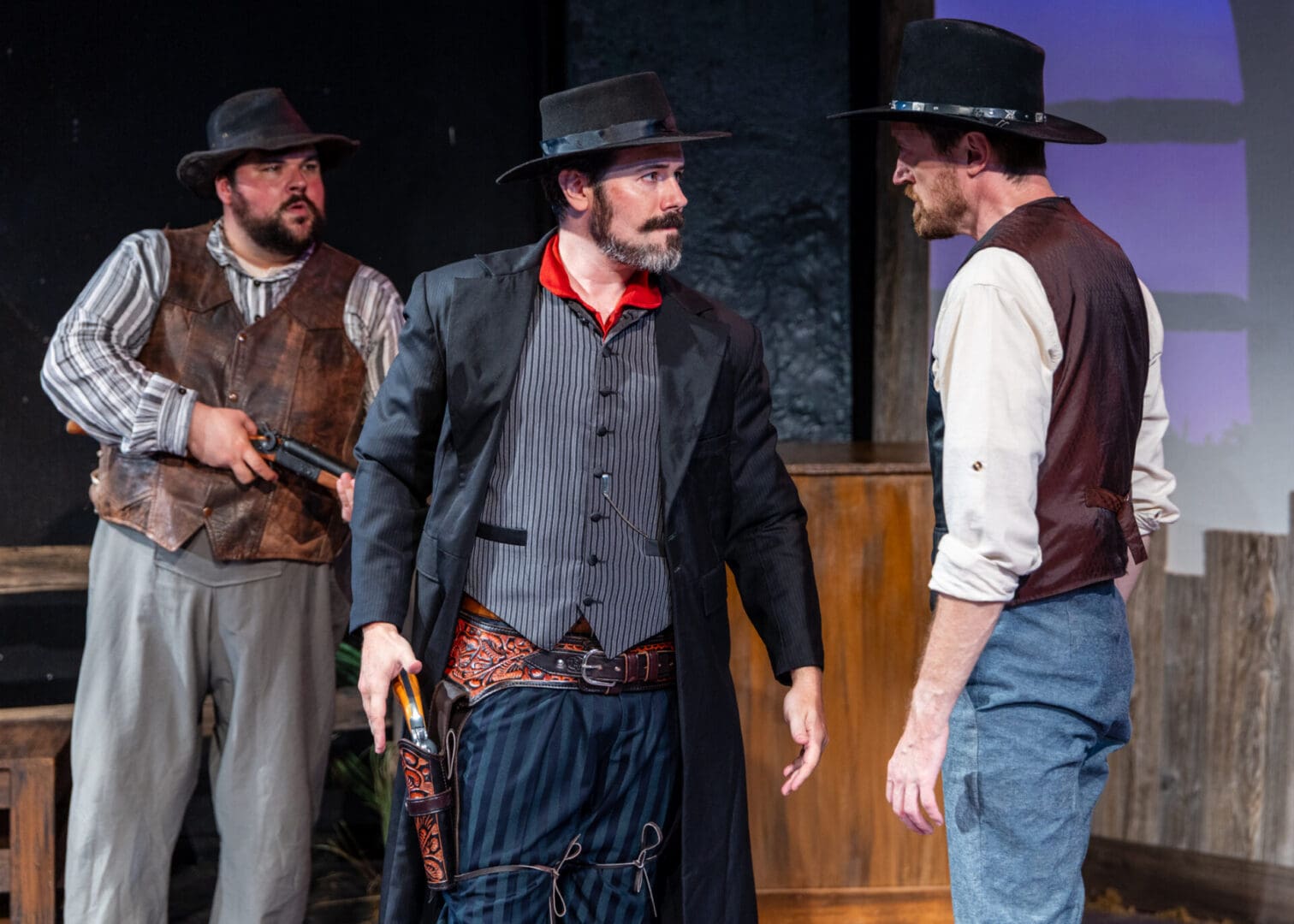
Ross Childs, Jay Donley, and Michael B. Woods
Both Odor and Minarik are crucial to the success of Shane, a show that posits that fundamental decency and goodness are the most important of human traits. The supporting cast is also solid, but I have to single out Jay Donley, whose stillness and precise delivery turn the foppish hired gun Stark Wilson into a genuinely terrifying villain. The fight scenes are well staged, and, with the help of some gorgeous lighting by Josiah Croegaert, Pracht orchestrates some stunning tableaux, framing characters against the projections as the light changes through the day. I’m usually a bit snotty about projections, but this is about as good a use of them onstage as I’ve seen in a while.
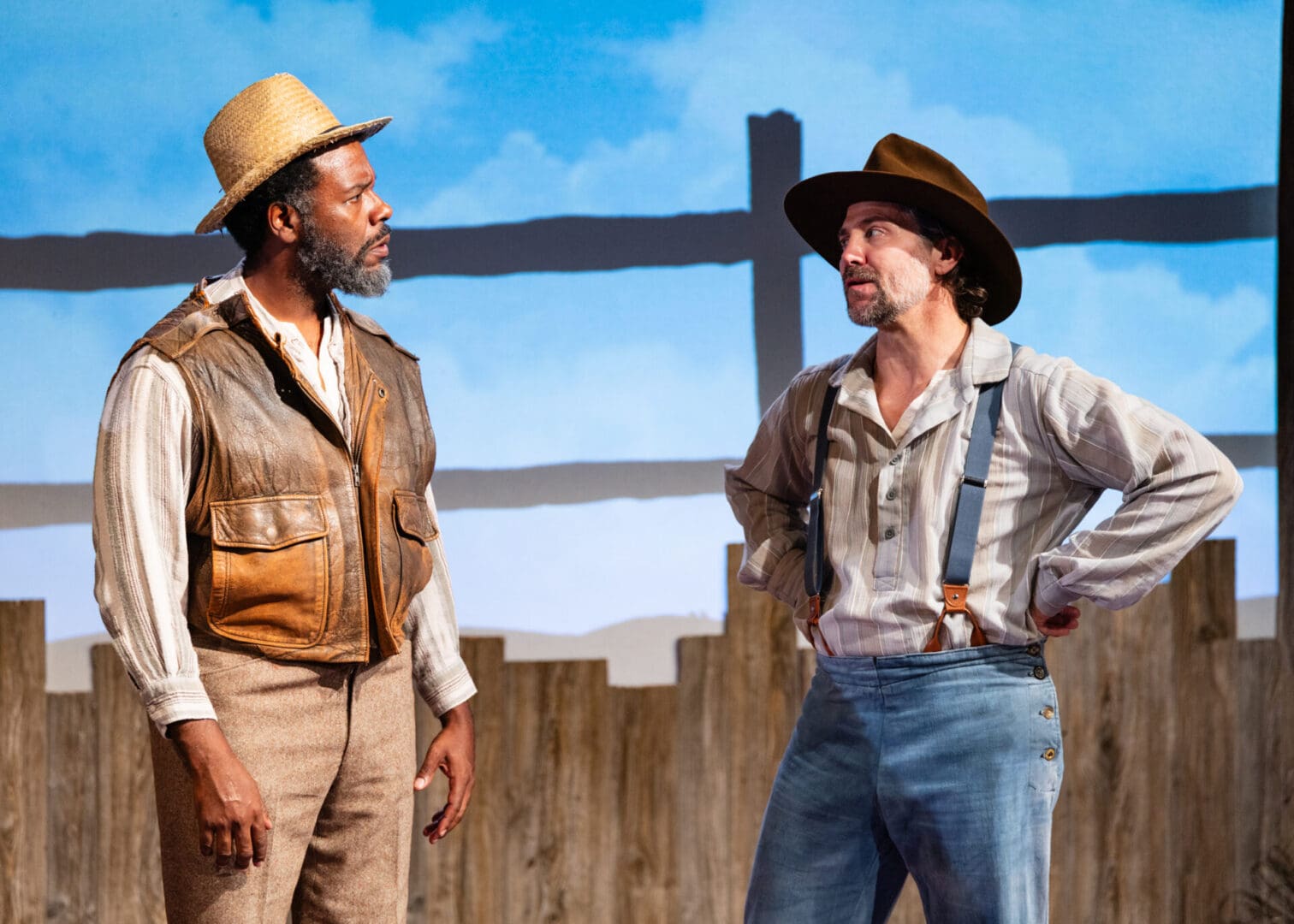
Brandon Boler and Josh Odor
The mechanics of the plot make for some gripping theater here, but Pracht’s script wisely focuses on the relationships among the three central characters, creating several sharply observed moments that linger only long enough to make an impression. He also unearths—intentionally or not, I’m not sure—a fascinating subtext in the source material that one could argue reframes the story as a metaphor for the evils of unfettered capitalism, a subversive take that had me trying hard to recollect whether it was present in the movie as well.

Whitney Minarik and Josh Odor
Walking away from the theater after the show, I found myself marveling for the umpteenth time at the depth and creativity of the Chicago storefront theater scene. City Lit is not technically a storefront theater, but you know what I mean. I will admit to skepticism about this production when City Lit announced its 2026–27 slate, but I’m delighted to have been proven wrong.
✦ ✦ ✦ ✦ ✦ ✦ ✦ ✦ ✦ ✦
photos by Steven Townshend
Shane
City Lit Theater
1020 W. Bryn Mawr Ave., second floor of Edgewater Presbyterian Church in Chicago
Fri.–Sat. at 7:30; Sun. at 3
additional performances Mon. Sept. 21 and 28 at 7:30
ends on October 4, 2026
tickets $40; students and active military $22
for tickets, call 773.293.3682 or visit City Lit Theater
for more shows, visit Theater in Chicago
✦ ✦ ✦ ✦ ✦ ✦ ✦ ✦ ✦ ✦
