


Areas We Cover
Categories

Theater Review: SISTERS (Writers Theatre / Chicago)
by C.J. Fernandes | September 11, 2026
in Chicago, Theater-Chicago
A GLITCH IN THE FAMILY
Brenda Barrie shines,
but this AI drama does not compute

Brenda Barrie
A spare stage greets you as you walk into the Gillian Theatre for Matthew Libby’s Sisters, the opening play of the 35th season of Writers Theatre. A leather armchair, an accent table, and a lamp sit on an elevated platform, and there are some artfully arranged window frames in the back, but that’s about all there is to A Inn Doo’s simple but elegant set.
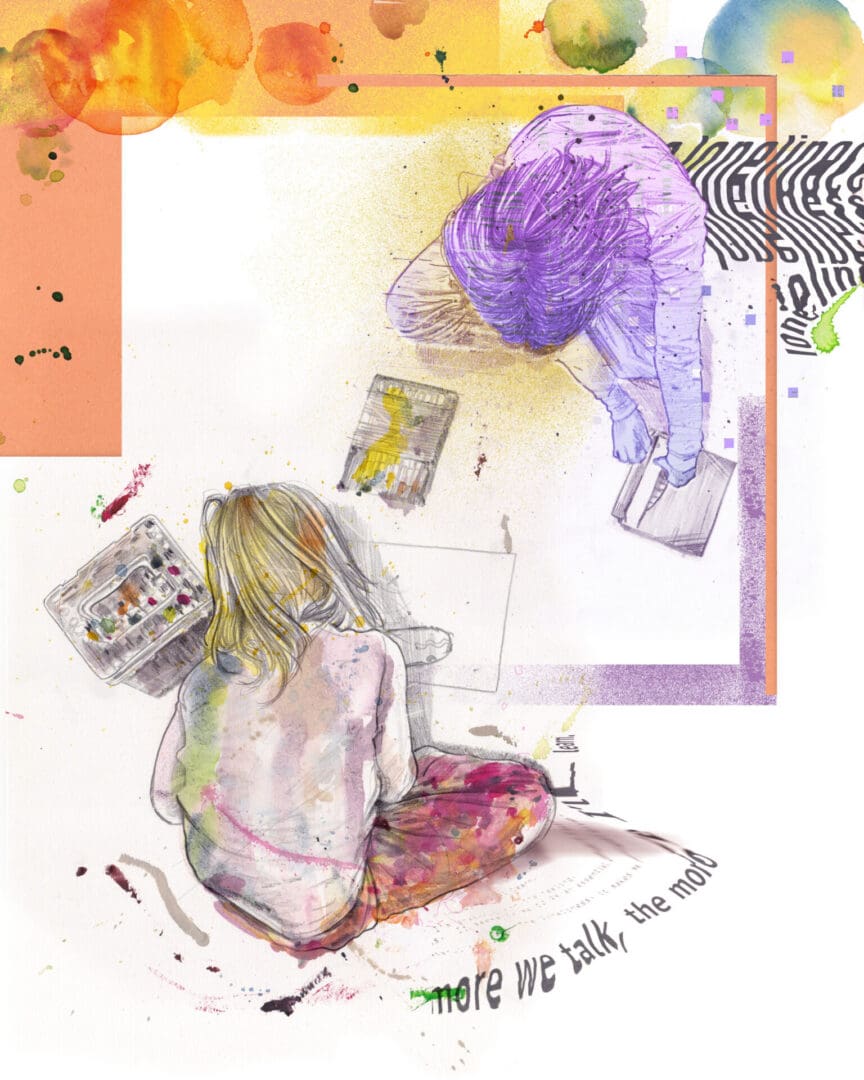
Directed by Jessica Thebus, Sisters opens with six-year-old Matilda (Brenda Barrie), awkwardly seated in the chair. She’s in the midst of a conversation with Greta (Chloe Johnston). Matilda, who has just lost her mother to illness, has been told that Greta, a program on a computer, is to be her new sister. She doesn’t understand how this is possible. Greta explains that the more they talk, the more she will learn, until she can be as close to Matilda as any “real” sister could be. Matilda is visibly dubious but, like most children would, goes along with the program just because voices of authority, her father and Greta, insist that this is a good thing.
Sisters charts the course of this relationship over ninety years. As the years go by, Greta’s voice and inflections become more realistic, and as her persona develops more complexity, so do the interactions between the two. They bicker like real siblings. They share Matilda’s secrets and loves. Then one day, when Matilda is 42, Greta makes an astounding demand: she’s tired of being attached to a computer. She wants to be more like a real person. She wants a body of her own.

Brenda Barrie
Sisters wants to make some sort of statement about AI and modern-day isolation, but it has a couple of major problems. The only way “Greta” works is if you don’t think about the concept too much. To be sure, science fiction requires suspension of disbelief, but it also requires logical consistency and rules of operation. Greta is fully aware that she is a program; her learning curve is explicitly laid out in the first scene. It makes no sense at all that she would “want” to become a real person. The idea of a non-sentient construct developing something as strikingly human as desires and wishes doesn’t click here because the work required to establish this possibility is not done. This sloppiness in construction extends to the dialogue as well. That Matilda would spend nearly 40 years with Greta before asking her whether she feels grief beggars belief. That exchange is symptomatic of a broader problem. The conversations between Matilda and Greta never seem like anything but a playwright’s first draft. The one exception to this is the very first conversation, when Matilda is a child, which works mostly because Barrie is such a remarkable actress. Similarly, the last third of the play is mostly a monologue stretched out over almost 40 years, which again, Barrie’s performance notwithstanding, makes no sense within the rules of the play. If Greta is everywhere, why isn’t she there? Or is she there and ignoring Matilda? That doesn’t work either, given the dialogue and the vibes in the last scene of the play.
I could have forced myself to ignore these narrative holes (indeed, I certainly tried), but the bigger problem with Sisters is that it’s derivative as hell. There is nothing here that we haven’t seen before. The hallway before the theatre is lined with a display of examples of artificial intelligence in other entertainment media, as well as landmark achievements in the scientific field. This is not wise. All it does is remind one of other, more successful stories. Almost every element in Sisters has been done better in other sci-fi works: a robot relative as a response to grief in A.I. Artificial Intelligence (2001); an operating system turning malevolent in 2001: A Space Odyssey (1968); and, most of all, the wonderful Spike Jonze movie Her (2013), where a lonely young man falls in love with an operating system that adapts, evolving and developing a personality and psychology based on its interactions with its user. Does that sound familiar?
As mentioned above multiple times, Barrie is a talented actress, and she does marvelous work here, especially considering that she’s required to react to an offstage computer for the entire duration of the play. But one excellent performance is not nearly enough, and 95 minutes is far too long for a concept this thin. Shifting back and forth between Matilda at different ages helps alleviate the monotony for a while, but by the time Sisters hits the one-hour mark, I was itching to leave. Writers Theatre last season was an unmitigated triumph. Topicality aside, Sisters is a curious choice for a season opener. Oh well, all streaks must be broken eventually.
✦ ✦ ✦ ✦ ✦ ✦ ✦ ✦ ✦ ✦
photos by Hugo Hentoff
Sisters
Writers Theatre
The Gillian Theatre, 325 Tudor Court in Glencoe
Wed. 2 & 7:30; Thurs.–Fri. 7:30; Sat. 2 & 7:30; Sun. 2 & 7
ends on Nov. 8, 2026
95 minutes, no intermission
for tickets ($75+), call 847.242.6000 or visit Writers Theatre
for more shows, visit Theatre in Chicago
✦ ✦ ✦ ✦ ✦ ✦ ✦ ✦ ✦ ✦
