


Areas We Cover
Categories

REALISTIC PROP CIGARETTES ARE CHANGING THE WAY SMOKING IS ACHIEVED ON STAGE AND SCREEN
by Marcus Thorne | September 13, 2026
in Extras, Theater
A small hand prop can affect performance, continuity,
venue planning and the visual language of an entire scene
A cigarette in a scene is rarely just a cigarette. It can fill an awkward silence, reveal nervousness, mark a period, establish status or give an actor a physical action while the meaning of a conversation shifts. For decades, productions often created that image with conventional or herbal cigarettes. Today, theater, film and television teams have a wider range of non-burning and reusable props to consider.
That change is not simply about replacing one object with another. A modern smoking scene involves decisions about what the audience must see, how the performer should handle the prop, how the effect will repeat and what the venue permits. The most convincing result begins with the dramatic purpose of the action, then works backward to the right practical solution.
The cigarette as part of the performance
Smoking has a familiar physical vocabulary. A character may search for a cigarette to buy time, offer one as a social gesture, light it with confidence or hold it without ever taking a draw. The object creates pauses and gives the hands something precise to do. Those details can communicate as much as the dialogue.
This is why a convincing scene depends on more than whether the prop looks accurate on a table. Its weight, balance and response must support the actor’s choices. If the script calls for a visible exhale, that effect has to arrive at the intended moment. If the cigarette is present only as a period detail, a simple non-functional replica may be enough. The action should determine the prop, not the other way around.
Why older methods can complicate a production
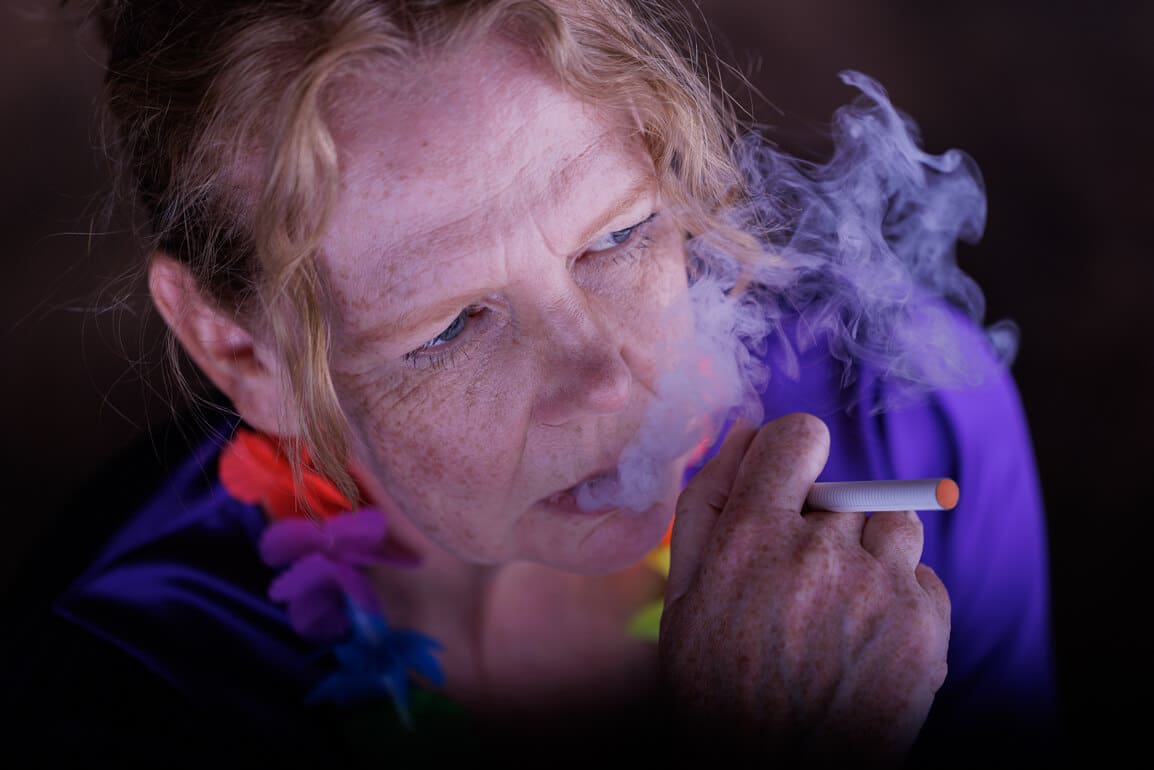
A burning cigarette introduces variables that continue after the actor has finished a line. It shortens, produces ash and must be extinguished. Smoke can drift toward another performer, the audience, a lens or a detector. The timing of a take may change the cigarette’s length, while ash can land on costumes or scenery. Each issue may be manageable, but together they add work for stage management, props, wardrobe and continuity.
Herbal cigarettes remove tobacco and nicotine from the equation, but they still burn. That means productions must still consider combustion, smoke, odor, ash and disposal. Whether they can be used at all depends on the venue, local rules, the production’s risk assessment and the needs of the people involved. A solution that is accepted in one theater or studio may not be accepted in another.
A broader toolkit for modern productions
Prop departments now choose from several approaches. An unlit replica can work when no smoke is required. A practical effect can be created elsewhere in the scene. Digital effects may be appropriate for a particular shot. Reusable devices can create a controlled visible exhale without a burning tip, while retaining the recognizable shape and handling of a cigarette.
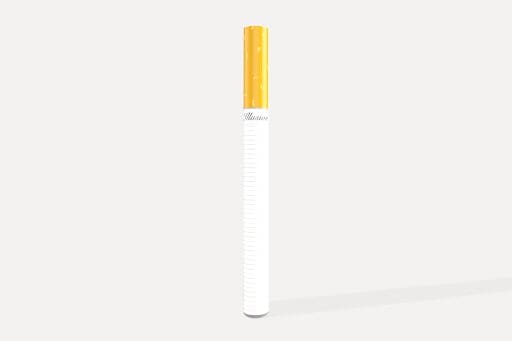
Purpose-built prop cigarettes are one example of this newer category. Designed for professional productions, these systems combine a cigarette-style appearance with a repeatable effect and avoid the changing length, ash and open flame of a combustible cigarette. They do not eliminate the need for rehearsal, venue approval or production-specific planning, but they give directors and prop teams another practical option.
The availability of more options also makes it easier to match the method to the shot or scene. A production does not necessarily need one solution for an entire show. A close-up insert, a wide stage scene and a promotional photo may each call for a different prop.
Stage and screen ask for different things
In theater, the effect must read across distance. The audience may need to see a glowing tip or a clear exhale, but few viewers will inspect the prop’s surface at close range. Reliability matters because the same action must work night after night, often with limited time for a reset between scenes.
The camera changes the priorities. A prop that looks convincing from the orchestra may reveal seams, unusual proportions or an artificial tip in close-up. Film and television also divide a scene into takes and angles. The cigarette’s position, orientation and apparent state must match from shot to shot. A reusable prop avoids burn-down between takes, but the actor and script supervisor still need consistent hand positions, draws and exhales.
Lighting matters in both settings. A tip that appears strong in a dark scene may disappear under bright stage lighting, while a visible effect may catch backlight dramatically or vanish against a pale background. Testing under the actual lighting and from the intended viewing distance is more useful than judging the prop in a rehearsal room alone.
Rehearsal turns the object into a believable habit
Audiences recognize when an actor is uncomfortable with a familiar object. The hand may grip too tightly, the timing may interrupt speech, or the performer may repeatedly look at the prop to check whether it is working. These small hesitations can draw attention away from the character.
A smoking action should therefore be rehearsed like any other piece of stage business. The actor needs to know when the prop enters the scene, which hand holds it, where it is placed between lines and how it is removed or exchanged. If a visible effect is required, the cue should be tied to a dramatic beat rather than added whenever there is space.
Rehearsal also gives the production team time to confirm reset procedures and assign responsibility. Batteries may need charging, replaceable components may need checking, and clean props may need to be allocated to individual performers. Clear backstage ownership prevents a small item from becoming a last-minute problem.
Continuity starts before the first take
For screen work, the prop department and script supervisor should decide what the cigarette is doing at each point in the scene. Is it newly lit, partly used, held near the face or resting in an ashtray? Does the character take a draw before or after a particular line? Photographs and concise continuity notes can capture these details.
Non-burning props solve the changing-length problem, but they introduce their own continuity questions. A visible tip should appear at the same moment across angles. The amount and direction of the effect should remain plausible. If different versions of the prop are used for wide shots and close-ups, their color, dimensions and markings should match.
The best effect is the one the audience stops noticing
A good prop cigarette does not call attention to its technology. It supports the actor, survives the production schedule and produces only the visual information the scene needs. Achieving that result may require a realistic replica, a reusable effect prop, a combustible cigarette where permitted or a combination of methods.
The important development is that production teams now have more control over the choice. Smoking scenes no longer have to begin with the assumption that something must burn. By separating the dramatic action from the traditional method used to create it, theater and screen productions can preserve the gesture, rhythm and period detail while choosing an approach suited to the performers, venue and camera.
