


Areas We Cover
Categories

THE BIGGEST POKER MISTAKES CHARACTERS MAKE IN MOVIES
by Michael Carr | September 17, 2026
in Extras
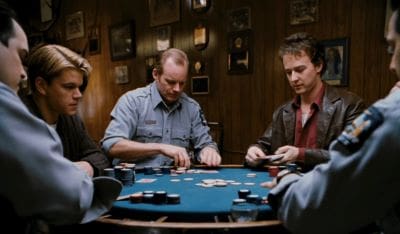
Why does a character stare at an opponent for 20 seconds before making the obvious decision? The answer usually belongs to the director. Film requires visible tension, so ordinary actions are slowed or enlarged and sometimes repeated until viewers can read them. Poker suffers from this treatment because much of competent decision-making happens internally and leaves little for a camera to record. The resulting mistakes fall into two groups. Some are errors that a knowledgeable character would avoid. Others are deliberate distortions used to make a scene legible. Both can weaken a film when the script claims expertise but presents conduct that contradicts it.
Improbable Clusters of Strong Hands
Movies often give every important character an exceptional hand at the same moment. One player has a full house, another has four of a kind, and the hero wins with a straight flush. This creates an easy visual hierarchy because each reveal appears stronger than the last. The sequence is dramatically efficient but statistically extreme. Strong hands are rare, and several appearing together are rarer still.
A scene can rely on such a coincidence once, though repeated use makes the outcome feel arranged by the screenplay. The character’s skill becomes difficult to assess because the cards decide everything.
Excessive Confidence in Physical Tells
Film characters often treat one gesture as proof. An opponent may touch an eye or move in a chair. A reach for a drink can also prompt the hero to claim instant knowledge of the concealed cards. This gives the audience a visible clue, but it makes uncertain observation seem like a perfect diagnostic tool.
Physical conduct can matter within a larger pattern.
A single movement has many possible causes. The person may be tired or uncomfortable. Awareness of an observer can also change posture. A convincing character compares the gesture with prior behavior and the action taken in the hand instead of treating it as a code with one fixed meaning.
Long Speeches During Decisions
Dialogue is useful to a screenwriter, so characters frequently explain their thinking while a hand is active. They may recount an opponent’s history and describe the possible cards. Some deliver a personal insult before acting. The table then serves exposition.
This behavior can give away information. A skilled participant will often avoid offering a rival unnecessary material during a difficult decision. Speech can be used deliberately, but a long monologue may change breathing, timing, or delivery, giving an attentive opponent additional behavior to consider. Silence is often the simpler and more credible choice.
Weak Control of the Bankroll
Movies favor the dramatic wager in which a character risks every available dollar. That act quickly establishes courage or desperation. It also ignores the practical distinction between money reserved for play and money needed for rent, travel, food, or debt.
A character may have a good reason to accept ruin as a possible result. The script should establish that reason. When an otherwise rational professional repeatedly commits an entire bankroll to one uncertain situation, the behavior conflicts with the expertise the film wants the audience to believe.
Procedures That Serve the Camera
Realistic poker games include stretches in which players wait through folds and watch. Films compress those periods.
The problem appears when compression changes the rules or lets a character act out of turn. It can also permit the dealer to explain information that experienced participants already know.
These choices may help viewers follow the scene, but the film should keep its internal procedure consistent. A rule explained in one scene cannot disappear in the next because the hero needs a dramatic reveal. Consistency allows the audience to judge the character’s decision using the same framework established earlier.
The Cinematic Cheating Shortcut
Cheating in movies is frequently reduced to a marked card or an obvious signal. The method must be visible so the audience can recognize the offense. An Associated Press report on alleged poker cheating also referenced movie cheats and gambling or criminal schemes depicted in films including Ocean’s Eleven, Molly’s Game, and Rounders.
The common mistake belongs to the cheater’s conduct. A character may use the same signal several times and meet a partner’s eyes after every cue. A suspicious movement at the decisive moment adds more evidence. Anyone capable of organizing the plan should know that repetition creates evidence. The screenplay requires discovery, so the scheme fails through conduct that contradicts the characters’ planning ability.
Screen Accuracy and Narrative Pressure
Film Threat has also examined how gambling movies depart from real-world security and gameplay. These changes show how narrative pressure affects accuracy. A heist needs an exploitable system, while a showdown needs a hand that can be recognized without lengthy instruction.
Accuracy still matters because the scene asks viewers to respect the character’s competence. A film can simplify procedure without making the central decision irrational. The best compromise keeps the motive and strategic choice credible, then condenses the routine steps surrounding them.
Visible Reactions After Every Card
Characters in weaker scenes respond to each new card with a glance or swallow. A change in posture may follow. The director uses those responses to guide viewers.
The cumulative result makes concealment impossible because every development produces a readable signal.
Some movie gambling scenes stay near real events, while others are shaped heavily by screen convention. A more convincing performance reserves reaction for the moments that genuinely change the character’s position. The actor can then make one small response matter.
Delayed Winning Reveals
The hero sometimes waits an implausibly long time before showing the winning cards. Other characters reveal in ascending order while the hero smiles and pauses. Only then does the final hand turn over. The delay is designed for the audience, though it can look theatrical inside the scene.
The 1994 film Maverick builds its climax around a riverboat tournament and a highly staged final reveal. That tone is consistent with a comedy built on tricks and reversals. A serious crime drama has less room for the same device because its characters are expected to protect information and act efficiently.
Selective Bluff-Calling
Screen heroes are often written as if they can identify every lie. They call at the decisive moment and expose a rival’s empty claim. The action is satisfying because it resolves a conflict through courage, but repeated success removes the cost of being wrong. Evidence gathered across the scene should support the call.
A stronger script also lets the hero fold when the available information supports it. That choice can demonstrate restraint and preserve resources for a later confrontation. It gives the eventual call a history, since viewers have already seen the character reject weaker opportunities. Selectivity connects nerve with judgment and keeps the opponent dangerous.
Expertise Shown Through Ordinary Choices
A credible expert folds often and notices procedural details. Careful protection of money from avoidable risk gives later dramatic choices a foundation.
If the character finally makes a dangerous wager, the departure from normal conduct becomes meaningful.
Filmmakers lose that contrast when every hand is extreme and every decision is announced. One accurately observed fold can establish discipline better than another miraculous showdown. The most convincing proof of expertise may be the uneventful hand the film almost cuts.
When Poker Drama Still Feels Real
Poker movies do not need documentary-level accuracy to make a card scene convincing. Hands can be compressed, reactions made visible and unlikely cards dealt when the story needs them. The problem begins when those choices contradict the expertise the characters are supposed to possess.
The strongest scenes preserve the logic underneath the spectacle. A skilled character can lose, fold, misread an opponent or take an unusual risk without suddenly forgetting how the game works. When filmmakers keep that distinction intact, dramatic license serves the story rather than exposing the screenplay, and the poker feels credible even when the hand itself is anything but ordinary.
