


Areas We Cover
Categories

Concert Review: WYNTON MARSALIS’ SYMPHONY NO. 5, “LIBERTY” (Wolf Trap / Vienna, VA)
by Barbara Papendorp | September 19, 2026
in Concerts / Events, Theater-D.C. / Maryland / Virginia
LIBERTY, IN ALL
ITS CONTRADICTIONS
Wynton Marsalis brings jazz and symphonic
traditions together in a sweeping portrait of an
America still wrestling with the meaning of freedom
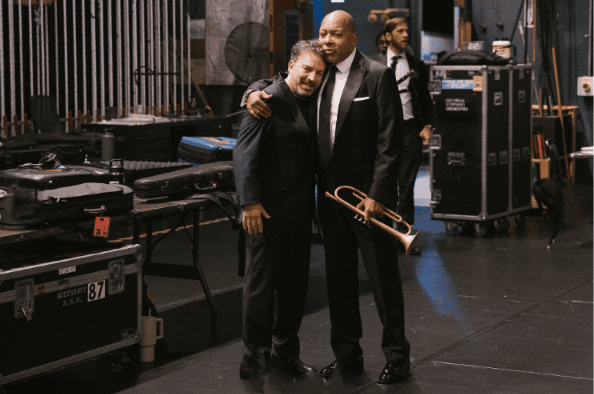
James Gaffigan and Wynton Marsalis
It was one of those beautiful September evenings at Wolf Trap when the night air seems to become part of the performance. Under the open sky at the Filene Center, the audience settled in for an extraordinary musical conversation between two very different ensembles: Wynton Marsalis’s Jazz at Lincoln Center Orchestra and the National Symphony Orchestra.
And then the music began to swing.
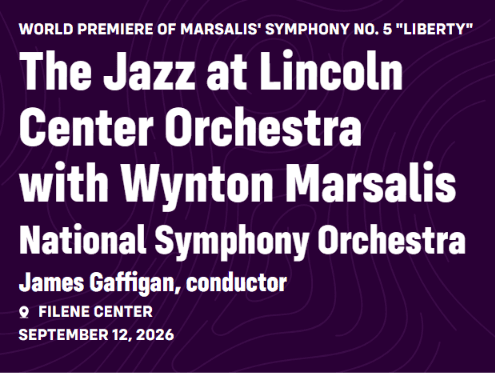
Marsalis was at Wolf Trap on September 12 for the world premiere of his Symphony No. 5, “Liberty,” a sweeping six-movement work co-commissioned by the NSO, Wolf Trap Foundation, and several other major orchestras and institutions as part of America250. Conducted by James Gaffigan, the symphony brought together the sound of the classical orchestra with the unmistakable voice of the jazz orchestra. The result was at once exuberant, thoughtful, unsettling, and deeply American.
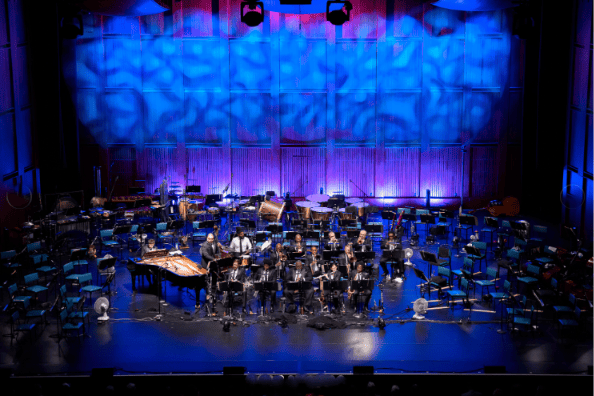
Jazz at Lincoln Center Orchestra
Before the premiere, the Jazz at Lincoln Center Orchestra reminded us why this ensemble is such a force. The musicians moved through the history of jazz, with sounds recalling old New Orleans and the many styles that followed. There was a wonderful sense of musical storytelling, as if we were hearing the evolution of an American art form unfold before us.
The playing was superb, but there was also an ease and humor among the musicians. “Bump, Set, Spike (with Elegance)” brought playful rhythmic energy, while trumpet and other instrumental features gave individual musicians moments to step forward and shine.
Then came Liberty.
What struck me most was that Marsalis did not present liberty as a single emotion—or as an uncomplicated celebration. Instead, the music moved through different states of being: joy, pain, hope, concern, and even discomfort.
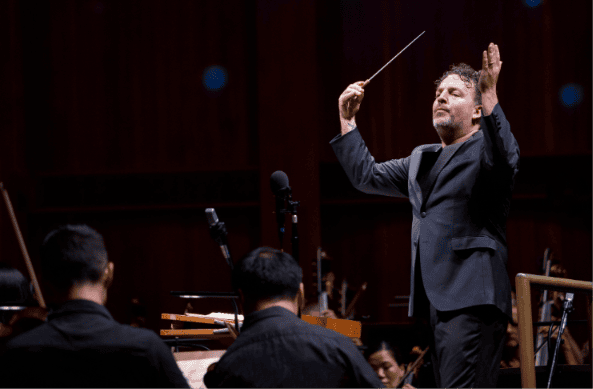
James Gaffigan
The first movement, This We Did, Despite the Word of the Lord (1850), seemed to draw on the sounds of gospel and marching bands, with passages recalling the expansive Americana of Aaron Copland. Gospel harmonies, orchestral textures, and rhythmic drive flowed into one another. At times, I could almost hear the church, the parade, and the concert hall occupying the same musical space.
The NSO and the Jazz at Lincoln Center Orchestra pushed and pulled against each other, sometimes sounding like one enormous ensemble and at other moments revealing the distinctive personalities of jazz and classical music. Marsalis knows both worlds intimately, and rather than keeping them in separate boxes, he lets them converse. Gaffigan seemed to revel in that conversation.
As he conducted, Gaffigan appeared almost to dance on the podium, his gestures expansive and energetic. There was visible joy in leading these musicians. He wasn’t simply keeping time; he seemed to respond physically to every musical turn. Watching him became part of the pleasure of the evening.
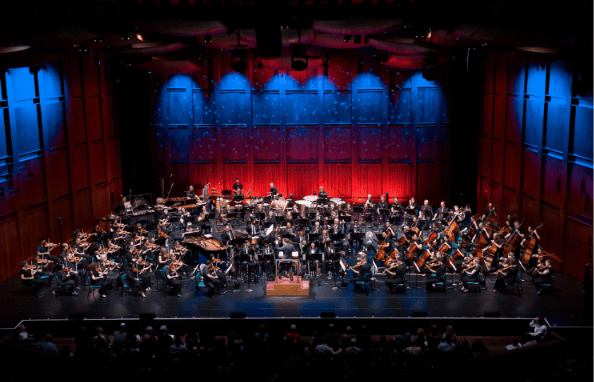
National Symphony Orchestra
The audience, too, became increasingly involved. At various points, foot taps and stomps became part of the orchestration, turning the concert hall into something closer to a gathering place. You could feel the rhythm moving through the Filene Center.
But Liberty also asks us to listen beneath the celebration. One of the most striking moments came when what sounded like the clang of a Liberty Bell gave way to the sound of chains. The juxtaposition was startling: the bell suggesting independence, freedom, and national pride; the chains reminding us that liberty has never belonged equally to everyone in America. In a few sounds, Marsalis captured a contradiction that runs through the country’s history—the ideal of freedom alongside the reality of oppression. The music doesn’t resolve that contradiction for us. Instead, it keeps moving.
The third movement, On the Battlefield of Belief (The 369th), carried a different emotional weight, while The Spirit of Freedom (1964) brought the big-band sound roaring forward. The music could be joyful and exhilarating even as the history beneath it remained painful.
That is one of the most effective aspects of Marsalis’s writing. He doesn’t separate American musical traditions from American history. Gospel, blues, marches, swing, the American Songbook, big-band jazz, and symphonic Americana all become part of the same story. Indeed, Marsalis describes the symphony as an exploration of the familial relationships among jazz, classical, Afro-Latin, and blues traditions.
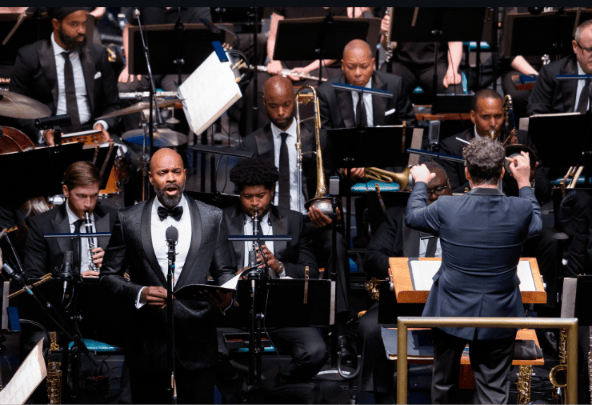
Eric Greene
The fifth movement, America My Home (Colonialism Is Not Patriotism), brought the evening into particularly powerful territory.
A violin entered softly before giving way to the deep, resonant baritone of Eric Greene. Greene’s voice immediately evoked the commanding presence of Paul Robeson. There was something almost monumental in the sound of that baritone—rich, warm, and powerful enough to fill the open-air theater without seeming to force itself upon the audience. The effect was deeply moving.
Here was an America of longing and aspiration, but also an America wrestling with its own history. Greene’s voice seemed to carry both the beauty of the American ideal and the weight of the questions surrounding it.
The final movement, The Hipness Is Everywhere (Are You There?) (2026), released some of the tension that had accumulated throughout the evening. The Jazz at Lincoln Center Orchestra came alive with its characteristic rhythmic vitality, and the NSO joined in the exuberance.

James Gaffigan and the NSO
After everything that came before—the gospel, marches, bells and chains, historical references, pain, and questioning—it felt good simply to hear these extraordinary musicians play.
Perhaps that is part of Marsalis’s larger message. Liberty is not static. It is not a monument or a word carved into stone. It is something that has to be continually examined, argued over, experienced, and, perhaps most importantly, created.
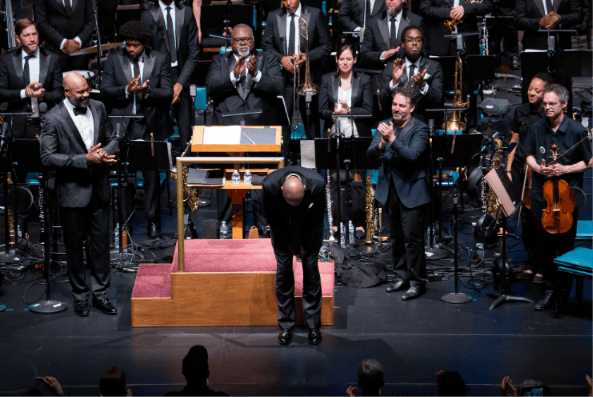
Wynton Marsalis takes a bow
Marsalis’s long relationship with Wolf Trap made the evening feel especially significant. This was his 18th appearance at the venue, and the Jazz at Lincoln Center Orchestra has been part of the Wolf Trap musical landscape for decades. The premiere also arrived during Marsalis’s final season as Artistic Director of Jazz at Lincoln Center, making the performance feel like both a celebration and a moment of transition. Wolf Trap confirms both the 18th appearance and Marsalis’s planned departure from the artistic-director post in July 2027.
For the Wolf Trap audience, however, the evening was wonderfully immediate. There we were—under the September sky—listening to an American symphony that could make us want to clap, tap our feet, reflect, question, and simply enjoy the music.
Liberty doesn’t tell us that America is perfect. It does something more interesting. It reminds us that America is a work in progress—a country whose music contains its celebrations and sorrows, promises and contradictions.
And on this particular night at Wolf Trap, all of those voices were swinging together.
✦ ✦ ✦ ✦ ✦ ✦ ✦ ✦ ✦ ✦
photos by Luigi Beverelli
Symphony No. 5, “Liberty”
Wynton Marsalis / Jazz at Lincoln Center Orchestra
National Symphony Orchestra / James Gaffigan, conductor
Filene Center at Wolf Trap, 1551 Trap Rd. in Vienna, VA
September 12, 2026 at 8
world premiere
presented as part of Wolf Trap’s America250 series
for more information, visit Wolf Trap
for more shows, visit Theater in DC
✦ ✦ ✦ ✦ ✦ ✦ ✦ ✦ ✦ ✦
SEO
POSTER / FEATURED-IMAGE TEXT
For the poster, I’d keep it very clean:
WYNTON MARSALIS
LIBERTY
Symphony No. 5
WORLD PREMIERE
Jazz at Lincoln Center Orchestra
National Symphony Orchestra
James Gaffigan, conductor
WOLF TRAP
The official Wolf Trap billing is “The Jazz at Lincoln Center Orchestra with Wynton Marsalis / National Symphony Orchestra / James Gaffigan, conductor,” and the concert was September 12 at 8 at the Filene Center.
One important correction from my previous pass: I would not retain the sentence saying Wolf Trap’s program describes the work as drawing on jazz, classical, Afro-Latin, and blues traditions inside Barbara’s review. That’s research I added, not Barbara’s observation, and she already makes essentially that point herself. Same with my explanatory sentence confirming the world premiere. Those are useful to me for fact-checking, not prose that belongs under Barbara’s byline.
