


Areas We Cover
Categories

Opera Review: CARMEN (LA Opera)

by Michael M. Landman-Karny | October 20, 2026
in Los Angeles, Music, Theater
THE SINGERS SOAR,
THE STAGING SWELLS
Domingo Hindoyan and a superb cast illuminate
Bizet’s masterpiece, even as an overstuffed
new production threatens to obscure it

Rihab Chaieb (Carmen) and Joshua Guerrero (Don José)
In 1888 Friedrich Nietzsche wrote that he had just heard Carmen for the twentieth time. He had broken with Wagner. Bizet gave him just the weapon he needed. “It approaches lightly, gracefully, with courtesy,” he wrote of the score. “It does not sweat.”
Domingo Hindoyan, opening his first season as LA Opera’s music director, has given us a Carmen Nietzsche would have recognized. The cast is superb. Above the pit, Thaddeus Strassberger‘s new production sweats through every scene.

Music Director Domingo Hindoyan
Bizet never set foot in Spain. His Seville came from Prosper Mérimée’s 1845 novella, a libretto by Henri Meilhac and Ludovic Halévy, and some borrowed tunes. The Habanera began as “El Arreglito,” a song by Sebastián Yradier. Bizet took it for a folk melody until someone told him otherwise.
The Opéra-Comique premiered Carmen on March 3, 1875. It was a family theater, where marriages were sometimes arranged in the boxes. Its patrons got a cigarette girl who slashes a coworker, seduces a corporal, and dies at his hands on stage. The critics were chilly. Bizet died on June 3, three months to the day after the opening. He was 36.
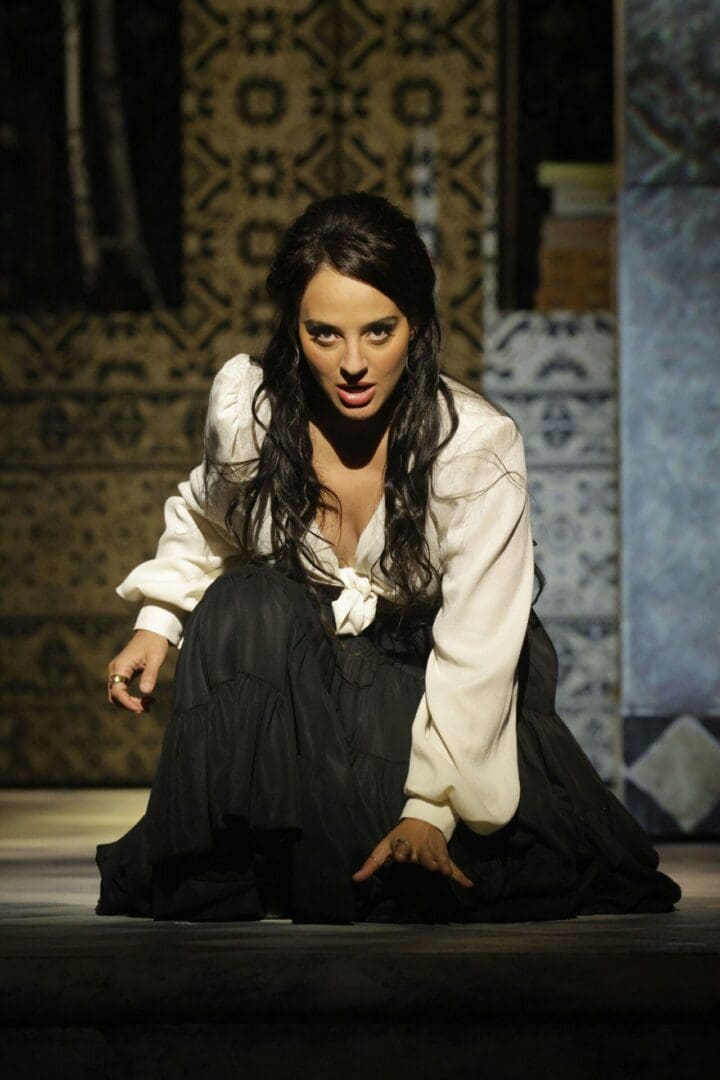
Rihab Chaieb
The story: In a Seville square, Micaëla comes looking for the corporal Don José with a letter and a kiss from his mother. Carmen, who works at the cigarette factory across the way, tosses José a flower. When she slashes a coworker in a brawl, Lieutenant Zuniga orders José to march her to prison. She seduces him with the Seguidilla, and he lets her run. He serves her sentence.
Two months later, at Lillas Pastia’s tavern, the toreador Escamillo arrives and makes his interest in Carmen plain. The smugglers want her for a job. José arrives fresh from the stockade, and when the bugle calls him back to barracks, Carmen mocks him. He answers with the Flower Song. Then Zuniga walks in, José draws on his superior officer, and the smugglers are his only escape.
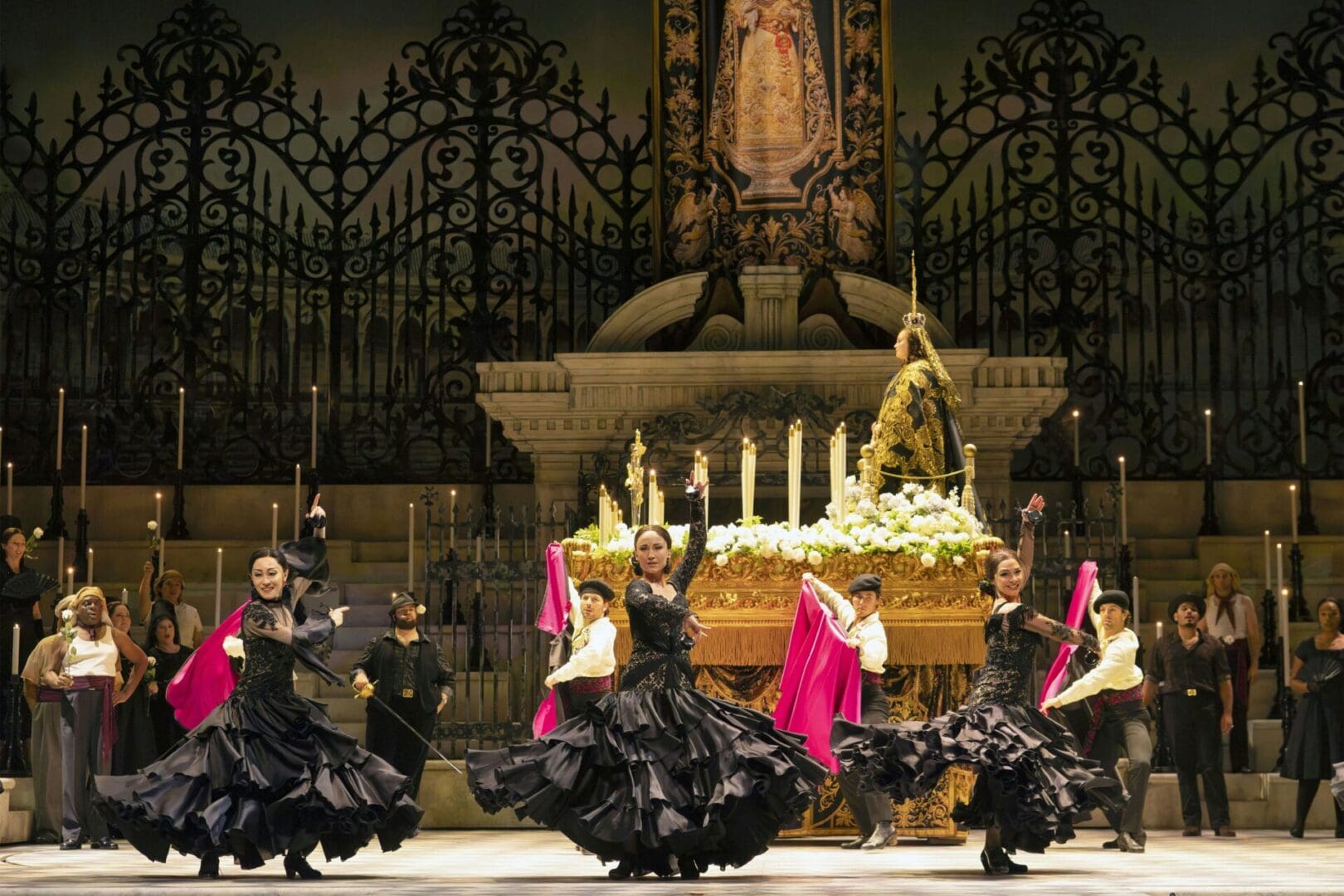
The Dancers
Strassberger directed and designed this production. He has looked to Cristina García Rodero‘s photographs of village ritual and the shadowed canvases of Zurbarán and Ribera. Wrought-iron gates tower over the stage, palace railings in one scene and prison bars in the next. Thousands of candles flicker beneath them. Devotion and confinement share the same flame.
But Strassberger cannot leave well enough alone. Dancers, doubles, and Greg Emetaz‘s projections crowd the margins, and ghostly figures scamper through scenes that need stillness. A silent woman in a shawl, Fate or Death or both, prowls most of the evening and pulls the eye from whoever is singing. Antonio Najarro‘s flamenco choreography fills every bar the score leaves open, and several it doesn’t.

Los Angeles Children’s Chorus
We are supposedly in the 1950s. The oddities keep coming. A helicopter drops contraband at the smugglers’ hideout. A piñata gets beaten to splinters. Lillas Pastia’s tavern turns into a Eurovision number, and Escamillo steps out of it like a Las Vegas headliner circa 1975. By the end, Micaëla has become the Virgin of a Semana Santa procession. Strassberger wants every image to count, but the accumulation detracts rather than adds to the opera.
Hindoyan lights the fuse in the prelude and lets it burn. The Habanera sways without going slack, and the dance numbers keep their pulse without turning mechanical. Textures stay clear enough to hear the woodwinds through the strings. He never lets the charm of a number drown out the fate motif, which keeps returning to announce how this ends.

Liam James Karai (Escamillo) and the cast

Rihab Chaieb (Carmen, center) and Joshua Guerrero (Don José, far right)
Rihab Chaieb plays Carmen as a woman who thinks before she moves. She sings the Habanera to lay down the rules. The Seguidilla, sung and danced at José while he stands guard, finishes what the Habanera started. She dances as well as sings, and her defiance never tips into camp. The voice darkens at the bottom and opens into warm high notes that hold their color. A native French speaker, she makes every consonant count.
Joshua Guerrero‘s José is coming apart from his first scene, and the chemistry with Chaieb is real. He sings with full-throated passion everywhere except the Flower Song, which he keeps in half-voice from first bar to last. That is an odd choice for the one aria in which José explains himself.
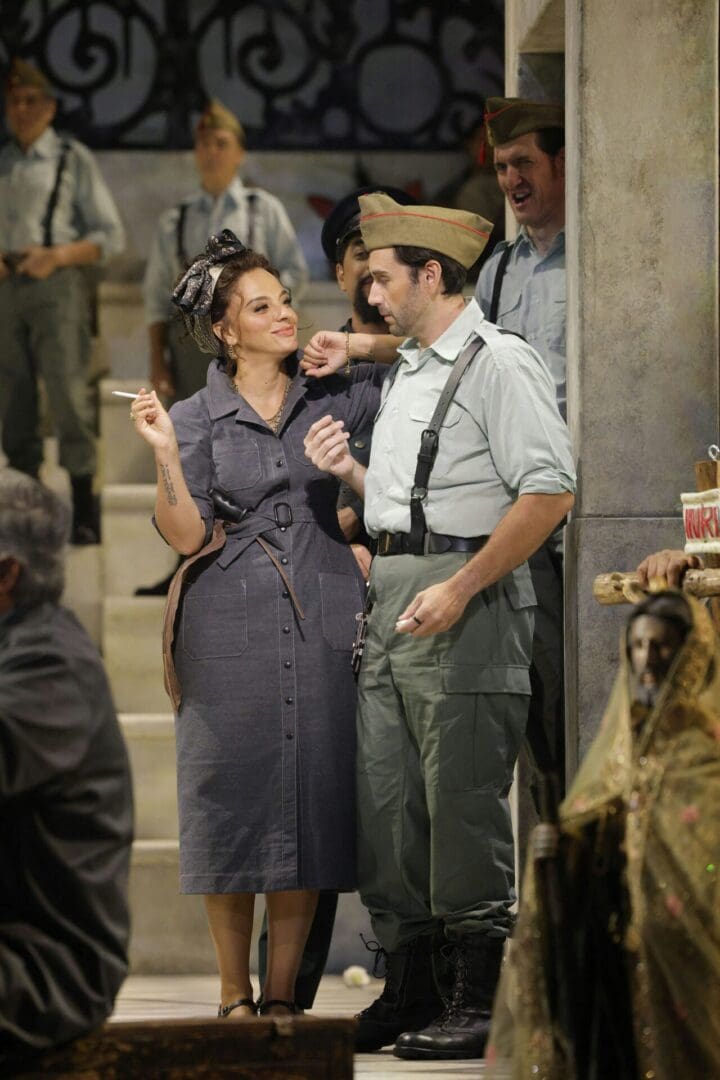
Rihab Chaieb and Joshua Guerrero
Kathleen O’Mara‘s Micaëla is the standout in this production. Strassberger treats her as a saint in waiting. Her face swells into a giant projection that rotates across the stage, and ghostly attendants bring her robes and a crown. During the bullfight, a catafalque bearing her likeness looms over the square while she watches the end arrive. None of it gets in her way.
In the Act 1 duet, O’Mara sings a true legato, soft but audible to the back of the house. Micaëla has come with a kiss from José’s mother, and she is a little in love with him herself. O’Mara lets that show in the voice and nowhere else. Her Act 3 aria, “Je dis que rien ne m’épouvante,” is the high point of the evening. She spins a long, even line over the horns. Fear rises in the agitated middle section, where Micaëla imagines facing Carmen. At the climax the soubrette brightness opens into a full lyric soprano.
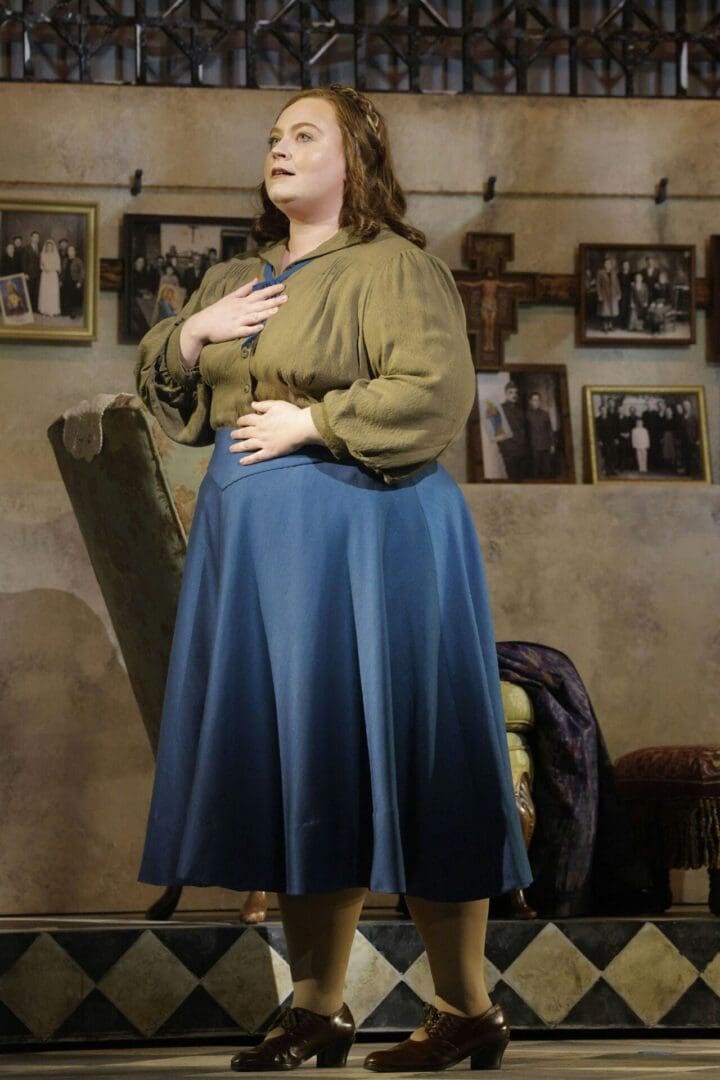
Kathleen O’Mara (Micaëla)
Liam James Karai, in his company debut, struts as Escamillo, every inch the bullfighter. His bass-baritone has heft at the bottom and glides into ringing top notes. Vinícius Costa gives Zuniga a firm, resonant bass and the bearing of an officer who has never been told no. Ryan Wolfe‘s Moralès runs on charm and a supple baritone.
In the card scene, Gabrielle Turgeon‘s bright soprano sparks above the trio while Katie Trigg‘s warm mezzo finds Mercédès’s earthy humor. The smugglers fare well, too. Samuel Wallace‘s Remendado pairs a light, incisive tenor with crisp French and sharp comic timing. Mario Manzo‘s smooth baritone gives Le Dancaïre his authority. The LA Opera chorus sounds splendid, with unusually clear French.
Nietzsche heard Carmen twenty times and never wrote a word about the scenery. This cast is worth hearing twice. The candles can take care of themselves.

Act III of Carmen
✦ ✦ ✦ ✦ ✦ ✦ ✦ ✦ ✦ ✦
photos by Cory Weaver
Carmen
LA Opera
Dorothy Chandler Pavilion, 135 N. Grand Ave. in Los Angeles
Oct. 25 & Nov. 1 at 2; Oct. 29 & Nov. 4 at 7:30; Nov. 7 at 7:30
3 hours and 30 minutes, including intermission
sung in French with English subtitles
ends on November 7, 2026
for tickets, call 213.972.8001 or visit LA Opera
for more shows, visit Theatre in LA
✦ ✦ ✦ ✦ ✦ ✦ ✦ ✦ ✦ ✦

Act IV of Carmen
