


Areas We Cover
Categories

Theater Review: PHANTOM (North Shore Music Theatre / Beverly, MA)
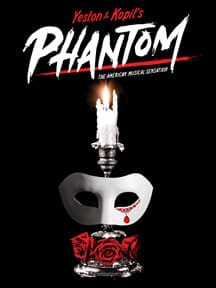
by Carmen Barsomian-Dietrich | October 25, 2026
in Boston, Theater
WHO COULD EVER HAVE
DREAMED UP YOU?
Yeston and Kopit’s alternative to Andrew
Lloyd Webber’s musical gives familiar
characters new depth and humanity
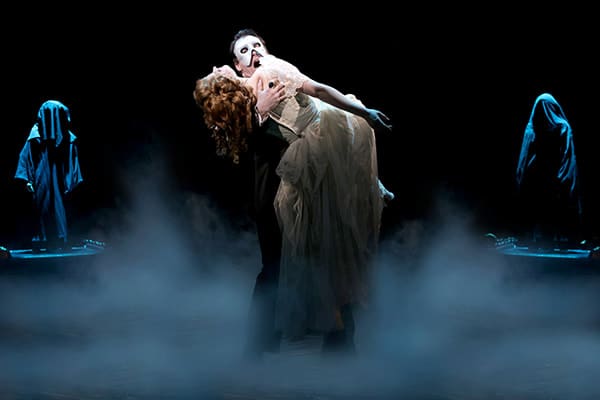
Sean Seamus Thompson (The Phantom) and Madison Claire Parks (Christine Daaé) in Yeston & Kopit’s Phantom on stage at Bill Hanney’s North Shore Music Theatre
Growing up singing along to Andrew Lloyd Webber’s The Phantom of the Opera, it wasn’t until recently that I learned there was a second musical adaptation of Gaston Leroux’s story: Maury Yeston and Arthur Kopit’s Phantom. Although it has enjoyed considerable popularity, including two previous productions at North Shore Music Theatre (NSMT), Phantom remains overshadowed by Lloyd Webber’s more famous version, so I arrived at the performance with no small amount of curiosity.
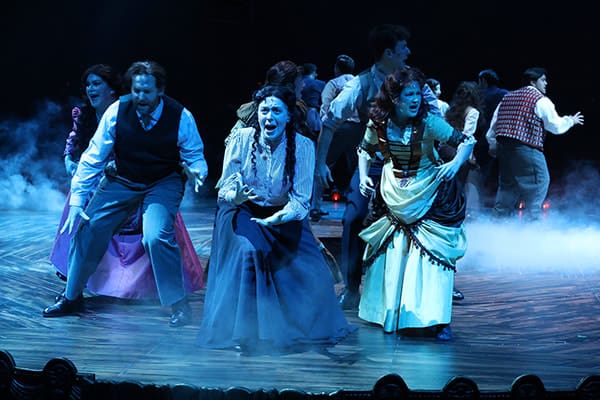
The cast
As Phantom begins, the shows quickly differentiate themselves not only in musical style but, especially, in character development. Which version is better? While different, both musicals are highly enjoyable and rich in their own ways.
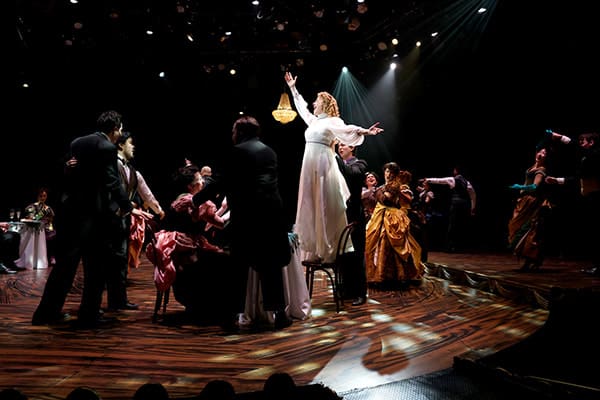
Madison Claire Parks (Christine Daaé) and the cast
Familiar with the story through both Leroux’s novel and Lloyd Webber’s musical, I was pleasantly surprised to find that Yeston and Kopit’s take brings new life to familiar archetypal figures. By changing certain details, they create additional depth that better explains characters’ motivations, giving key plot points a fresh twist. Phantom is unexpectedly humorous at times despite its gothic horror genre. The musical is vibrant, enthralling, and has a score that left me humming its “Melody de Paris.”
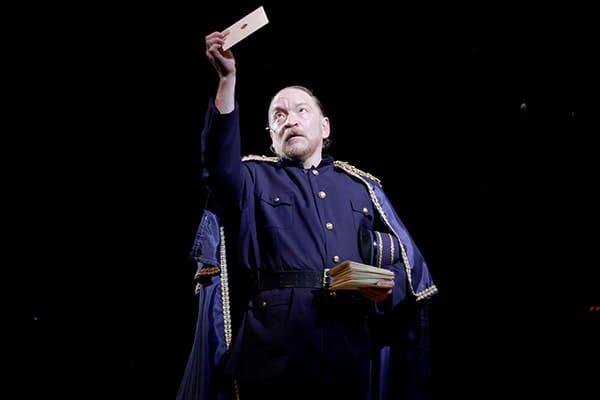
Justin R. G. Holcomb as Inspector Ledoux
Although the American project began in 1983, the success of Lloyd Webber’s 1986 British version quickly took center stage. Phantom finally debuted in early 1991, but despite numerous productions across America and internationally, it has never played on Broadway. The score by Yeston (Titanic, Nine) leans into a more classical operetta style. Numbers such as Carlotta’s “This Place Is Mine” and Philippe’s “Who Could Ever Have Dreamed Up You?” have a light-hearted musical-theater quality, while the Phantom’s “Where in the World” and Christine’s “Home” are more operatic. Other songs, such as “Music Lessons,” are admittedly better experienced in the context of the show than heard on their own. The musical motifs are nevertheless charming and haunting by turn and easy enough to get stuck in your head.
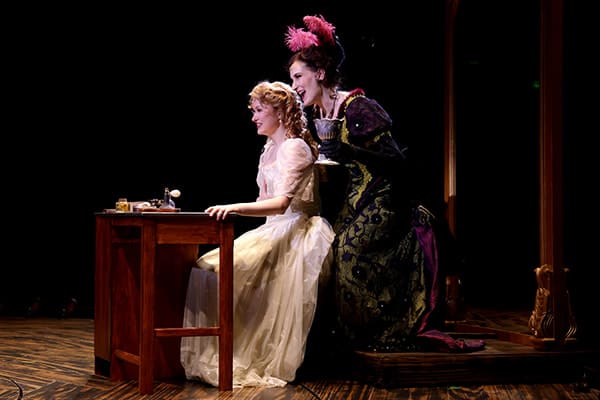
Madison Claire Parks (Christine Daaé) and Victoria Huston-Elem (La Carlotta)
As Christine Daaé, Madison Claire Parks makes the score feel effortless, bringing a velvety warmth to her soprano and providing a fresh contrast to Victoria Huston-Elem’s more dramatic La Carlotta. Though La Carlotta may draw bad reviews for her lack of talent, Huston-Elem’s sharp and witty performance leaves no doubt that she should be the Paris Opera’s reigning diva. Sean Seamus Thompson as the Phantom is in turns intense and vulnerable, carrying the revolving emotions of the story while simultaneously demonstrating why he more than earns the right to be Christine’s teacher.
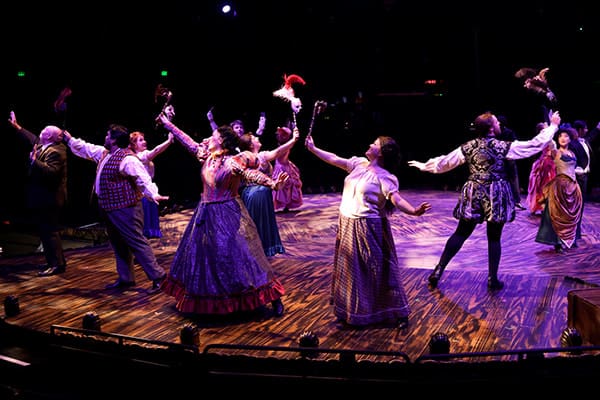
The ensemble
Taking full advantage of NSMT’s space, Scenic & Lighting Designer Jack Mehler uses a clever set of stairs and the stage’s lift to transport us from the Paris streets to the Opera House and draw us into the catacombs. Satellite stages interspersed in the audience further immerse you in the drama as actors appear almost magically and somewhat startlingly at times to expand the stage’s reach. Supporting the 26-member company is a live 10-member orchestra conducted by Dale Rieling that sends the score soaring throughout the theatre.
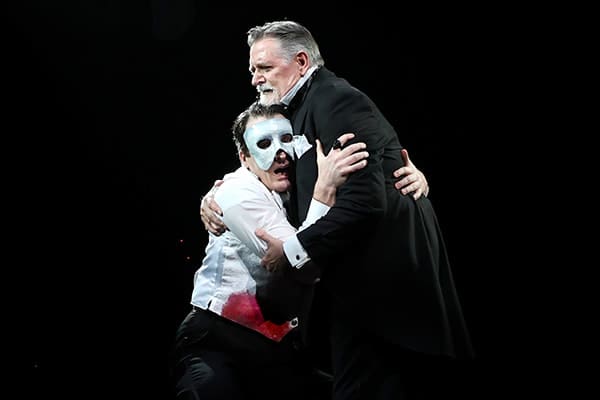
Sean Seamus Thompson (The Phantom) and Gregory North (Gerard Carriere)
For all of director Robert W. Schneider‘s imaginative staging at NSMT, Phantom is most alluring in its development of the characters. Here, the Phantom is Erik, a man with dreams and hobbies, even a favorite poet, William Blake. No longer merely an obsessive ghost lurking in the catacombs, he emerges as a fully realized human being. Crucially, by giving him a classic “I want” song, this telling shifts the perspective from the love story between Christine and Count Philippe de Chandon (Christian Probst) to a story about Erik. While Phantom retains certain plot points, the decision to focus on Christine and Erik’s relationship as student and teacher gives them a far more natural and sympathetic relationship—and makes the conflicting emotions that Christine feels for him and her wealthy patron more understandable. The choice to develop Erik’s backstory by exploring who his parents were and how he grew up changes not only how Christine feels about him but also enables the viewer to feel true sympathy for one who has struggled all his life. It creates a far more impassioned end to the musical that is by turns intense, tender, and heartbreaking.
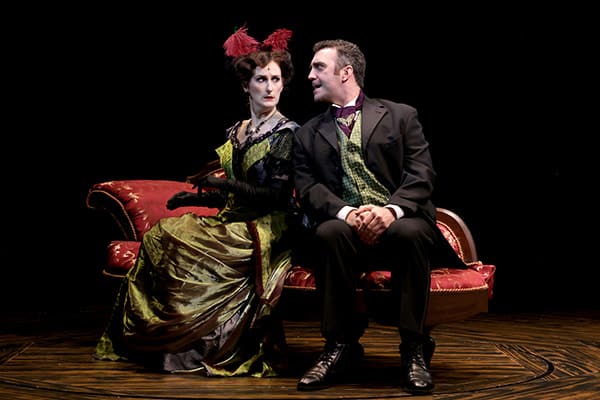
Victoria Huston-Elem (La Carlotta) and Alex Syiek (Alain Cholet)
The other main character who is given more agency here is Carlotta. While still a diva, as the wife of Alain Cholet, the Paris Opera’s new manager (Alex Syiek), she is given more power, and her demands are made more sympathetic—as is her jealousy of Christine. Though her character is made more humorous, her songs give insight into her motivation beyond maintaining her position as the Paris Opera’s prima donna.
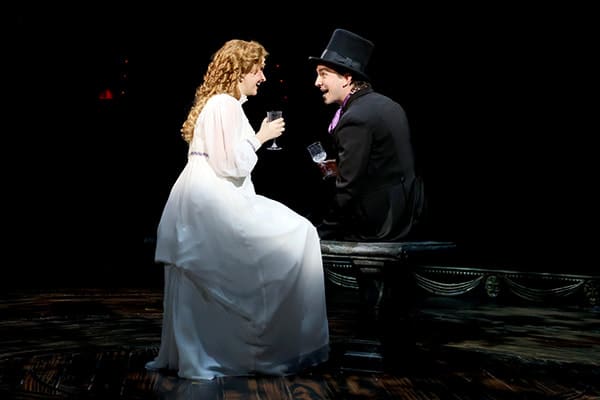
Madison Claire Parks (Christine Daaé) and Christian Probst (Count Phillippe de Chandon)
Kopit’s book makes certain adjustments to Christine’s character, introducing her as a street singer and replacing Raoul, her love interest from the novel, with Philippe. While most of these changes are fairly minor, they help to explain her natural talent as well as her need for singing lessons. They also create a reason for her naiveté as she is new to the world of opera and fulfilling a lifelong dream.
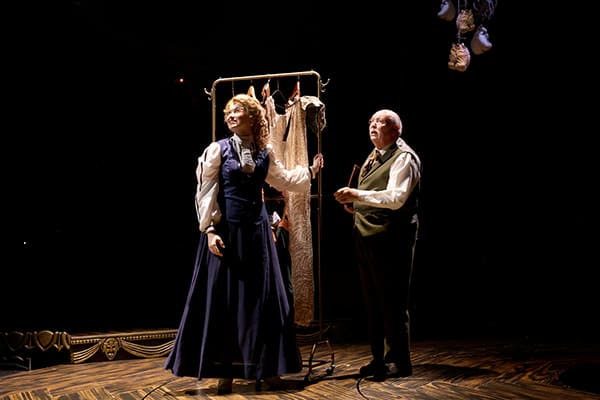
Madison Claire Parks (Christine Daaé) and David Coffee (Jean-Claude)
Andrew Lloyd Webber may have given the world its most famous Phantom, but Yeston and Kopit remind us that there is more than one way to tell this story. At North Shore Music Theatre, the man behind the mask finally gets his due.
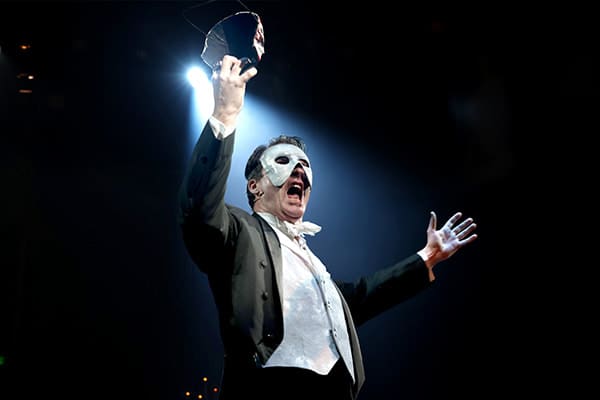
Sean Seamus Thompson as The Phantom
✦ ✦ ✦ ✦ ✦ ✦ ✦ ✦ ✦ ✦
photos by Paul Lyden
Phantom
North Shore Music Theatre
54 Dunham Rd. in Beverly, MA
2 hours and 40 minutes, including intermission
Tue–Thu at 7:30; Fri & Sat at 8; Wed, Sat & Sun at 2
ends on November 1, 2026
for tickets ($85–$105), call 978.232.7200 or visit North Shore Music Theatre
$25 student rush; limited $45 upper-circle evening rush;
discounts for children ages 4–18 and groups of 10 or more
for more shows, visit Theatre in Boston
✦ ✦ ✦ ✦ ✦ ✦ ✦ ✦ ✦ ✦
