


Areas We Cover
Categories

Theater Review: CONFEDERATES (Fountain Theatre / Los Angeles)

by Michael M. Landman-Karny | November 6, 2026
in Los Angeles, Theater
ALLIES WITH STRINGS ATTACHED
Two Black women, separated by 164 years, discover
that everyone offering help wants something in return
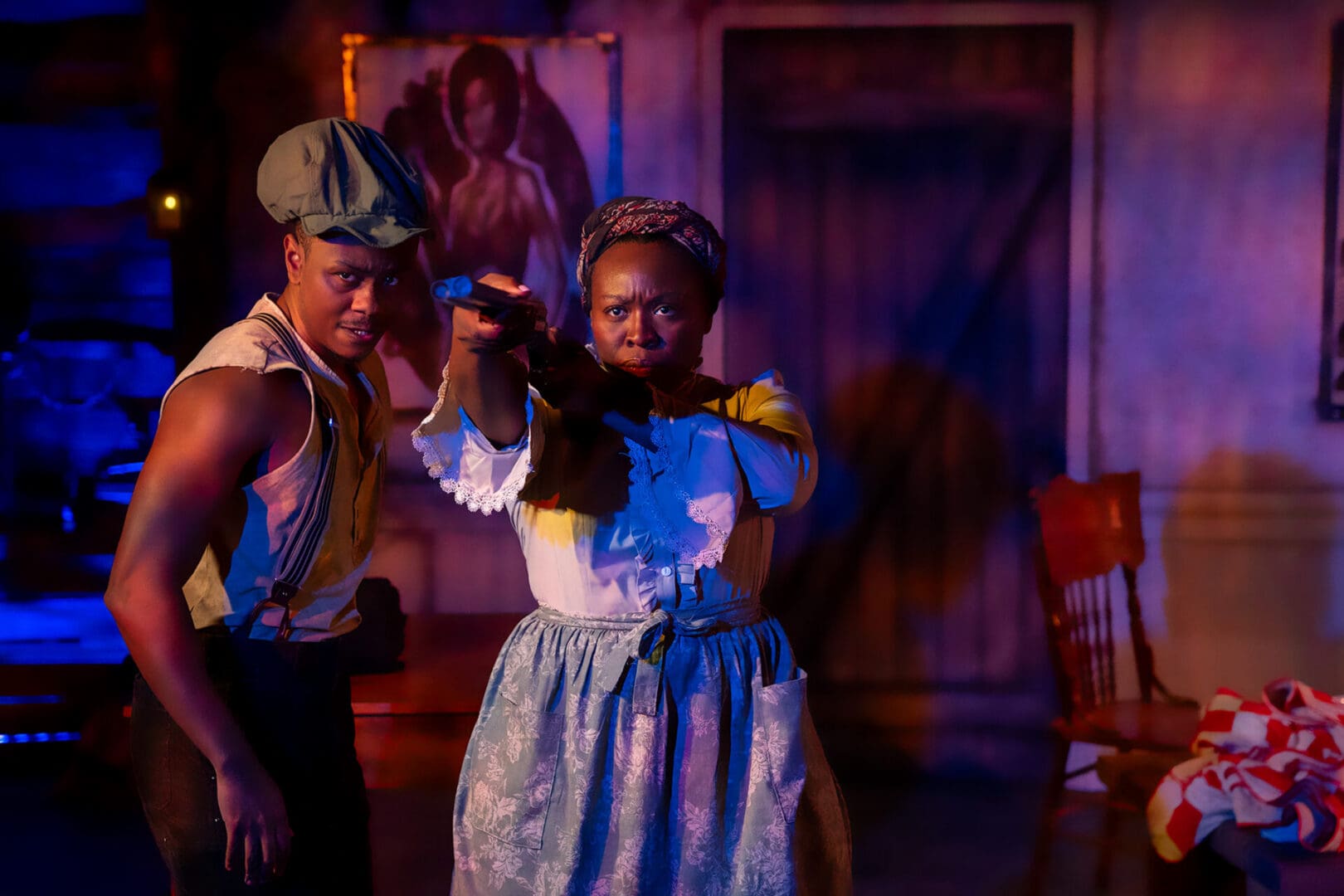
Dake McClettie II and Nedra Ryan Taylor
Only one character in Dominique Morisseau’s Confederates says the title word out loud. Sara, an enslaved woman copying Confederate troop movements off her master’s desk, has overheard Master Dan talking strategy in his office. She explains the term to her brother: “His white kin what be on his same side.” The dictionary gives two meanings. A confederate is an ally. A confederate is also an accomplice. Morisseau spends ten scenes sorting her characters into one column or the other.
Morisseau alternates two stories. In 1862, Sara (Nedra Ryan Taylor) stitches up her brother Abner, a runaway turned Union soldier, and begs him to let her hold his musket. Then Missy Sue, the master’s daughter and Sara’s childhood companion, comes home from the North a fresh convert to abolition. She gets Sara moved into the big house to spy on her father. In 2026, Sandra (Sarah Scott Davis), a tenured political science professor at a mostly white university, finds a picture hanging on her office door. It shows an enslaved wet nurse with a white baby at her breast. Someone has photoshopped Sandra’s face onto the nurse. Sandra wants the culprit found. Everyone she questions wants something from her first.
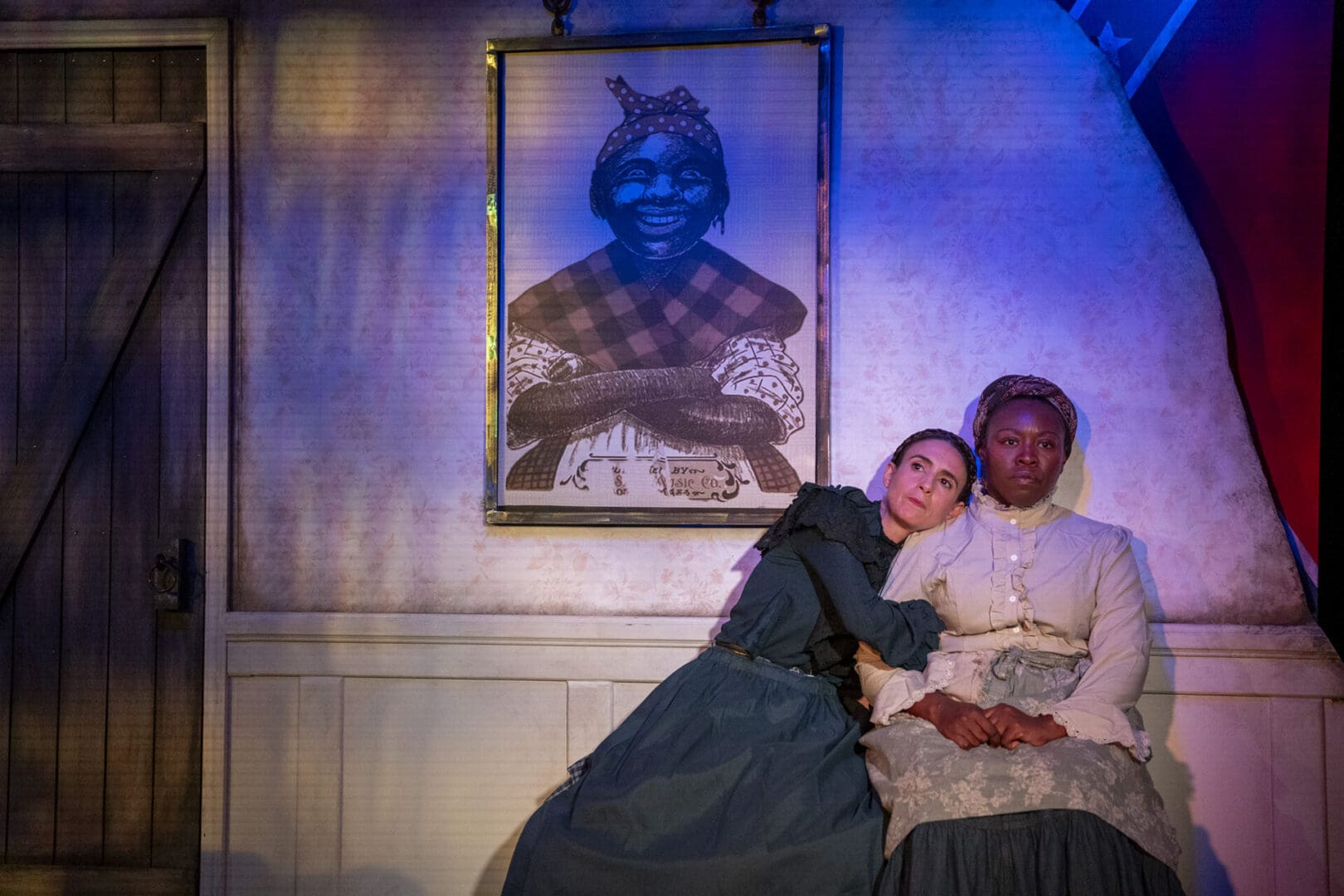
Mara Klein and Nedra Ryan Taylor
Five actors play eight roles, and the three supporting players each cross the centuries. The doubling pays off in the differences. Missy Sue’s father owns Sara. Candice, Sandra’s student assistant, needs the job to cover room and board once her financial aid runs out. Both crave a Black woman’s approval of their enlightenment. Only one has a family that can sell the woman she’s courting. Abner forbids his sister the war that might free her. Malik, Sandra’s scholarship student, accuses her of grading him harder than his classmates, then asks whether it’s because he’s a man. LuAnne trades her body for a bed in the big house. Jade opens with flattery and closes with a question about Sandra’s tenure vote. Same faces, different leverage.
Morisseau’s note to directors insists the play is funny and asks for full Gone with the Wind excess in the Missy Sue scenes. Raymond O. Caldwell takes her at her word, and the laughs keep coming out of brutal material. Missy Sue describes the progressive meetings that filled her calendar up North while her husband was out philandering. Sara replies, “Sounds busier than picking cotton.” Missy Sue laughs, praises Sara’s wit, and recalls the one time she worked the field, at twelve, when a hurricane threatened the crop. Sara, picking since age seven, credits her strong hands. Missy Sue wonders if that was a dig and decides to forgive it. The play’s whole method sits in that exchange. The joke lands as an indictment, and the white woman elects not to hear it.
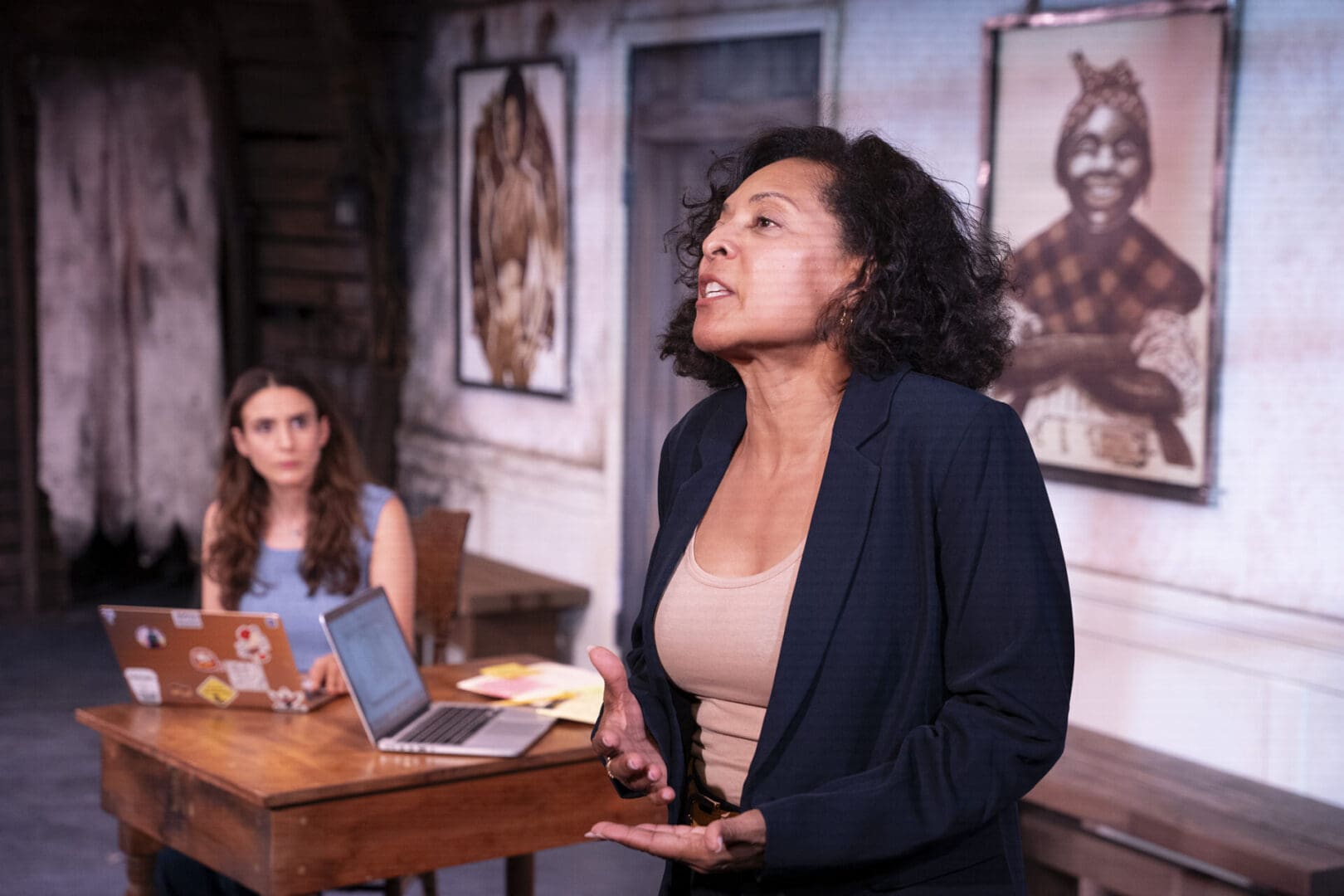
Mara Klein and Sarah Scott Davis
Caldwell paces the evening well and moves the action nimbly between centuries and settings: slave cabin, master’s office, faculty office. Some of the changes happen in plain sight. An actor remains visible in semi-darkness, shedding one costume and taking on another before stepping into the next century. Elsewhere, the changes happen offstage. The ensemble is excellent from top to bottom, and three performances stand out.
Taylor has the richest role and plays it at full size. Sara asks one actor for brassy satire and ferocious political oratory, sometimes in the same scene. Taylor hits the comic notes without strain. She carries herself with an authority that barely conceals the pain beneath it. Sara begins the play wanting to fight in a man’s war, but Taylor makes clear that her struggle is larger than any army’s cause.
Davis has the harder assignment. Sara’s story runs on action: she copies her master’s plans, keeps secrets, and picks up a gun. Sandra’s runs on argument, one office conversation after another. Davis, in a red power suit from costume designer Wendell C. Carmichael, gives us the poised, self-assured academic. Then she lets the nerves show under the steel.
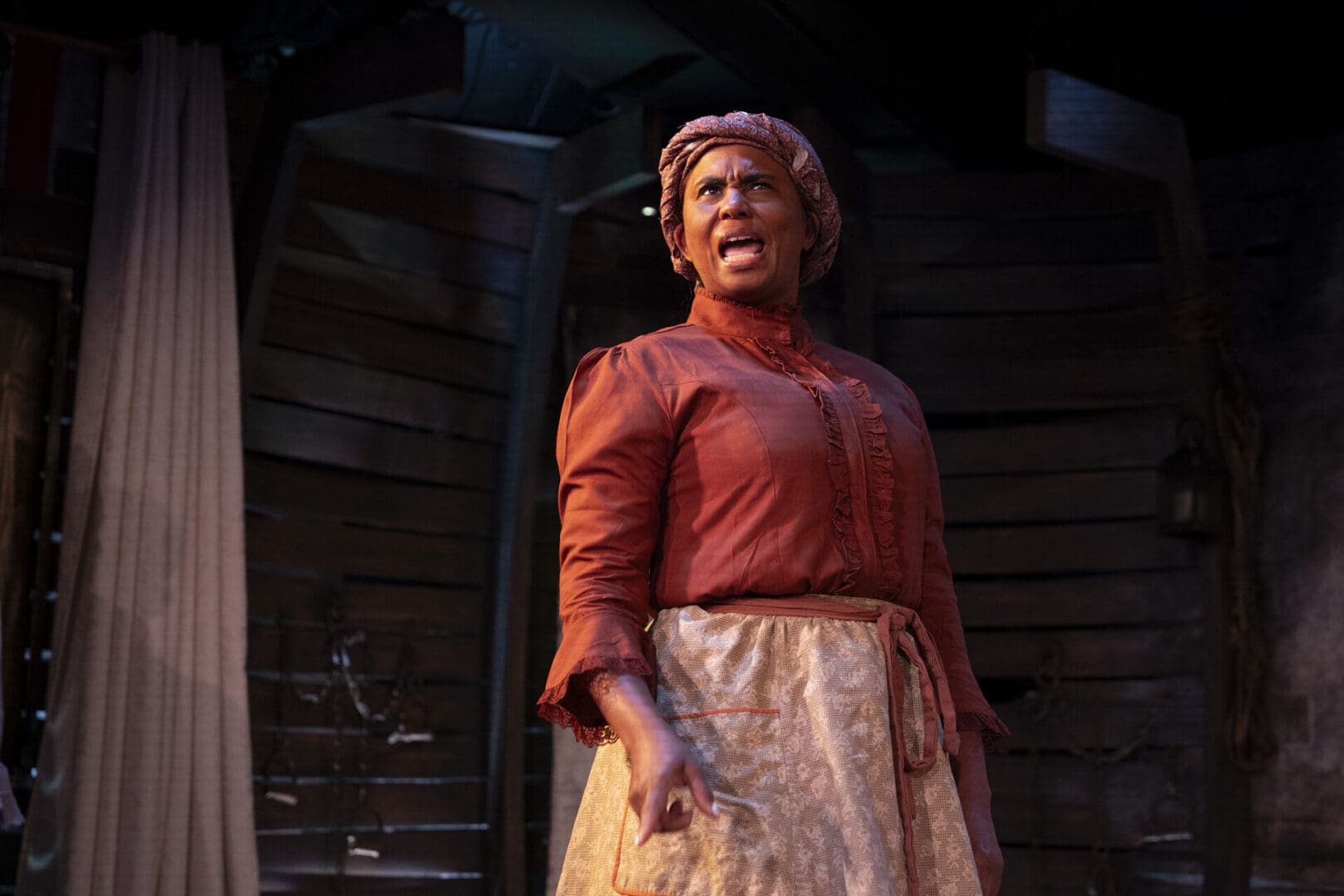
Cortney Scott Wright
Daks McClettie II, making his Fountain debut, gives Abner and Malik the same quick, animated repartee. It suits two young men who can’t stop arguing with the women they love or study under.
Mara Klein plays up the cluelessness of both her white women. One is a plantation daughter who confuses ownership with friendship. The other is a student who can’t discuss her privilege without proving she doesn’t understand it. Cortney Scott Wright oozes cool as Jade, brusque and straight-shooting. She also plays LuAnne, who gets the hardest speech in the script, a defense of the bed she shares with the master. Whatever she gives up to him, LuAnne tells Sara, “it’s leaving borrowed, not stolen.”
My one complaint is the set. Matt McCarren’s design alternates between an 1860s plantation and a present-day campus, and it does the job. But the physical construction looks basic, even by the standards of a 99-seat house. The dressing on the walls is smarter than the scenery itself. There is an Aunt Jemima type, a slave auction, and a busty Blaxploitation heroine who looks like Pam Grier’s Coffy or Tamara Dobson’s Cleopatra Jones. There are also shackles on the wall and pieces of a Confederate flag. The images belong here. Sandra opens the play reciting every slavery film and book she has absorbed, from Roots to Django Unchained, and the production adds a slide show of the movies’ Black stereotypes. The walls keep that catalog in view.
Morisseau brings the two stories together without pretending that 164 years have erased the differences between them. Sara and Sandra have spent the evening surrounded by people who claim to be on their side, provided the women give them something in return. By the end, each must decide what she owes those supposed allies, and what she owes herself. When the two women finally look at each other across the centuries, neither wants anything from the other. That’s the other meaning of the word.
photos by Davis Northern
Confederates
Fountain Theatre
5060 Fountain Ave. in Los Angeles
RUNNING TIME NOT FOUND
Thu–Sat at 8; Sun at 2; Mon at 8 (Nov. 16, 23 & 30 only; dark Nov. 26 & 27)
ends on December 13, 2026
for tickets ($5–$75), call 323.663.1525 or visit Fountain Theatre
secure on-site parking $5
for more shows, visit Theatre in LA
✦ ✦ ✦ ✦ ✦ ✦ ✦ ✦ ✦ ✦
