


Areas We Cover
Categories

Theater Review: AMERIKA OR, THE MAN WHO DISAPPEARED (Open Fist Theatre Company)
by Tony Frankel | November 13, 2025
in Los Angeles, Theater
THIS WAY TO THE AMERICAN DREAM–
MIND THE TRAP DOORS
Kafka’s story still needs an ending,
but Open Fist delivers a wildly inventive Amerika
If you think America is in an existential crisis right now, you either don’t know your U.S. history, or you aren’t familiar with Franz Kafka’s Amerika or, The Man Who Disappeared—which, in Dietrich Smith’s sprawling, imagination-on-steroids adaptation at Open Fist Theatre, becomes a delirious, zany, occasionally exasperating funhouse ride through the American Dream’s historical malfunctioning. Its investigation of immigration, corporate dominance, and the eternal divide between haves and have-nots mirrors our nightly news, but this rendering of the search for the elusive American Dream is far more insightful, and infinitely more entertaining.
Marc Jablon, Matthew Goodrich, Ethan Remez-Cott, Jack Sharpe, Jade Santana
Ethan Remez-Cott and Jeremy D. Thompson
Smith adapts and directs, and that double-duty is both the production’s superpower and its Achilles heel. As a writer, he’s crafted a whip-smart, kaleidoscopic journey for young Karl Rossmann (played with amiable, lightly bewildered charm by Ethan Remez-Cott), the exiled European teen tossed into a mythic early-20th-century America that looks, sounds, and behaves like Dickens wandering through a Wes Anderson set after a late-night philosophy bender with Sartre and Ionesco. As the leader of a team of crafty technicians, he not only succeeds but practically reinvents the wheel, showing what small theatre in L.A. can accomplish.
Ensemble Jack Sharpe, Tambrie Allsup, Chima Rok,
Matthew Goodrich, Jade Santana, Marc Jablon
As a director, however, Smith sometimes lets the energy run so hot that performers appear to be inventing their own stylistic lanes—some playing it straight (to excellent effect, in the case of Debba Rofheart as an executive chef and Marc Jablon as Karl’s shipping-magnate uncle), others diving into full farce like Jack Sharpe, who creates an uproarious gait, an inflated waddle of self-importance as the medal-covered Romanian ship engineer Schubal. The problem isn’t the variety; it’s the lack of a shared compass. Accents wander across the American map, and the level of exaggeration shifts scene to scene, suggesting the actors could use clearer guidance on the world they’re meant to inhabit.
Ethan Remez-Cott and Jade Santana
Marc Jablon, Jeremy D. Thompson, Jack Sharpe and Ethan Remez-Cott
The technical achievements here are outrageous in the best way. Projections by animation legend John R. Dilworth (yes, Courage the Cowardly Dog Dilworth) and a soundscape from seven-time Oscar-winning Gary Rydstrom create a pop-up storybook of industrial clang, looming bureaucracies, and dreamlike American vistas. A particular delight is when tiny animated figures skitter up and down an impossible tangle of ship stairways, the kind of visual paradox that would send M.C. Escher into a spiral. Open Fist has staged big before, but this is the first time I’ve seen them marry spectacle and absurdism so seamlessly. It’s a world that breathes, flickers, glitches, and reassembles itself—exactly the way Kafka feels in your brain.
Jack Sharpe, Tambrie Allsup, Ethan Remez-Cott and Jeremy D. Thompson
Tambrie Allsup and Ensemble
And Dilworth and Rydstrom are building all that atop a team of designers doing heroic work. The scenic design, by Frederica Nascimento, isn’t a literal period reconstruction; it’s a modular, shifting environment of platforms, staircases, rolling units, gorgeous drops (artist Elizabeth Moore), and collapsible spaces that let episodic scenes snap together like panels in a graphic novel. Nothing sits still for long. One moment we’re in a ship’s bowels, then the penthouse of a New York office building, then an elevator in a huge county hotel, then slums, then the open West—yet the design keeps an uncanny coherence, as if all of Karl’s “America” is one giant, bureaucratic stage trap he can’t escape. Gavan Wyrick’s lighting intensifies that feeling with neon slashes of color, oppressive chiaroscuro, and sudden bursts of expressionistic glare that underline the absurdity. And because the show contains more scene shifts than a congressional hearing, stage manager John Dimitri is calling automation, actor tracks, lighting cues, prop handoffs, sound stingers, projection sequences (Nick Foran, programmer), and transitions that move with circus-level coordination. The entire evening runs on his invisible clockwork.
Ethan Remez-Cott
The Ensemble
With varying degrees of success, most very good, the army of shape-shifters that keep the whole machine alive are Jeremy D. Thompson, Grace Soens, Tambrie Allsup, Chima Rok, Matthew Goodrich, Jade Santana, and Kelsey Kusinitz. Their role-swapping becomes part of the dramaturgy: Karl is lost, so faces morph, reappear, vanish. Bureaucracies become interchangeable men. Authority becomes a costume parade. A. Jeffrey Schoenberg‘s wonderful outfits reinforce that theme: turn-of-the-century silhouettes are blown just wide enough to represent the era but don’t tip into caricature.
Matthew Goodrich and Ethan Remez-Cott
Tambrie Allsup, Ethan Remez-Cott, Chima Rok and Jack Sharpe
Perhaps the production’s biggest missed opportunity comes at the center: Karl should be the straight man, the calm eye of the hurricane. Instead, he sometimes gets swept into the same absurdist rhythm as the supporting characters, softening the comedic contrast that would have sharpened everything around him.
And then there’s the ending. Or, rather… the not ending.
Jade Santana, Debba Rofheart, and Ethan Remez-Cott
Marc Jablon, Jeremy D. Thompson, Ethan Remez-Cott and Debba Rofheart
Kafka left the novel unfinished. Smith honors that, and dramaturgically speaking, the impulse is understandable. But theatre is an act of interpretation, not transcription, and after three hours of inventive stylistic bravado, the production stops rather than concludes. It’s dramatic coitus interruptus—funny, frustrating, and entirely preventable. A resonant theatrical landing, even a bold one, would have transformed an already exciting night into an unforgettable one.
Still, what’s here? It’s mighty swell. Smart, stylish, and buzzing with creative electricity. America may not be great again (this play asks, “Was it ever?”), but Amerika at Open Fist certainly is.
Tambrie Allsup and Grace Soens
Ethan Remez-Cott and Kelsey Kusinitz
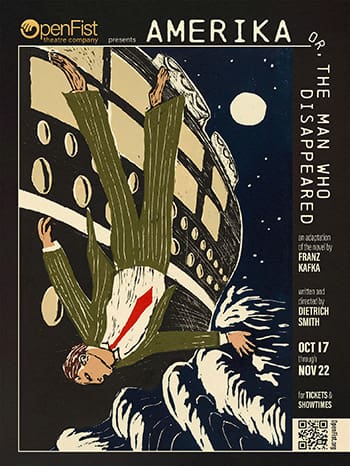
[Art Note: A perfect choice for the show art, the poster is a print from a woodcut by Richard Bosman, part of The Met Collection and used with permission of the artist. The Met states about Man Overboard, “Bosman’s representation of a man falling headfirst into moonlit waters from the side of an ocean liner recalls a still from a motion picture or a panel of a comic book. He wears a suit and tie but is barefoot. We can only guess at the story. With expressionist cuts to the woodblock in this ambitious eight-color print, the artist depicted a moment in an unknown narrative somewhere between beginning and end.”]
✦ ✦ ✦ ✦ ✦ ✦ ✦ ✦ ✦ ✦
photos by Keats Elliott
Amerika or, The Man Who Disappeared
Open Fist Theatre Company
Atwater Village Theatre, 3269 Casitas Ave. in Atwater Village
Fri at 7:30; Sat at 7; Sun at 2
ends on May 3, 2026
for tickets ($26–$45), call 323.882.6912 or visit Open Fist or Circle X Theatre
for more shows, visit Theatre in LA
✦ ✦ ✦ ✦ ✦ ✦ ✦ ✦ ✦ ✦
