


Areas We Cover
Categories

Theater Review: SPACEBRIDGE (ArtsEmerson)

by Lynne Weiss | November 22, 2025
in Boston, Theater
A BRIDGE TO UNDERSTANDING
There may have been, at some point in human history, an evolutionary advantage to sorting other people into “us” and “them.” But with modern weapons technology, whatever benefit that old reflex once offered has long vanished. Since the development of nuclear arms, in fact, that instinct to classify entire groups as enemies poses a real threat not only to specific populations, but to humanity as a whole—and it’s the danger SpaceBridge confronts head-on.
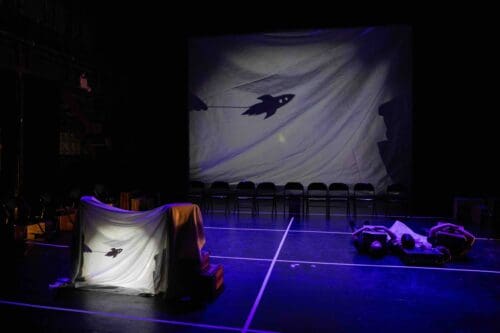
During the Cold War, the arms race between the United States and what was then the Soviet Union embodies that threat. Today, it has not diminished, and more nations possess weapons of mass destruction. It is more important than ever, for the sake of our own survival, that we develop the ability to recognize the humanity of others. Now playing through Sunday at ArtsEmerson, SpaceBridge is an innovative and moving piece of documentary theater that offers a bridge, so to speak, toward achieving that goal.
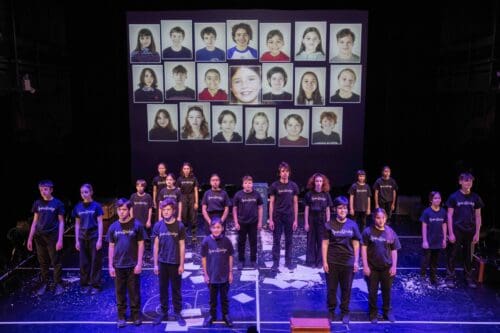
The show features eleven Russian adolescents whose families are seeking asylum in the United States because one or more of their parents oppose Russia’s attack on Ukraine. Ellen Lauren plays Samantha Smith, the American schoolgirl who wrote a famous letter to Soviet leader Yuri Andropov urging him to work with President Ronald Reagan to avert nuclear war—a gesture that led to an invitation for Smith and her parents to visit the Soviet Union. Smith’s life is tragically cut short in a small-engine plane crash in 1985, when she is just 13, but creator and director Irina Kruzhilina has resurrected Smith as a 53-year-old adult, returning to consider what her youthful plea for peace means to a new generation.
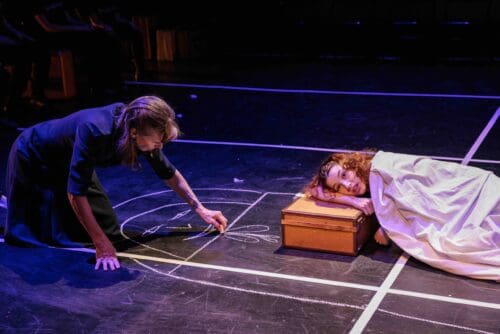
Lauren’s portrayal of this imagined adult Smith feels slightly off; she comes across more like a kindergarten teacher than someone engaging with intelligent and insightful adolescents. No matter—the kids and their stories of traveling to the United States by way of Istanbul, Mexico City, and Tijuana, where they jump on their phones at 9 a.m. each day to secure the limited digital entry forms that allow them to cross the border legally, provide the most compelling part of the story.
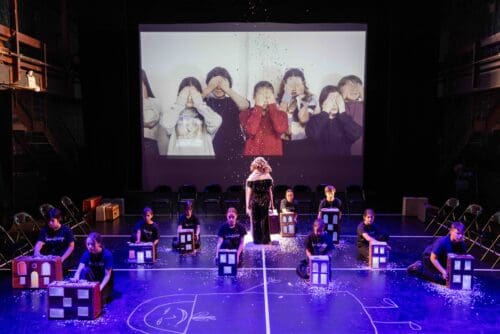
Many of the teenagers leave Russia with only two hours’ notice—or learn they are leaving only once they are in a taxi on the way to the airport. Many still have a parent—not to mention friends, grandparents, and other relatives—back in Russia. They know they may never see these people again.
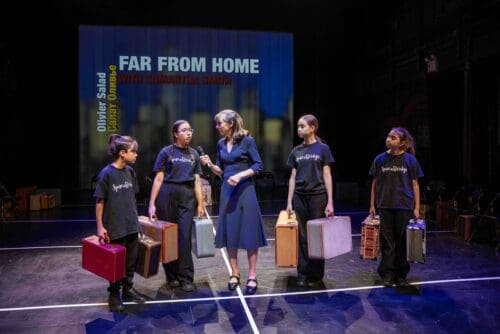
Once in the U.S., however, they face new obstacles—including suspicion and hostility based on assumptions that they are spies or emissaries of Vladimir Putin, despite the fact that they are here because of their opposition to him. Most end up in shelters of varying quality. The group we meet in SpaceBridge lives in New York City shelters; they are eventually joined onstage by a group of New York adolescents who overcome widely held prejudices to befriend these refugees.
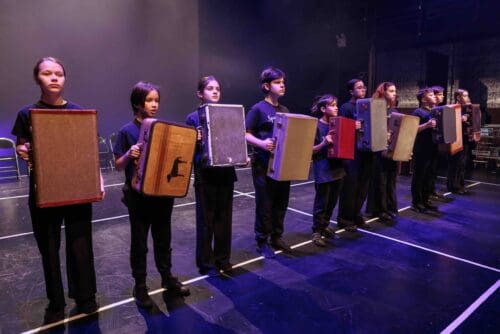
The stories of the present-day refugees are compelling enough to create an informative and absorbing evening of documentary theater. The addition of Samantha Smith provides an extra layer of poignancy—she illustrates the ways in which young people work for peace in the past as well as in the present.
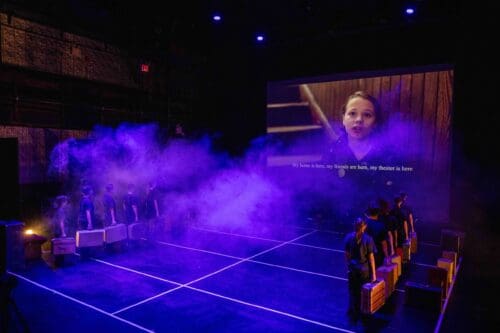
Less successful are some of the other stories that are alluded to but not fully explained. The title of the show, SpaceBridge, is unnecessarily obscure: it refers to a little-known series of experimental satellite video links between U.S. and Soviet citizens in the early 1980s. But our young refugees and their parents are not filling the same role as those initiatives. They are not acting as citizen diplomats; they are people fleeing political oppression to a nation that currently has little toleration or sympathy for immigrants. They are simply courageous human beings in need of protection, material support, and ultimately, friendship and all that implies.
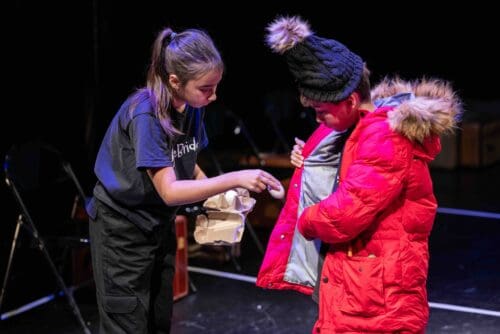
Despite the obstacles, the refugees hold on to hope for their own future as well as for that of the rest of the world. Their determination to stay optimistic in the face of all they have endured—and all they continue to face—is what makes SpaceBridge not only informative but deeply inspiring for those of us who enjoy a more settled existence.
✦ ✦ ✦ ✦ ✦ ✦ ✦ ✦ ✦ ✦
photos by Walter Wlodarczyk
SpaceBridge
La MaMa ETC in association with En Garde Arts and Visual Echo,
originally presented at Under the Radar Festival in NYC.
Emerson Paramount Center
Robert J. Orchard Stage, 559 Washington Street in Boston
95 minutes, no intermission (ages 12+ recommended)
ends on November 23, 2025
for tickets, visit Emerson
for more shows, visit Theatre in Boston
✦ ✦ ✦ ✦ ✦ ✦ ✦ ✦ ✦ ✦
Lynne Weiss is a member of the Boston Theater Critics Association. Her work has also appeared in Literary Ladies Guide and in The Common, Black Warrior Review, and the Ploughshares Blog. She has an MFA from UMass Amherst and has received residencies from Yaddo, the Millay Colony, and Vermont Studio Center and grants from the Massachusetts Cultural Council. A lifelong social justice activist, she is at work on a novel set in 1930s Cornwall. Her reviews, travel tales, and progressively optimistic opinions are on her substack.
