


Areas We Cover
Categories

Opera Review: ALICE RYLEY & BIG DEATHS (Source/Filter Music Collective at Heritage Square)

by Nick McCall | January 10, 2026
in Los Angeles, Theater
OPERA AMONG THE GHOSTS
From playful parlor deaths to a chilling one-act
about crime, punishment, and memory, Source/Filter
Music Collective made Heritage Square sing.
On November 8, Source/Filter Music Collective returned to Heritage Square Museum with the west coast premiere of Michael Ching’s 2015 true-crime opera Alice Ryley, about the first woman executed in Georgia.
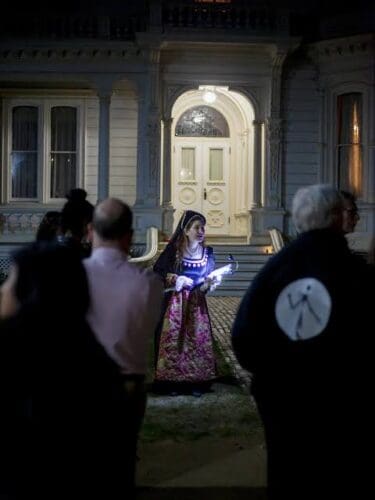
But first was Big Deaths, a program of opera selections staged inside the mansions of Heritage Square. As told by our cheeky tour guides, the museum used to host many opera productions. Today, ghosts from the operas noisily haunt the grounds, continually re-enacting their deaths (and keeping movie productions away).
We then saw a random selection of three death scenes along two simultaneous tracks for two rounds, some performed with light humor, others done completely straight. I was able to catch four of them (out of eight total).
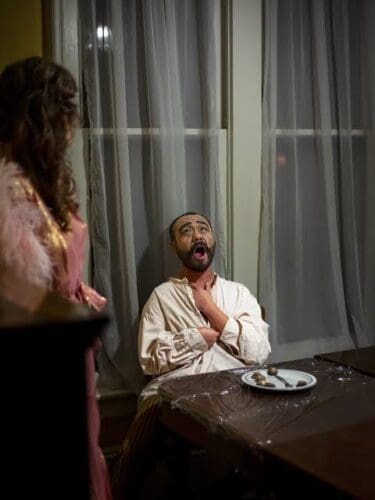
I started with Shostakovich’s Lady Macbeth of the Mtsensk District, here staged in a kitchen, where Katerina gleefully poisons the cruel Boris with rat poison.
The haunting finale from Britten’s The Turn of the Screw surprised me when Peter Quint showed up dressed as a horned devil; I was not expecting to see such elaborate costuming and makeup for such a bare-bones staging.
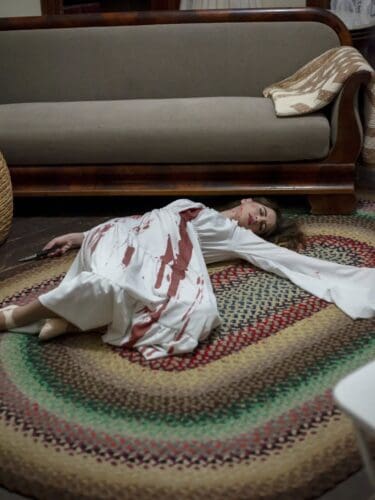
Next came the mad scene from Donizetti’s Lucia di Lammermoor. As we entered the tiny room, Lucia was already bloody and dead on the ground, and we had to be careful not to trip over her. Stunningly intimate, we got the full-blast aria with her just inches away. For a delightfully silly touch capping it off, once Lucia was dead for good, she came back to life solely to absorb the applause—and then plopped back on the ground.
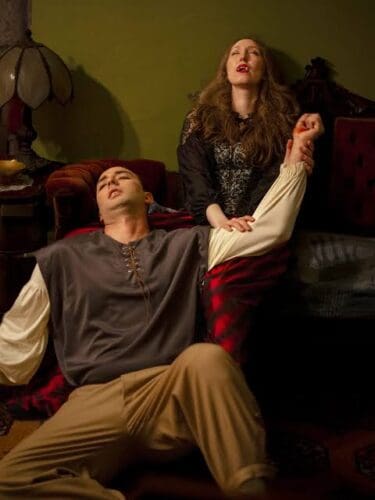
The entire final scene from Bizet’s Carmen concluded the program. We all know this scene: it’s Carmen and Don José going at it again. I was expecting to see just the two of them perform, but this living-room staging included an amazing “off-stage” chorus. Another twist—Carmen kills José. In a full production, a directorial defacement like this would irritate me, but in the context of these informal parlor performances, it worked, and I really liked it. (Frankly, it was also nice to see Carmen live, for once.)
What I liked most about Big Deaths, however, was that—except for Lucia—the selections were performed in English. The audience connected with them because of it (at least those who weren’t absorbed in recording with their phones). When it was over and we all were walking to the church for the main performance, people around me were commenting on how much they liked being able to understand the words.
Alice Ryley took place in the church. This one-act opera is about Irish immigrant Alice Ryley (or “Riley”), who came to the Georgia colony to be an indentured servant either in late December 1733 or early the following January. Several months later, she, along with fellow servant Richard White, was convicted of murdering their master, William Wise, committing Georgia’s first murder. Her story gained notoriety when she turned out to be pregnant, giving birth in prison. Barely a year after arriving in the colonies, she was executed.
Almost nothing is known about the historical figures. Composer-librettist Michael Ching used the scaffolding to tell an archetypal immigrant story (hopes and dreams, etc.). Nothing groundbreaking, but the characters are engaging, the music lovely, and the time-jumping format interesting. The story alternates between Alice in prison and pre-murder Alice. Sets weren’t much to look at, with the church doing most of the visual heavy lifting. Making up for this was the excellent cast, large eight-member chorus, and music direction by Milena Gligic and conductor Caleb Yanez Glickman, which is what really counts. Salette Corpuz’s costumes were period-appropriate, but a few actors needed to remove their nose piercings. Director Britta Sterling made full use of the church and staged the exciting climax in a blackout, which I greatly appreciated. The modern-day prologue was cut, perhaps wisely. It’s very different from the opera proper and would have clashed with the spooky ambience everyone was creating.
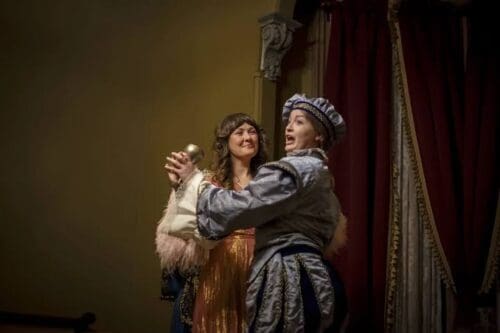
Notable members of the cast included Emily Gallagher as Alice and Christine Li as Jailed Alice. However, less than a year separates the two Alices, and the two actresses looked nothing alike. Had director Sterling not told us about the dual-Alice conceit in her introduction, I might not have made the connection until the opera was nearly over – a fundamental problem with the production, but one that offers many creative solutions. Source/Filter’s executive director, Rae Shrum, played Mary, Alice’s compassionate jailer and eventual midwife. Adrian Melendrez played Alice’s dreamy love interest and accomplice, Richard White, and Kirk Garner played their abusive master, William Wise. These two impressed me by being the only cast members to put on accents, Irish and Southern, respectively. How often do you see intentional accents in opera?
At about an hour, Alice Ryley is a beautiful, tight little opera that packs a punch. While the big opera companies are trying to convince us that their new unmusical sound art is good, I’m grateful that small companies like Source/Filter can find little gems that are enjoyable. It’s to our area’s discredit that it took ten years for Alice Ryley to reach Los Angeles.
✦ ✦ ✦ ✦ ✦ ✦ ✦ ✦ ✦ ✦
photos courtesy Source/Filter
Alice Ryley & Big Deaths
Source/Filter Music Collective
Heritage Square Museum — The Church
3800 Homer Street in Los Angeles
played November 7–9, 2025
for more info, visit Source/Filter Music
for more shows, visit Theatre in LA
✦ ✦ ✦ ✦ ✦ ✦ ✦ ✦ ✦ ✦
