


Areas We Cover
Categories

Theater Interview: RICHARD CHANG (张德胜) (Playwright and Performer of “Ai Yah Goy Vey!”)
by Caroline Cao | March 23, 2026
in Interviews, New York, Theater
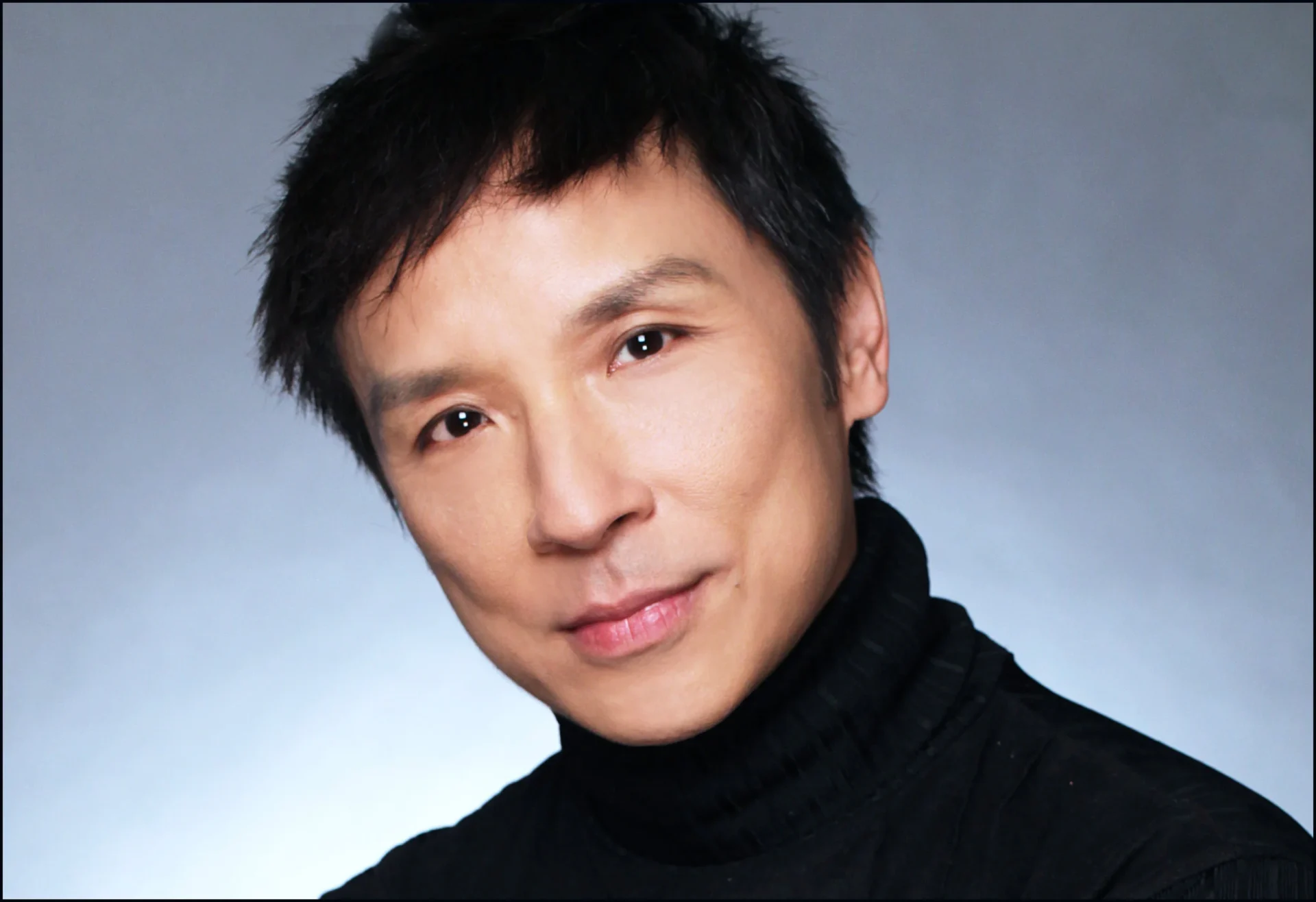
Playwright-Performer Richard Chang
Turns Reductionism Into Multiculturalism
Years ago, while riding the subway, playwright Richard Chang witnessed passengers snickering at a Chinese battery seller advertising his wares in a thick Cantonese accent. Raised in the melting pot of Malaysia, Chang considered how the American landscape reduced a marginalized stranger into a laughable spectacle. It was this incident that inspired the role of Sun Jik Ke, aka Jackie Sun, the main character in Chang’s solo play, Ai Yah Goy Vey! Adventures of a Dim Son in Search of His Wanton Father presented by Pan Asian Repertory Theatre at the A.R.T./New York Mezzanine Theatre, where it closed March 1.
At first glance, Chang’s absurdist premise seemed uncomfortably counterintuitive, presenting Sun, his Chinese mother, and New Yorkers within racial stereotypes. But through his raunchy reductionism, Chang makes a subversive bid for multicultural harmony.

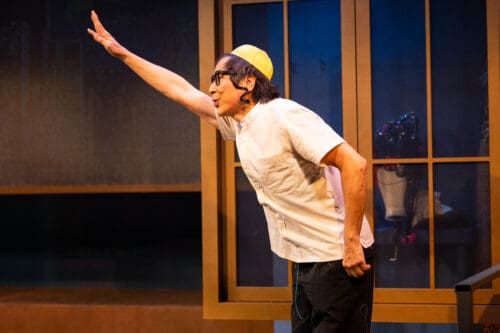
Directed by Laura Josepher, the play follows Sun’s quest from China’s Changdao county to New York City in search of his long-lost father. With a cartoonish air, Sun’s commentary is peppered with linguistic puns and song-and-dance numbers featuring Peking opera, rap, and reworked showtunes like “If I Were A Rich Man” from Fiddler on the Roof. In a series of convolutions, he at first pictures his “Papa” as fully Chinese, but his father’s alleged tape recordings and yarmulkes (which he thinks are frisbees) says otherwise. Then narrative turns possibly point to a traveling Jewish American comedian–a fictionalized Jackie Mason–as his father.
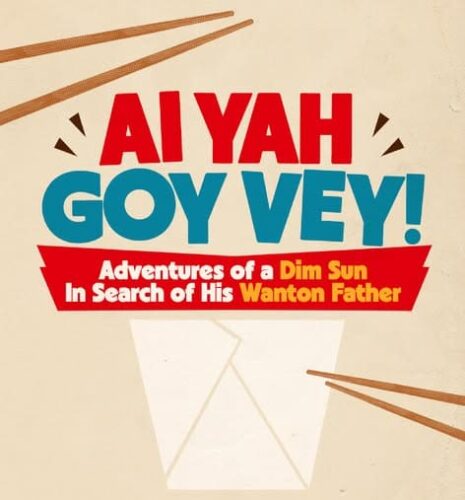
Sun also conflates the recordings’ Yiddish with Chinese, and these trips of language and translation form the play’s thematic throughline. The title itself, Ai Yah Goy Vey!, points to the identical meanings between the Chinese exclamation, “Ai Yah,” and the Yiddish “Oy vey.” In one scene, a projected text juxtaposes the English translations of “Gui” and “Goy” on a classroom chalkboard (scenic design by Sheryl Liu). As Sun explains, “Gui” in Cantonese means “not Chinese” and its pronunciation happens to resemble “goy,” a Yiddish term for a gentile or non-Jewish person. In another instance, Sun mistakes a New York “fuck you” for a good luck greeting, hearing it as the Cantonese “fook.” These errors encourage audience laughter, but by the time he sincerely tells the audience, “fook you,” to wish them good luck, Sun is reframing his silly obliviousness into a positive, and still humorous, exchange.

Mileage would vary with Chang stereotyping of the play’s other characters (costumes by Karen Boyer; headwear by Chang). These supporting players include a Black Harlem singer named LaKeisha ShaNaeNae DeVine (their encounter spurred by Jackie assuming the Wu-Tang Clan is a Harlem-based Chinese organization); an Irish Catholic priest swigging from his whiskey flask; an Egyptian cafe owner who “enters like an Egyptian” profile as the script calls for; the cafe owner’s religiously Muslim father, characterized as a flat shadow puppet; an exoticized Russian-Kyrgyzstan ballet dancer who adopted bellydancing in Egypt; the aforementioned Borscht Belt comedian Mason; and a long-bearded reb of China’s Kaifen Jewish community. To a postmodern extent, many of the stereotypically-amalgamated attributes point to Western-bred reductionism, orientalism included, inflicted on each respective community member. Furthermore, these portrayals are grounded in Sun’s headspace, an inquisitive gaze of an immigrant then-uninformed to unpack the politicized contexts embodied by each New Yorker.
And yet, Chang’s play insists that exaggeration, what society tends to deem “racial,” can be characterological, perhaps potentially fitting in a manner like Peking opera. Putting to use his Peking opera training under the Lincoln Center’s Peony Pavilion veteran Wen Yu Hang, his performance as Sun’s overdramatic Peking opera mother ends up as the production’s most revealing commentary about stereotypes merging into identity. During her Peking-inspired chore dance, Sun’s mother produces a pink apron printed with Hello Kitty, a Japanese icon. On one level, this getup satirizes the absurdity of reducing a Chinese individual into interchangeable Pan-Asian amalgamations. And yet, she confidently wears this icon as a complement to her hyperfemininity as a Peking opera performer. Society might impose an incongruous cultural marker on her, so she absorbs it into her identity and self-expression.
The play’s comedy fantasizes a level playing field where laughing at oneself and others can disarm the negativity against those who fit a stereotypical box, break down barriers, and open exchanges between diverse cultures without appropriation. Sun marvels that his encounters with diverse New Yorkers reveal commonalities and connections with his Chinese background, oftentimes bluntly and affectionately nodding at overlaps (whether coincidental or acquired) between Chinese and Jewish cultures. The play advocates for “mix-and-match” multiculturalism, like the Wu-Tang Clan adopting a Chinese-inspired name or wontons resembling kreplach. The title treats “Ai Yah” and “Oy Vey” as a handshake of unity and one-ness. I spoke to Chang to discuss the Malaysian upbringing that inspired his play and his conviction that being outwardly “racial” is subversive.
This interview has been edited for clarity and length.
Caroline Cao: Your 2022 play, Citizen Wong, a play about Chinese American activist Wong Chin Foo, felt very informed by that background. How has your journalism career helped you as a playwright?
Richard Chang: For me, research is very important because I want to be true to the material and not just make things up like in Hong Kong films where they just burst out into Kung Fu for no reason. With Ai Yah Goy Vey!, I wanted it to be grounded in truth. How do I show that in an entertaining way? Many of the portrayals—a Jewish community in China and Russian ballet dancers performing bellydancing in the Middle East—in Ai Yah Goy Vey! are based on truth.
I actually discovered the story of Wong Chin Foo after I wrote Ai Yah Goy Vey!. I thought Wong Chin Foo is just too important for me to not tell his story first. Everybody needs to know that he existed. And I thought that if people can see this romantic Asian leading man in a Victorian period drama, that would just shatter stereotypes and take away any excuses producers have for not casting Asians in leading roles. It would be very validating for minorities to just see somebody like them up there. So I felt a huge responsibility to be as accurate as possible, especially with Citizen Wong. Ai Yah Goy Vey! is more fun because it’s a cartoon. There have been films produced by white people who just think something sounds funny with Asians, but it’s not grounded in reality. With Ai Yah Goy Vey!, Jackie speaks with a very strong Cantonese accent. But that is true because it’s a genuine accent. I’m not just a white guy making it up to somebody. It was based on a real person. There was a guy selling batteries in the subway who would come in and say, “Battely, battely, wan dallah” [as written in Chang’s script]. People would just snicker. I just wonder, “If he only knew what people thought of him.”
CC: So he was the template for Jackie Sun.
RC: He was part of the idea. And then [Jackie’s] Jewish mother, I wasn’t quite sure how to portray her. How do you show a “Jewish mother” who’s also “Chinese”? Then I thought of Kuang-Yu Fong. She’s from Taiwan and obsessed with Chinese opera. Kuang-Yu is connected with everybody in the Chinese opera world and the puppetry world through her husband as well. Her husband [puppeteer Stephen Kaplin] is Jewish, so they’re a “Goy Vey” couple. He is one of the top puppet masters in the country. He made the shadow puppets in The Lion King, and he’s how I got the Ali Baba shadow puppet [in the Ai Yah Goy Vey!].
I never thought that I would ever be a playwright. I thought it would be too difficult. I thought I would never do stand-up comedy. But I was in the Pan Asian Repertory acting workshop taught by Ernest Abuba, to whom this show is dedicated to. I thought, “Oh God, the only thing I have is an idea for a practical joke,” to pretend to sell batteries in the subway and then suddenly speak like Jackie Mason and shock everybody and basically tell them, “Don’t assume from how people look and speak that you know their backgrounds.” That was my challenge to make a joke really deep, meaningful, and epic. That’s how this show came about.

CC: Sheryl Liu’s set design resembles a colorful classroom for learning language. This adult show has a strange air of innocence in an educational environment.
RC: It has a lot to do with childhood innocence, silliness, and imagination. I want to share these with the audience, so that they shed their grown-up hang-ups about everybody. That’s my game plan: to show them [stereotypical] imagery that people typically will have an opinion about and then shatter that. We cannot claim the food that we eat exclusively in our culture. Wonton is not just Chinese; it’s also Jewish, Polish, and Italian.
CC: Talk about the Peking opera in the show.
RC: Mama’s first song is “Mai Shui.” Chinese opera divas use extreme drama and the water sleeves. I actually wanted this production to have the costume first appear as a curtain, hanging on a rod, and then I wear it. It’s like Carol Burnett and Scarlett O’Hara in Gone with the Wind. I’m making fun of Chinese opera with a great fondness for the art. I’m not just borrowing it for sensational effect for a white audience. For the mother’s “Battle Scene” dance, I asked Chinese opera performers, “What can I do to make it bigger and more funny?” Someone suggested a ribbon dance, so I made these double-headed snake-head puppets [referring to a running gag where Mama lambasts her long lost lover]. A Peking opera performer told me that the final weapon should be the biggest one. At first, I had wok ladles. Then I thought, “What’s bigger? Oh, lightsabers.” Laura, my director, said, “I’m okay with it, as long as they look like cleaning stuff.” I went to the discount store and made it into a Project Runway challenge. For the crown, I got these scrubbers and a visor and I put them together.

CC: Stereotypes are scrambled throughout. I say deliberately playing stereotypes to make a point is risky. Was there a certain reluctance to pull this off?
RC: I personally just had fun with it. I think the caution was coming from Tisa [Chang, Founding Artistic Director of Pan Asian Repertory Theatre]. Originally, I had LaKeisha say snapbacks like, “Your mama’s so ugly, your mama’s so big.” I had Jackie take them literally.
The director thought, “Let’s leave that out” [and it’s not in the final draft of the play]. But I felt I go into other cultures to find what’s funny to them and have Jackie react to it in his own way. I feel, frankly, a lot of what people find offensive is not because the group involved finds it offensive. The people from outside the group think that we should not joke about it because they don’t really know that culture. White people think, “We shouldn’t make fun of Chinese people speaking like that.” But I’m a Chinese speaking like Jackie Sun in an authentically Cantonese way. So do you want to criticize me for speaking with an authentic, heavy Cantonese accent? But I’m making fun of everybody with goodwill, with a lot of love. I think that’s the difference between being offensive and embracing everybody’s culture.
CC: A message of this show is that multiculturalism comes from the osmosis of language. Even mistranslations make way for a new meaning, or they’re merging into others.
RC: I grew up in a very multicultural society where it’s not unusual for people to use two or three languages in one sentence because there are concepts easier to express in a certain language. We do that in America without being conscious of it. New York is very much multicultural, but in Malaysia, we celebrate everybody’s festivals: Chinese New Year, Malay New Year, Indian New Year, Thaipusam, and Wesak Day.
On those national public holidays, we visit each other’s homes. In America, we tend to have a generic whiteness we’re supposed to meld into. Where I grew up, we were not expected to do that as much. I went to an Irish Catholic school, and we would make racial jokes at each other without taking offense. “Racial” is different from “racist.” I think people need to understand that difference. That’s what I’m showing: Racial is not racist. Racial is just who we are. We are a multi-racial society, so let’s embrace every race and all the quirkiness of that.

CC: What reactions have you seen from the Asian American community and other communities lampooned in the show?
RC: Whoever has given me any feedback has been very positive. A couple of people told me they laughed until they cried. I do want to make people laugh and cry because that is a way of clearing hang-ups. I think we grow up with so many hang-ups, not necessarily our own, transmitted through the mass consciousness. I just went through this childish innocence. When we were kids, we didn’t have these hang-ups. We just took people for who they are.
CC: Not everybody’s on equal footing. There’s always a different context to why a group is treated the way they are.
RC: Exactly.
CC: The cafe scene brings up 9/11 and how stereotypes change due to world events.
RC: For the show, I thought of an Egyptian man being a racial profile, literally flat [a shadow puppet in the show]. Jeannie, Ali’s Russian-Kyrgyzstan wife, is named after a popular 1960s American show, I Dream of Jeannie. At the time, people didn’t think of Jeannie being Arab. She was blonde and blue-eyed. There was Jeannie, magic, and the magic carpet. But after 9/11, the stereotypes changed overnight. That’s why the father is a shadow puppet. We just see them as two-dimensional since 9/11, but they’re so much more than that. Through the humor, I want to show that these are real people.
CC: So about the battery-seller in the subway, what do you imagine his thoughts would be if he ever saw the show?
RC: I don’t know if he knew much English. He’s a very earnest person. I’m sure everyday he goes in the subway to do the same thing–with the same determination Jackie had to find his father. He’s just trying to make money. I hope he would have found the show entertaining.
✦ ✦ ✦ ✦ ✦ ✦ ✦ ✦ ✦ ✦
