


Areas We Cover
Categories

Off-Broadway Review: PUBLIC CHARGE (The Public)
by Gregory Fletcher | March 25, 2026
in New York, Theater
FROM SANTO DOMINGO
TO STATE DEPARTMENT
An ambitious portrait of Julissa Reynoso’s rise spans continents,
though its cool staging keeps emotion at a distance
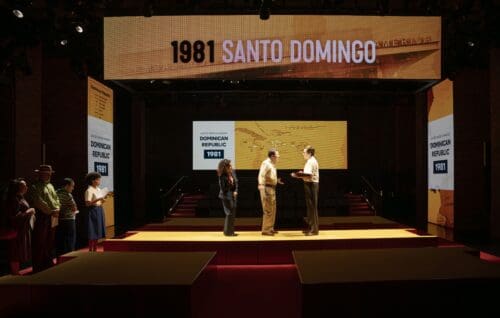
Zabryna Guevara, Al Rodrigo, and John J. Concado
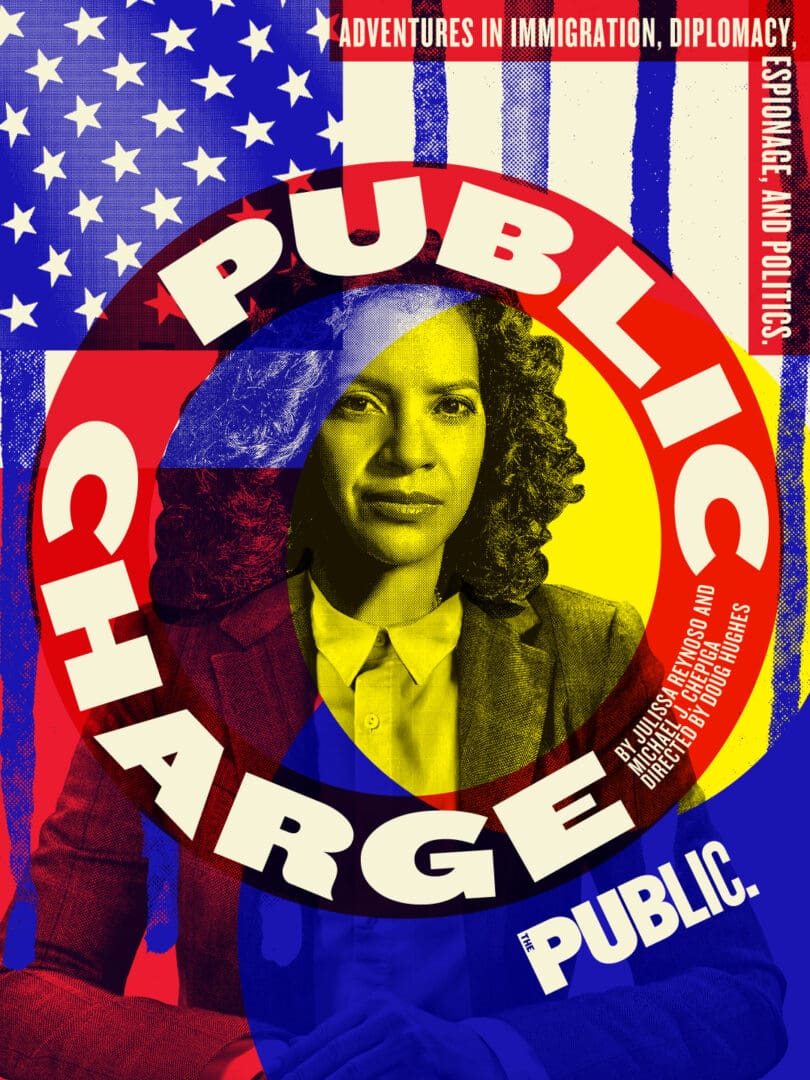
At The Public Theater, the world premiere of Public Charge arrives with the weight of history and the urgency of lived experience. Inspired by the real-life journey of former U.S. Ambassador Julissa Reynoso, this smart political drama traces an expansive arc—from immigration to the upper echelons of American diplomacy—while asking whether government, at its best, can still function as a force for good in an often chaotic world.
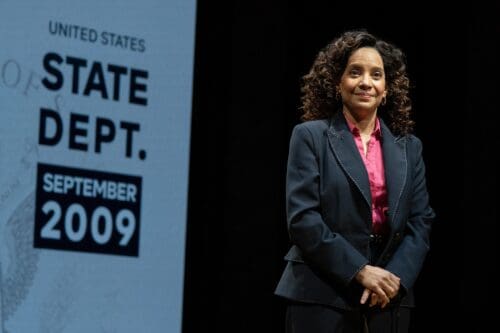
Zabryna Guevara
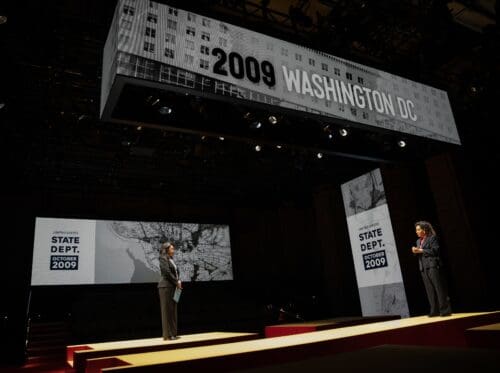
Marinda Anderson and Zabryna Guevara
Written by Reynoso with Michael J. Chepiga, and directed by Doug Hughes, the play runs approximately 100 minutes and unfolds across 34 brisk scenes set mostly between 2009 and 2014. We first meet Julissa as a young girl in 1981 Santo Domingo, dreaming of joining her mother in the Bronx. From there, the play leaps forward to a final job interview overseeing Caribbean and Central American Affairs under Secretary of State Hillary Clinton—referred to simply as “she.” The narrative spans continents—Haiti, Uruguay, Cuba, and Washington, D.C.—touching on humanitarian crises, immigration policy, espionage, and delicate diplomatic negotiations. A central thread involves negotiations with Cuba to secure the release of imprisoned American Alan Gross.
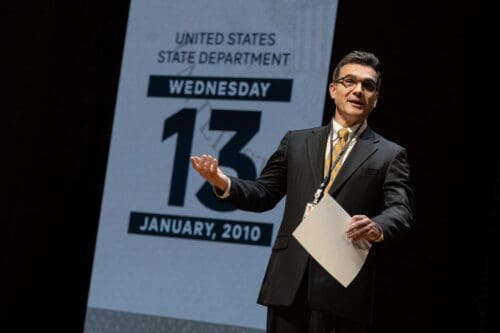
Dan Domingues
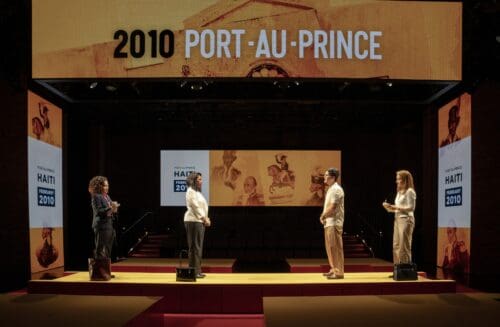
Zabryna Guevara, Marinda Anderson, Armando Riesco, and Maggie Bofill
The sheer scope of Reynoso’s experiences provides fertile ground for drama, and the play clearly respects both its subject and the complexity of the global stage she inhabits—an undeniably ambitious undertaking. At its core, Public Charge champions a distinctly American ideal: that a government composed of immigrants will aspire toward moral purpose, even when the machinery of policy feels impersonal or opaque.
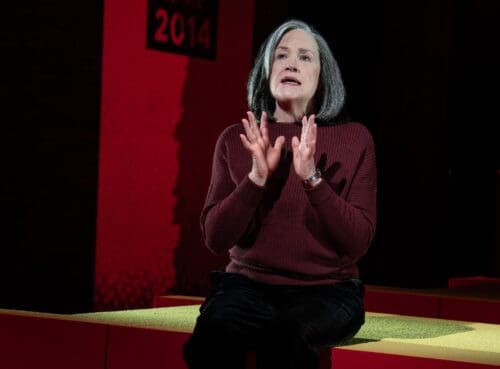
Deirdre Madigan
The staging leans heavily into that impersonality. Hughes keeps the production moving efficiently, but largely as a traffic controller, guiding actors from one of Arnulfo Maldonado’s six platforms to another. Scenes frequently consist of phone calls in which characters speak outward rather than to one another, creating a deliberate sense of emotional distance. While the pace is undeniably swift, the visual repetition—actors stepping on and off identical platforms—can become monotonous. The world remains curiously abstract, with Lucy Mackinnon’s video design doing most of the work to establish time and place.
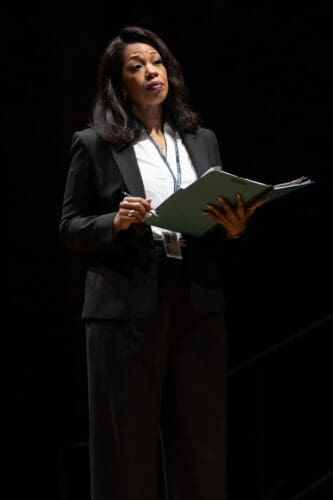
Marinda Anderson
This aesthetic coolness extends to the play’s depiction of the State Department itself: a realm of intellect, strategy, and constant motion, but one in which warmth and human connection are often in short supply. Realistic or not, the result is a production that feels more procedural than visceral—more informative than immersive.
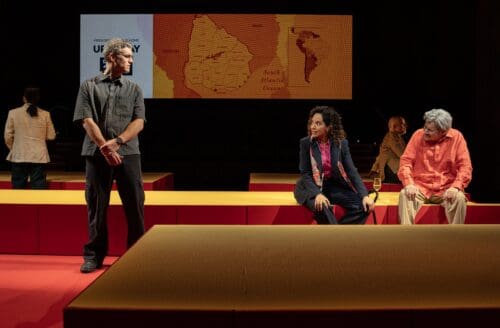
Armando Riesco, Zabryna Guevara, and Al Rodrigo
Still, the cast works tirelessly to animate the material. Zabryna Guevara, who bears a striking resemblance to Reynoso, is onstage throughout, delivering a performance of remarkable stamina and focus. She navigates the play’s rapid transitions and dense dialogue with clarity and commitment, anchoring the production even when the staging offers little support.
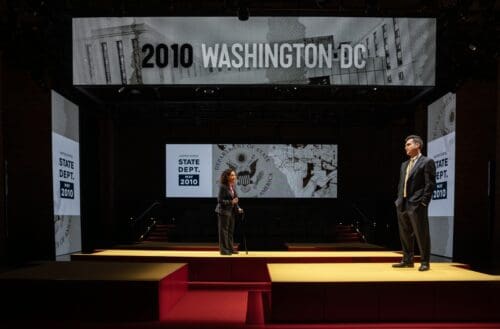
Zabryna Guevara and Dan Domingues
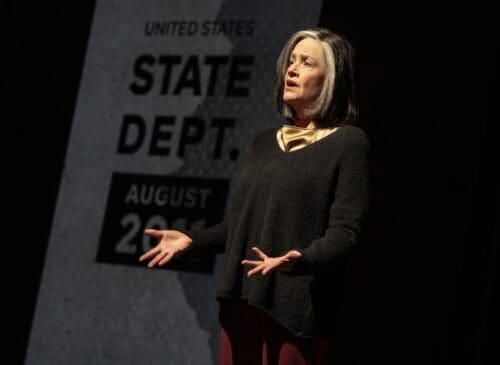
Deirdre Madigan
Among the supporting players, Marinda Anderson brings wry precision to Cheryl Mills (memorably punctuating conversations with a well-timed demand: “pause”). Dan Domingues stands out as a hard-edged Ricardo Zuniga who clearly knows how to play the game. Deirdre Madigan lends emotional weight as Judy Gross. The ensemble—Nate Betancourt, Maggie Bofill, John J. Concado, Yesenia Iglesias, Paco Lozano, Nairoby Otero, Armando Riesco, and Al Rodrigo—handles multiple roles with admirable fluidity. Particularly noteworthy is the dialect work by Rosie Berrido, which lends authenticity and specificity to the many international voices heard throughout the evening.
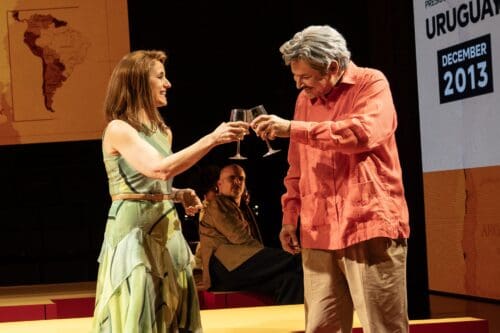
Maggie Bofill and Al Rodrigo
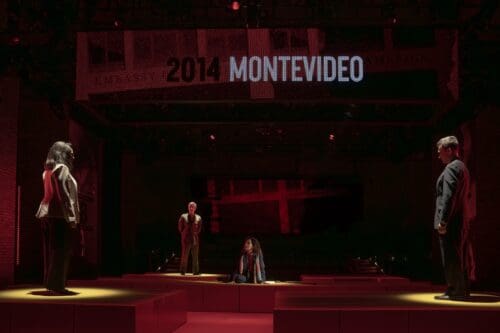
Marinda Anderson, Armando Riesco, Zabryna Guevara, and Dan Domingues
Public Charge is clearly a well-intentioned piece, one that honors both its subject and the ideals she represents. While the production’s cool, methodical staging keeps the audience at arm’s length, the story it tells—of an immigrant who rises to shape global policy—remains a compelling and distinctly American narrative, even when the drama itself struggles to fully ignite. The final note lands with a bittersweet irony, as optimism about leadership collides with the audience’s awareness of how history ultimately unfolded.
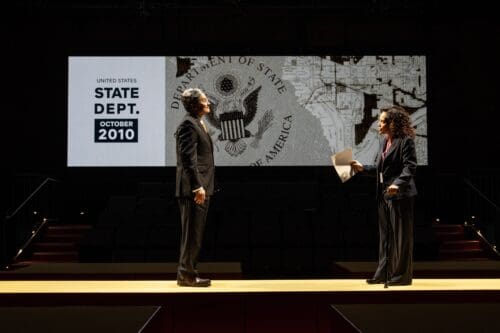
Al Rodrigo and Zabryna Gu evara
✦ ✦ ✦ ✦ ✦ ✦ ✦ ✦ ✦ ✦
photos by Joan Marcus
Public Charge
The Public Theater, Newman Theater
425 Lafayette St., New York
Tues–Sun at 7; Sat & Sun at 1
ends on April 12, 2026
for tickets, call 212.967.7555 or visit The Public
✦ ✦ ✦ ✦ ✦ ✦ ✦ ✦ ✦ ✦
Gregory Fletcher is an author, theater professor, playwright, director, and stage manager. His publishing credits include a craft book on playwriting entitled Shorts and Briefs, as well as a collection entitled A Playwright’s Dozen: 13 short plays. Other publishing includes two YA novels (Other People’s Crazy, and Other People’s Drama), 2 novellas in the series Inclusive Bedtime Stories, 2 short stories in The Night Bazaar series, and five essays. Website, Facebook, Instagram.
