


Areas We Cover
Categories hhhh

Theater Review: WHAT THE CONSTITUTION MEANS TO ME (Greater Boston Stage Company)

by Lynne Weiss | April 14, 2026
in Boston, Theater
A GREAT DEBATE
A play that asks the audience to think
about what the Constitution means to them

Janis Hudson
When she was 15, Heidi Schreck went on tour to compete for college scholarships by delivering a talk called What the Constitution Means to Me to American Legion posts. Her talk was successful enough to pay her way through college, and decades later, in 2019, she took a play by that name to Broadway. That production did more than pay tuition—it was nominated for a Tony in the Best Play category and was a Pulitzer finalist as well.
The Greater Boston Stage Company version, directed by A. Nora Long, is well worth seeing. It’s a 90-minute, informative, thought-provoking, and gripping spin through the rarely discussed weaknesses of the Constitution that leads us to reconsider the foundations of U.S. government. Schreck points out not just the absence of women in creating the Constitution; she also reminds us that for most of U.S. history, women had no role in its execution and interpretation (Sandra Day O’Connor became the first woman on the U.S. Supreme Court in 1981).
Although Schreck herself was the original lead, subsequent productions have featured other performers in the role. Janis Hudson, likeable and unpretentious, yet utterly convincing as the play’s author, plays Schreck in the Greater Boston Stage Company’s production, stepping in and out of Schreck’s 15-year-old and adult self, thanks to changes in lighting (Matthew Brian Cost) that signal these transitions. Similar lighting shifts cue transitions between the teenage Schreck’s formal presentation before the Legionnaires and her internal monologues.
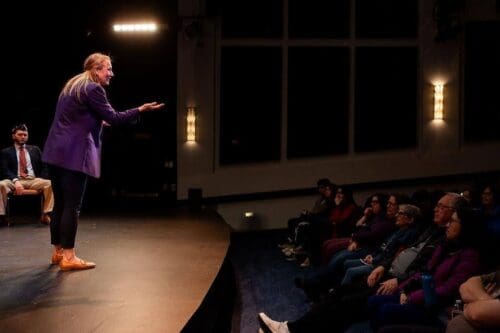
Janis Hudson
In one of the most harrowing segments of the play, Schreck discusses the Castle Rock case, a tragic event in which the police of Castle Rock, Colorado, failed to enforce a restraining order, allowing the murder of three children. Schreck then plays a clip of the recorded Court deliberations over the meaning of the word “shall” in relation to the responsibilities of local police, illustrating the shocking lack of empathy of the male-dominated Court for either the murdered children or their mother, Jessica Gonzales. In other words, the Constitution doesn’t just ignore women; it is actually used against them.
Schreck examines her own history and that of her mother, grandmother, and great-grandmother. Her great-grandmother was brought to Washington state from Germany as a mail-order bride, even though there were many women in the area—they just didn’t happen to be white. Schreck points out that marriages between white men and Indigenous women were common prior to Washington’s statehood, but once Washington joined the United States, such marriages became illegal.

Maya Feldman, Joseph Morella, and Janis Hudson
There’s a lot of material about injustice and violence against women in the show, as well as about the treatment of people of color and immigrants, a topic that’s especially timely now. But Schreck makes it clear that she doesn’t hate men. Far from it, in fact, as she mentions her longing for and enjoyment of sex with men several times during the show.
Joseph Marrella steps out of his role as a Legionnaire to discuss some of his own childhood experiences with pressures to conform to expectations for socially defined “masculine” behavior. (It wasn’t clear whether these experiences were actually Marrella’s or part of the script—which is a tribute to both his acting and the naturalness of the play.)
The show culminates in a parliamentary-style debate between Schreck and a young debater. In the Stoneham performance I saw, that was Maya Feldman, who more than held her own in arguing in favor of abolishing the Constitution (her position determined by a coin toss) against Schreck, who urged amending it.

Janis Hudson
Frankly, it’s hard to believe that Schreck won multiple college scholarships based on the version of her 15-year-old self who claims that the Constitution is like “a witch’s cauldron.” Was there actually a time when the American Legion would have tolerated such a simile? I’m not in a position to argue. But whatever the weaknesses of teenage Schreck’s presentation, her present-day arguments regarding the Constitution’s flaws are compelling.
Schreck takes the Constitution to task for failing to consider all the American people, and while this is a play with a script and professional performers, it manages to engage audience members and invites them to see themselves as invested in the outcome. Following the debate, a member of the audience is chosen to cast a single vote regarding a decision to abolish or amend the Constitution. The representative in Stoneham, like the one who represented me when I saw the show on Broadway back in 2019, voted in favor of abolition. Just as we might disagree with the positions of our representatives in government, some in the audience may disagree with this outcome, whichever way it goes at the performance they see. But either way, they are likely to leave the experience feeling as though they have a stake in the future of their government.
✦ ✦ ✦ ✦ ✦ ✦ ✦ ✦ ✦ ✦
photos by Maggie Hall Photography
What the Constitution Means to Me
Greater Boston Stage Company
395 Main Street in Stoneham, MA
90 minutes, no intermission
ends on April 26, 2026
for tickets ($25-69), call 781-279-2200 or visit Greater Boston Stage
for more shows, visit Theatre in Boston
✦ ✦ ✦ ✦ ✦ ✦ ✦ ✦ ✦ ✦
