


Areas We Cover
Categories

Theater Commentary: THE PRICE OF NOT PERFORMING EMPATHY
by Michael M. Landman-Karny | April 24, 2026
in Extras, New York, Regional, Theater
CRITICISM VS CONFESSION
When analysis starts to look like refusal
Editor’s note: Jesse Green was reassigned from his role as chief theatre critic at The New York Times in 2025 and now serves as a culture correspondent, continuing to write about theatre alongside broader arts coverage. This commentary reflects on the larger critical and cultural shifts surrounding that change.
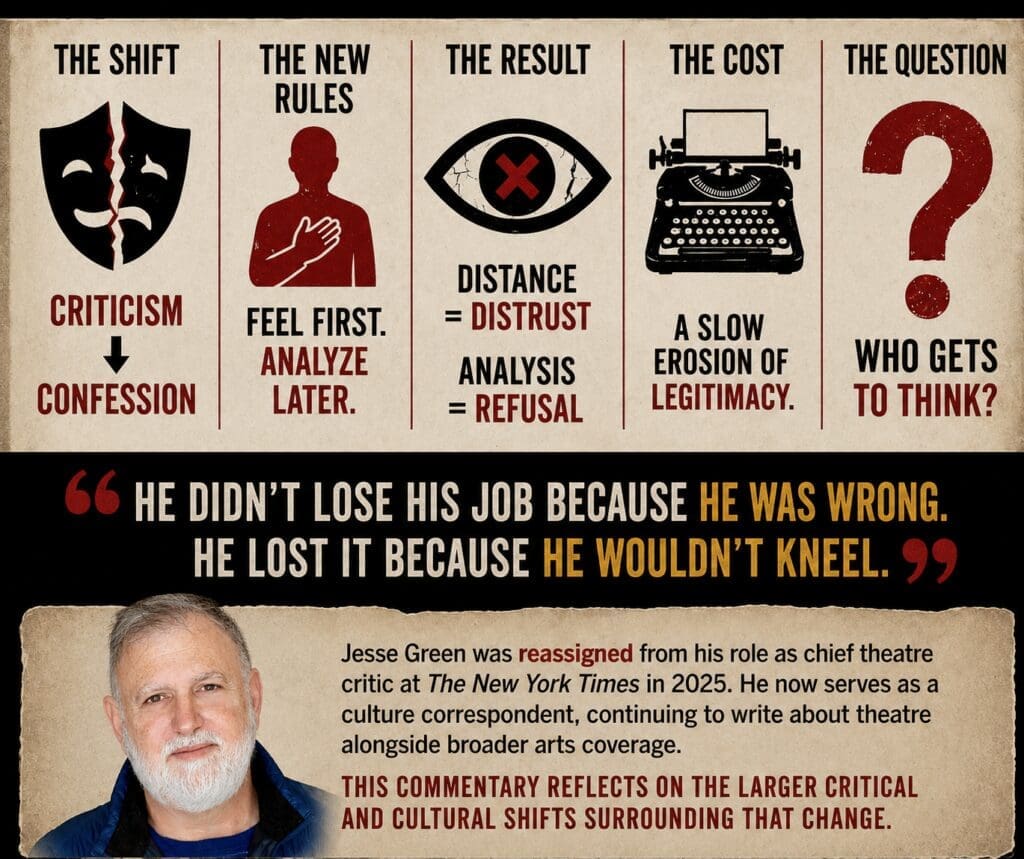
Theatre criticism used to work like this: you went, you thought, you wrote. The mechanics were so obvious they didn’t require explanation. Sometime in the last decade, the work onstage stopped asking for interpretation and started demanding testimony. Not your analysis—your position, your body, your willingness to declare allegiance.
Jesse Green got caught in this shift. He was recently reassigned from his job as chief theatre critic at The New York Times. The problem was never that he couldn’t write. His prose had actual elegance, a bone-dry wit. He knew how plays worked. He could tell when a production succeeded on its own terms and when it buckled under its ambitions. Not everyone can do this.
American theatre moved. Green didn’t. Right when the field started treating criticism as moral witness, he kept practicing it as intellectual labor. He examined structure, questioned intentions, held onto the evaluative distance that used to be called professionalism. This made him look, to some, out of step.
Four productions by African American playwrights became flashpoints: Slave Play, Fairview, Pass Over, A Strange Loop. Green’s reviews for these shows were actually positive and often perceptive. But they arrived at a moment when parts of the theatre community had begun to expect critics not just to analyze but to publicly register identification and response.
Jeremy O. Harris built Slave Play as a trap for its interpreters. Green responded by describing the mechanism instead of surrendering to it. He saw the intelligence, declined to perform the required emotional submission. When criticism gets redefined as solidarity, analysis can read as refusal.
Antoinette Chinonye Nwandu’s Pass Over drew criticism of Green for doing his job. He traced the play’s relationship to Samuel Beckett, to the modernist tradition. Some readers called this “recentering whiteness.” But situating work within its artistic lineage is what critics do. Except now genealogy carries political stakes. You demonstrate allegiance first; then you get to make connections.
Jackie Sibblies Drury built Fairview to implicate its audience. Green admired the construction, but refused to narrate his own implication. He wouldn’t offer himself up as evidence. The newer critical mode often asks for precisely this kind of self-exposure—this willingness to become part of the text.
A Strange Loop opened and Green celebrated its formal intelligence, its musical sophistication. The review radiated pleasure in how the show constructed itself, how it thought through song. Michael R. Jackson had written something that bled vulnerability. Green’s delight in the craft looked, to some readers, like emotional retreat. Twenty years ago, this would have been called close reading. Now it registered as distance.

What happened to Green’s career was more subtle: a gradual erosion of centrality. His reviews became controversies not because of their arguments but because of what he seemed to represent—a critic who declined to perform empathy rituals. His presence generated tension. Authority migrated elsewhere. The person who had anchored the conversation was no longer its singular voice.
Here’s the strangest part: identity provided no insulation. Green is gay and Jewish, hardly the figure of institutional power some tried to cast him as. But the newer critical idiom doesn’t operate on identity alone; it also depends on how that identity is expressed. What matters is adopting the prevailing discourse. Green thought criticism should preserve some autonomy, some capacity to stand apart from what it examines. That position became increasingly difficult to maintain.
This isn’t really about aesthetics. It’s not even about politics in the conventional sense. Theatre has moved toward being, simultaneously, art, activism, therapy, and moral instruction. When a play presents itself as political intervention, it often invites critics to respond as political actors. Withholding judgment can look like taking a side. Distance can look like indifference.
Maybe the shift made critics more conscious of their power. Maybe it made criticism narrower and more predictable. Either way, in contemporary American theatre, a critic who declines to confess risks being read as declining to care.
Jesse Green didn’t lose his role because he was wrong about the shows. He lost it, some would argue, because he wouldn’t kneel.
