


Areas We Cover
Categories

Concert Review: THE SOLDIER’S TALE (Boston Symphony Chamber Players, Symphony Hall)

by Lynne Weiss | April 25, 2026
in Boston, Concerts / Events, Music
FIDDLER, DEVIL, AND
A DEAL GONE WRONG
Beautifully realized, with narration and
music in sync—The Soldier’s Tale is devilishly
surprising, if a bit abrupt at the finish
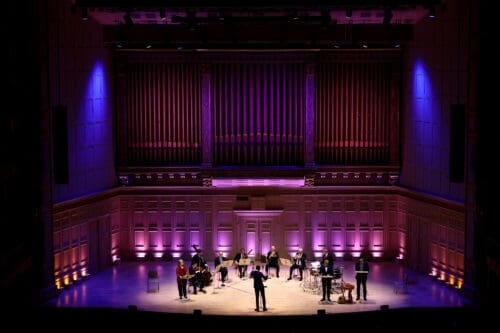
The Soldier’s Tale at Symphony Hall
Igor Stravinsky composed L’Histoire du Soldat (The Soldier’s Tale) in the waning days of World War I, when resources were scarce. Working with a Swiss writer named C. F. Ramuz, he devised an hour-long theatrical production based on a story by Russian writer Alexander Afanasyev about a series of encounters between a fiddle-playing Soldier and the Devil.
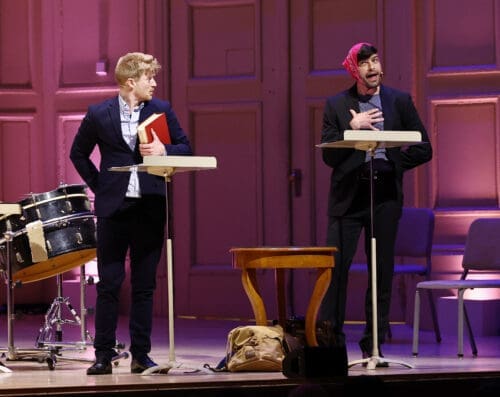
Caleb Mayo and Daniel Berger-Jones
In addition to seven musical instruments from the Boston Symphony Chamber Players, conducted by Samy Rachid, three actors are included: Karen MacDonald, Narrator; Caleb Mayo, Soldier; and Daniel Berger-Jones, Devil.
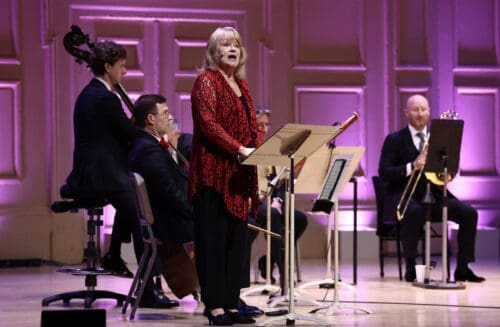
Karen MacDonald narrates
The narration is synchronized with the opening music, “The Devil’s March”; MacDonald did not just speak the role, she integrated the text into the music (English version by Michael Flanders and Kitty Black). Rachid literally conducted her narration along with the music that accompanied it.
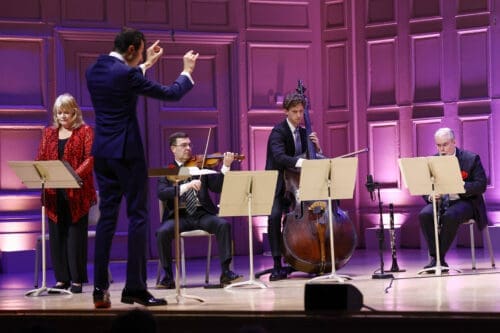
Nathan Cole, violin, and Caleb Quillen bass
The Soldier meets the Devil when he is on his way home during a 10-day furlough. He succumbs to the temptation of promised wealth and gives up his violin. Much of the strength of the piece resulted from the actors, and Mayo and Berger-Jones threw themselves into their roles even though they performed from music stands and had only minimal props.
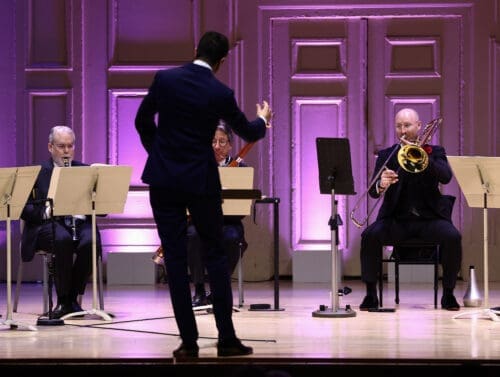
Trombonist Toby Oft
In addition to the narration, which MacDonald delivered beautifully, she also plays the Princess who marries the Soldier—and convinces him to violate the terms of his agreement with the Devil to take her to visit his home village and meet his mother. (It doesn’t go well.)
Although he achieves the wealth, he loses the love of those he most cared for—his mother and his fiancée. The piece thus becomes a study in dualism—a series of events in which the Soldier loses and regains his violin as well as material wealth and, eventually, the love of a princess.
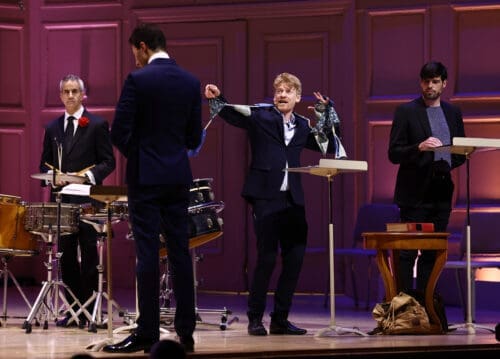
Caleb Mayo
Stravinsky expresses this dualism through a series of contrasting rhythms—the percussive and mechanistic “Soldier’s March,” for example, as contrasted with the freely expressed and even joyous “Three Dances: Tango, Waltz, Ragtime.” Though the ensemble is relatively small, the variety of instruments (violin, clarinet, bassoon, trumpet, trombone, percussion, and double bass) allows the working out of these dualities. This provides an interesting musical experience, though arguably the ending comes too abruptly.
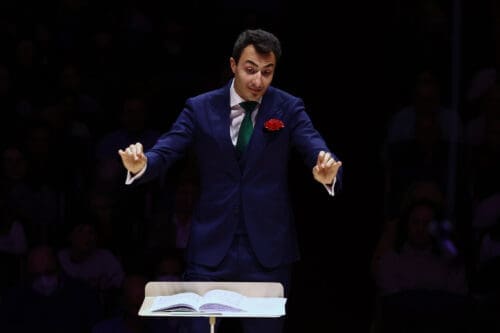
Samy Rachid
Conductor Rachid and most of the ensemble wore red flowers on their lapels, a symbol of protest also adopted by audience members in response to BSO management’s announcement that conductor Andris Nelsons’ contract would not be renewed after it ends in August 2027.
✦ ✦ ✦ ✦ ✦ ✦ ✦ ✦ ✦ ✦
photos by Winslow Townson, courtesy of the BSO
The Soldier’s Tale
Boston Symphony Chamber Players
Symphony Hall, 301 Massachusetts Ave. in Boston
reviewed on April 24, 2026
for more info and other shows, visit BSO
for more shows, visit Theatre in Boston
✦ ✦ ✦ ✦ ✦ ✦ ✦ ✦ ✦ ✦
