


Areas We Cover
Categories hhhh

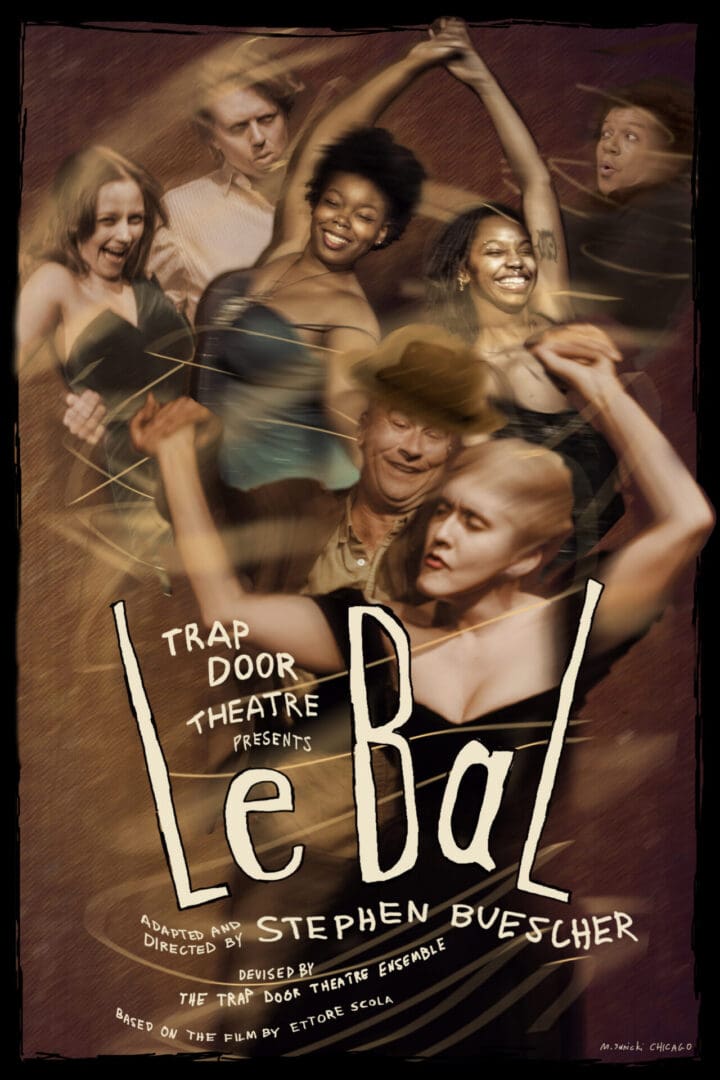
Theater Review: LE BAL (Trap Door Theatre / Chicago)
by C.J. Fernandes | May 26, 2026
in Chicago, Theater
DANCING THROUGH THE DECADES
A mesmerizing theatrical collage
that rewards surrender over analysis
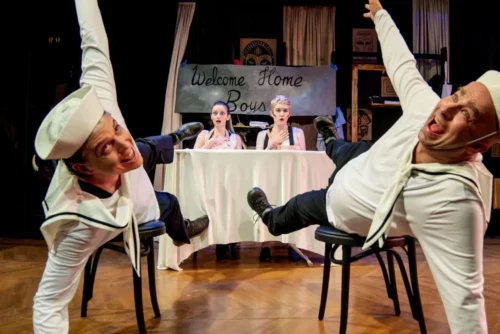
Gus Thomas, Emily Nichelson, Genevieve Corkery, and Carl Wisniewski
One never quite knows what to expect from the good folks at Trap Door Theatre, and I’m sure they wouldn’t want it any other way. The company restricts itself to furiously political works from lesser-known authors; they have a fondness for the avant-garde and the absurd, and delight in unconventional, frequently surreal narratives. All of this is to say that even by Trap Door’s own standards, the closing production of its 32nd season is a doozy.
Adapted by Stephen Buescher (who also directs) from the Oscar-nominated 1983 film by Ettore Scola, Le Bal retains the concept of the film: dialogue-free depictions of several decades in the political evolution of a country, shifting the action from France and French Algeria to the United States of America. The decades covered span about ninety years and are presented in roughly five segments.
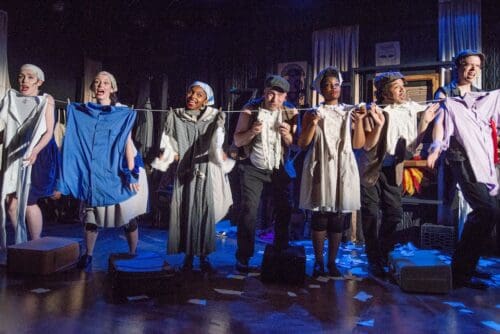
The cast of Le Bal
Merje Veski’s scenic design is characteristically spare; the back and side walls of the performance space are artfully lined with shelves and displays containing props and costume accessories, all of which will be deployed during the 90-minute running time of the show. Rachel Sypniewski’s costumes are built on a basic kit of a white top and black trousers or skirts with black suspenders. For the most part, the performers change during the show as they move from one decade into another. It’s all hyper-efficient and very clever.
Le Bal begins with a bit of silent comedy, in which one of the ensemble interacts with the audience, clowning around and finally coaxing an audience member into mimicking a record arm. As the arm drops, the scratchy sounds of a vintage record player kick in and we are launched into the play proper, beginning with the 1980s.
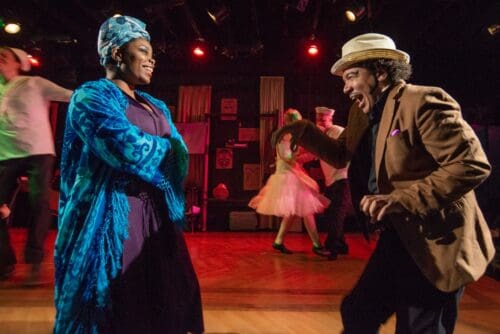
Cat Evans and Dan Cobbler
One of the two best segments in the show, the 1980s takes us straight into a club in Chicago, with pulsating music, cocaine-fueled manic dancing, anonymous bathroom sex, and so on. Thanks to some spirited choreography, fantastic music—the sharp sound design is by Danny Rockett—and light effects by Richard Norwood, it is a propulsive start to the show, even when the segment ends with the cold shower of the AIDS epidemic. The other segments roughly cover the 1930s, the 1950s, the early 2000s, and the 2020s.
The seven-member ensemble is superb across the board. An unfortunate consequence of the concept is that there is little opportunity for the individual performances to stand out from the group, but director Buescher gives each performer at least one moment to themselves. The opening comic routine would be one. A striptease that ends with a side-splitting visual punchline is another. And my favorite: a stunning moment in which a performer stops the action, walks across the stage, carefully assembles a bassoon, and then plays a mournful introduction that turns into an elegy for victims of war. Clearly, acting, singing, and dancing without a break for an hour and a half is not nearly enough; one must also play one of the most difficult musical instruments live on stage. I’m pointedly not mentioning the individual actors in these scenes because this is about as pure an ensemble as I’ve seen, and separating them out does a disservice to the performance.
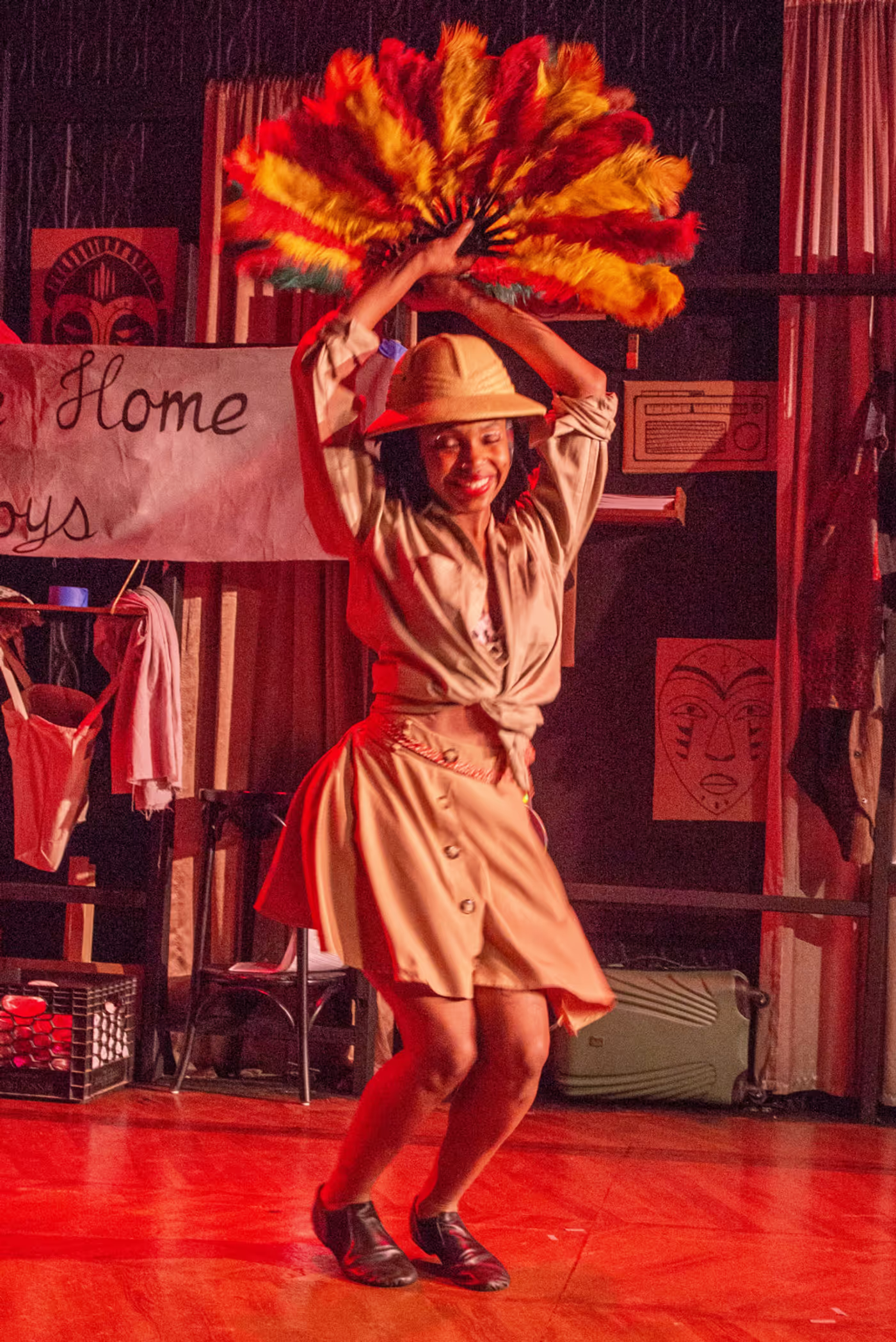
Jasz Ward
It’s difficult to classify Le Bal: it doesn’t fit any categories. There are portions that are surreal and portions that dabble in realism. The actors may not speak, but they do sing—quite beautifully, I might add—but it’s not a musical. It features an equal amount of dancing and acting. Unlike the source material, the narrative, such as it is, is non-linear. Some of the segments are better than the others—the ’50s would be my favorite segment—and some of the song choices are a bit on the nose, but it all clicks together. Even allowing for the fact that it is an adaptation, as a piece of performance it is sui generis, which is quite remarkable when you think about it.
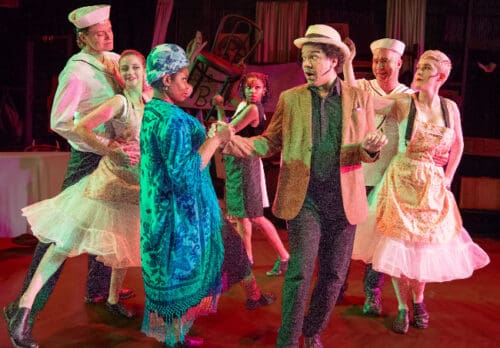
The cast of Le Bal
About a third of the way through, I realized that I was wrong in my attempts to pin the segments down, to try and place the radio jingles and political addresses. The best way to experience Le Bal is to let it wash over you and just absorb the sounds and images. It is not concerned with narrative but understanding, presenting a political history of the last century as fragments that merge into one another, looping time and space as ideas, political movements, and philosophies repeat themselves, eventually bringing us to our current state of affairs.
And judging by the powerful final tableau, a sad state of affairs it is indeed.
✦ ✦ ✦ ✦ ✦ ✦ ✦ ✦ ✦ ✦
photo by Michael Janicki
Le Bal
Trap Door Theatre
1655 W. Cortland St. in Chicago
90 minutes, no intermission
ends on June 20, 2026
for tickets ($32; Thursdays 2-for-1),
call 773.384.0494 or visit Trap Door Theatre
for more shows, visit Theatre in Chicago
✦ ✦ ✦ ✦ ✦ ✦ ✦ ✦ ✦ ✦

Another fine review, Croydon. Nobody makes the case for Chicago theatre better than you. Your reviews don’t just point readers to the strongest work in town. They explain what sets Chicago apart from New York, LA, and London.