


Areas We Cover
Categories hhhh

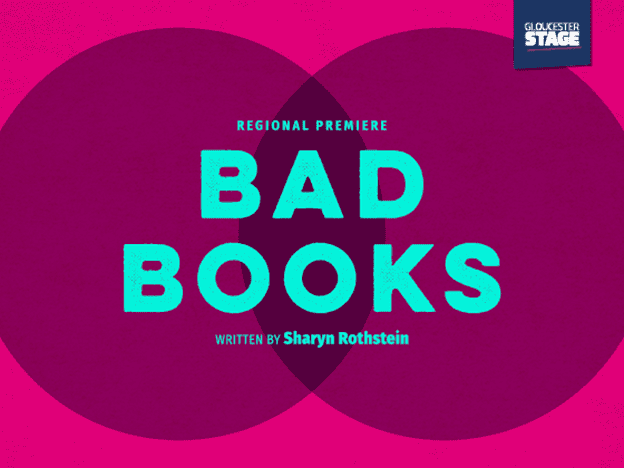
Theater Review: BAD BOOKS (Gloucester Stage Co. / MA)
by Lynne Weiss | June 15, 2026
in Boston, Theater
TO BAN OR NOT TO BAN
Who decides what children
are allowed to read?
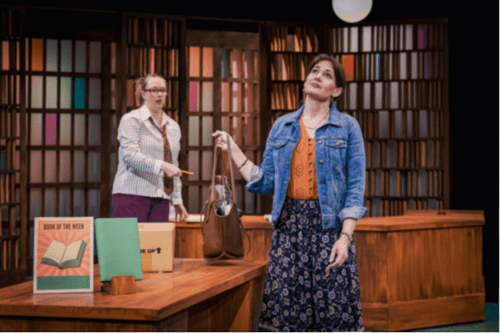
Theresa Plaehn and Aimee Doherty in Bad Books at Gloucester Stage Company
Playwrights are among the many who are struggling to reconcile the escalating conflicts among different factions of our society. Huntington Theatre’s Eureka Day portrays the executive board of a progressive private school at odds with itself when a mumps outbreak pits anti-vaxxers against vaccinators. Similarly, Bad Books, a two-hander directed by M. Bevin O’Gara, presents the friction between an overprotective parent and a librarian who sees books as a way of supporting young people in making challenging life decisions.
Aimee Doherty is The Mother, concerned about a book her 15-year-old son found in the local library. Theresa Plaehn is The Librarian who offered him the book. (In addition to the appealing, hard-swearing librarian, Plaehn plays The Manager and The Editor in subsequent scenes.) Tables are turned and turned again and again to keep the audience wondering which of these combatants will emerge victorious in this battle for moral and social dominance.
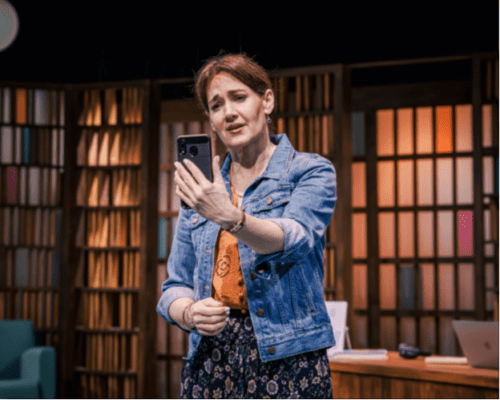
Aimee Doherty
At Gloucester Stage Company, the direction of the play is fetching: when Doherty and Plaehn first come onstage, they bounce and flex as though preparing for a fistfight. Later, when moving furniture around the set between scenes, they gleefully cavort and frolic.
Both Eureka Day and Bad Books mine plenty of humor from differences in perspective over whether or not to vaccinate or whether or not to keep books that cover difficult topics out of the hands of young people. There’s a certain amount of pleasure in the crisp delivery of playwright Sharyn Rothstein‘s witty dialogue. Unfortunately, both Eureka Day and Bad Books succumb to the very problem they try to address—oversimplification and stereotyping of those whose positions are at odds with one another.
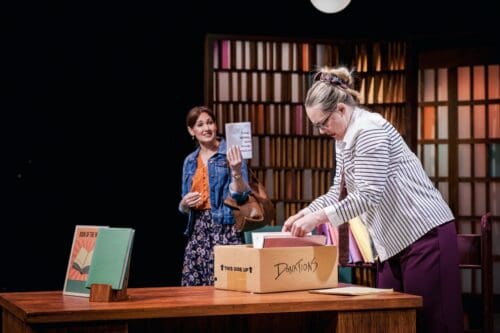
Aimee Doherty and Theresa Plaehn
The Mother is a parent organizer with a significant social media following. The Librarian knows something about The Mother’s past that The Mother would like to keep hidden. But the gaps in the logic of the plot are too big to fill with witty dialogue. Like Eureka Day, Bad Books fails to dig below the surface of these conflicts except to note that they are amplified and exacerbated by social media. And neither play offers a potential solution—perhaps because there is no obvious way out of these conflicts.

Theresa Plaehn
Rather than presenting The Mother and The Librarian as fully realized characters, the play relies on an audience that thinks it knows who these people are from the beginning. While the opening scene is funny, the sudden transition from good-natured small talk between the two women to a confrontation over a book is too abrupt to be believable, unless we see The Mother as a character capable of such a skilled and rapid change in tone. But there’s nothing about the character to make us think she is that adept; nothing to hint that she is planning to switch gears on the librarian.
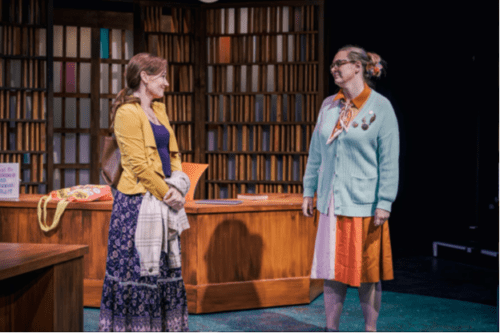
Aimee Doherty and Theresa Plaehn
While there’s some appeal in the way events come back to bite The Mother, a would-be book banner whom a live-theater audience is likely to resent, one result of her campaign is too brutal for comedy, and the reaction of this woman—who has been so intent on protecting her son—is inappropriate for the gravity of the event. And the librarian’s clever “solution” to the book banner’s campaign, while amusing to those of us who object to book banning, would in reality only fan the flames of further rage.
These conflicts that pit people who share institutions like schools and libraries against one another are deeply troubling. It’s appropriate that playwrights such as Rothstein and Jonathan Spector (Eureka Day) are giving us a chance to work through them through dramatic portrayals. But in the end, we need more than comedy and neatly satisfying conclusions to understand these rifts in our social fabric. I applaud the Huntington and Gloucester Stage Company for bringing them forward, but I hope playwrights and directors are hard at work on other plays that take us deeper into an exploration of these frictions.
✦ ✦ ✦ ✦ ✦ ✦ ✦ ✦ ✦ ✦
photos by Jeff Bousquet Photography
Bad Books
Gloucester Stage Company
267 East Main Street in Gloucester, Massachusetts
ends on June 27, 2026
for tickets, visit Gloucester Stage Company
for more shows, visit Theatre in Boston
✦ ✦ ✦ ✦ ✦ ✦ ✦ ✦ ✦ ✦
Lynne Weiss is a member of the Boston Theater Critics Association. Her reviews, travel tales, and progressively optimistic opinions are on her substack.
