


Areas We Cover
Categories

Theater Review: THE WASH (Front Porch Arts Collective / Boston)
by Lynne Weiss | November 8, 2026
in Boston, Theater
SISTERS DO IT
FOR THEMSELVES
In 1881, as today, Black women of
Georgia were changing history
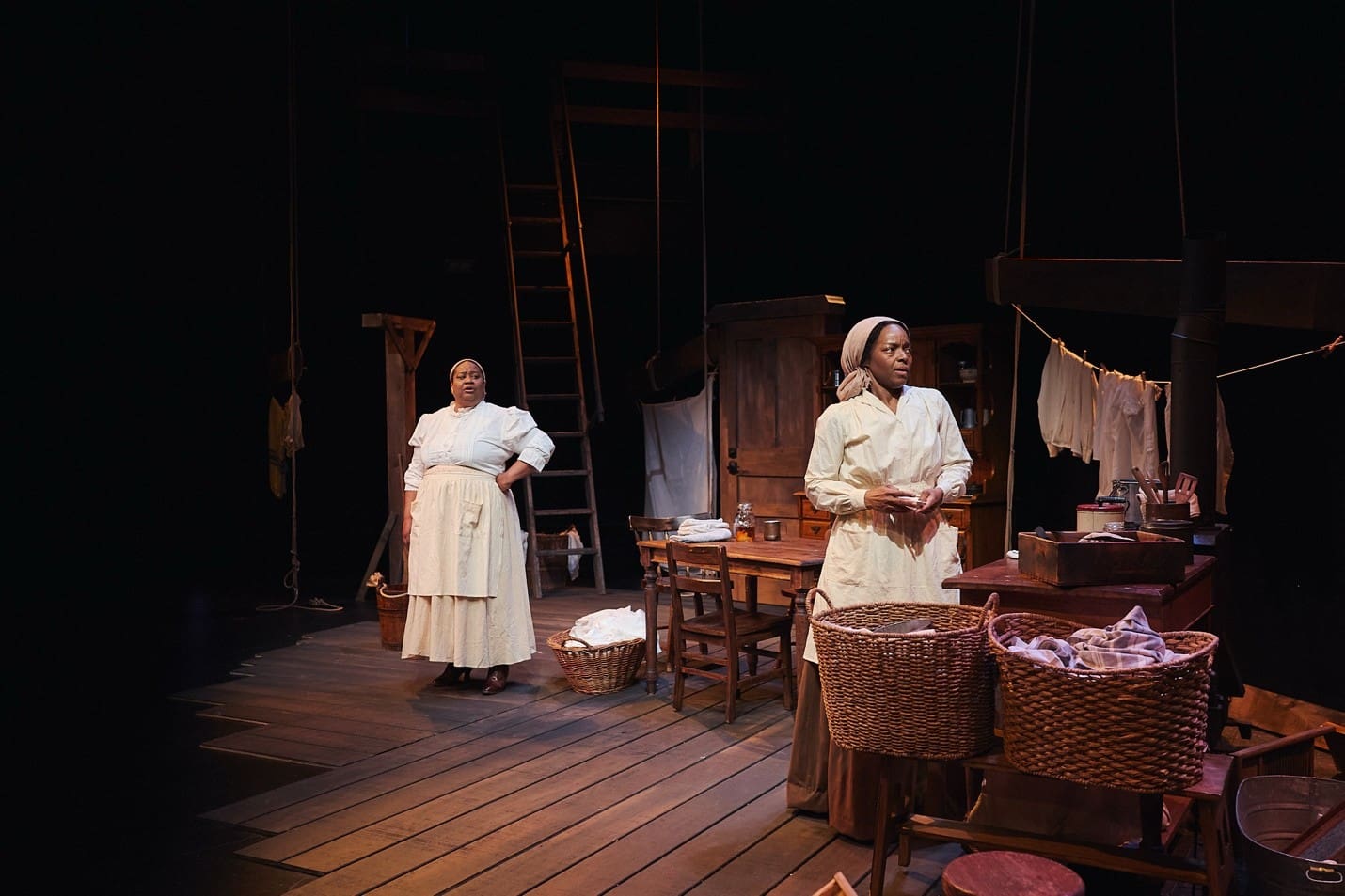
Maconnia Chesser and Lindsey McWhorter
There were no automatic washing machines in 1881, yet people had more clothes than ever before, thanks to industrialization of the textile industry. While people in the more industrialized North could have their clothes and linens washed in commercial laundries, in the South, laundry was still done manually. Fast-growing, densely populated Atlanta was still developing its water and sewer systems. This meant that doing laundry was backbreaking, time-consuming work. Water had to be fetched or pumped and then boiled. Soap had to be made from caustic lye. Laundry had to be soaked in buckets overnight and stirred with wooden paddles. Stains had to be scrubbed out on washboards. Damp laundry was then hung to dry, often in private homes, and once dry, had to be ironed and folded.
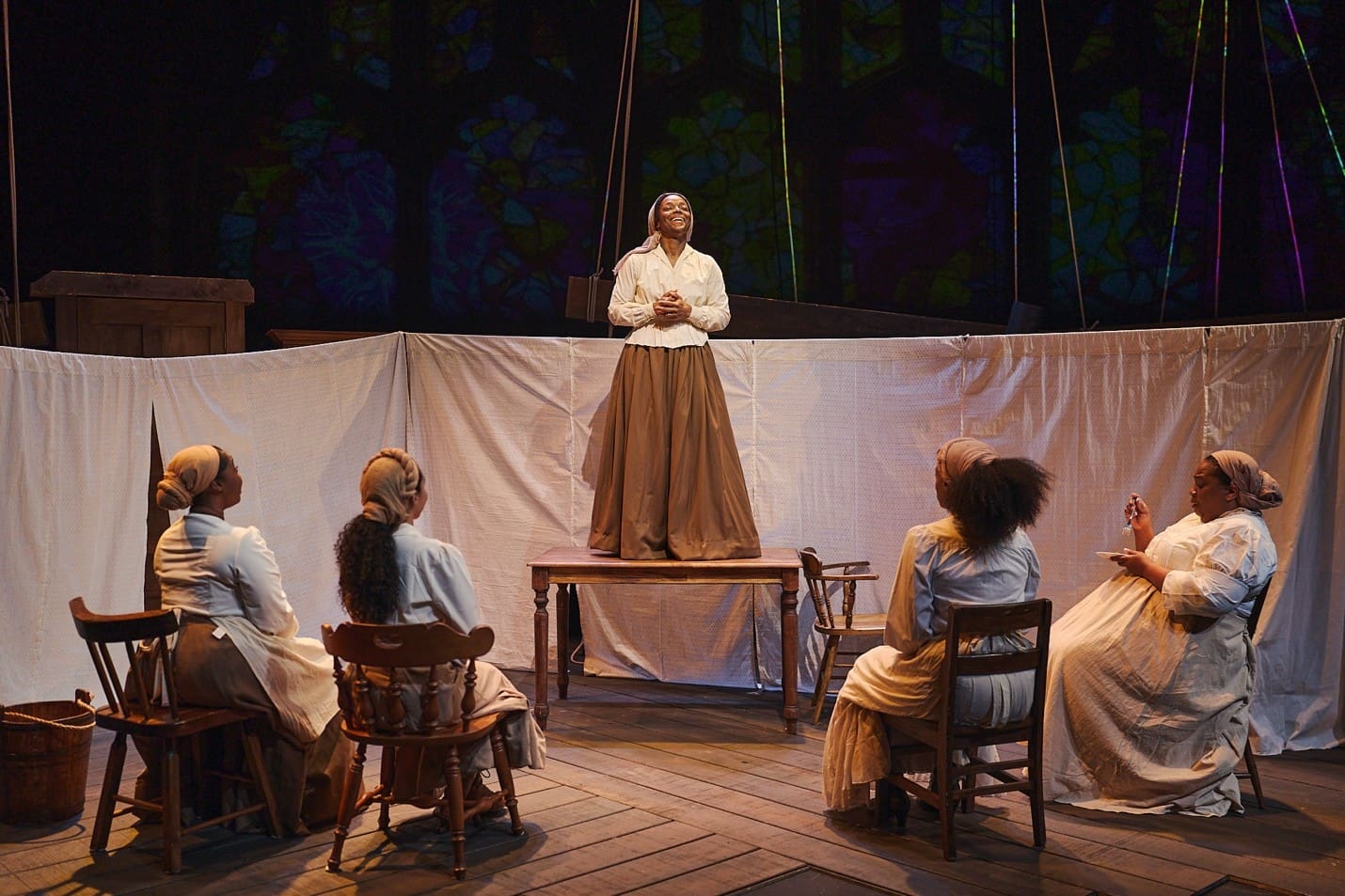
Lindsey McWhorter with the cast
In 1881 Atlanta, the setting for Kelundra Smith’s The Wash, 98% of laundresses are Black women. The play opens on what looks like a private home with a wooden table and kitchen furnishings, but there are also buckets for soaking, planks for ironing, a washboard for scrubbing, and clothing suspended on lines (Janie E. Howland, scenic design). No actors appear for several minutes—an unusually long time—with the only sound a rhythmic and persistent dripping or ticking. And then five women appear, all of them Black. Dressed in white shirtwaists (what we would call blouses today) and solid-color ankle-length skirts (Athena Parkman, costume design), they proceed to pantomime the demanding work of doing laundry. They pour water into a bucket, scrub fabric on a washboard, heat an iron on a stove and then use it to press. Lighting changes to indicate the passage of time over the course of a day (Amanda E. Fallon, lighting design), and our laundresses stretch, grimace, and groan to ease aching backs and shoulders.
We get it: this is hard work.
But then something else happens. The groaning becomes humming. The stretching becomes stamping. A spoon scrapes the washboard and paddles beat the buckets. The women dance. They are not simply workers enduring hard lives. They are human beings filled with joy and endurance; they are women who can dance together to their own rhythm and melodies.
The women put away their equipment. Night falls. Not a line has been spoken, but we have learned a great deal about who these women are. Director Tasia A. Jones has chosen a unique and powerful way to begin a play that risks didacticism and oversimplification, and it’s this beginning—along with some other directorial choices—that redeems this production for me.
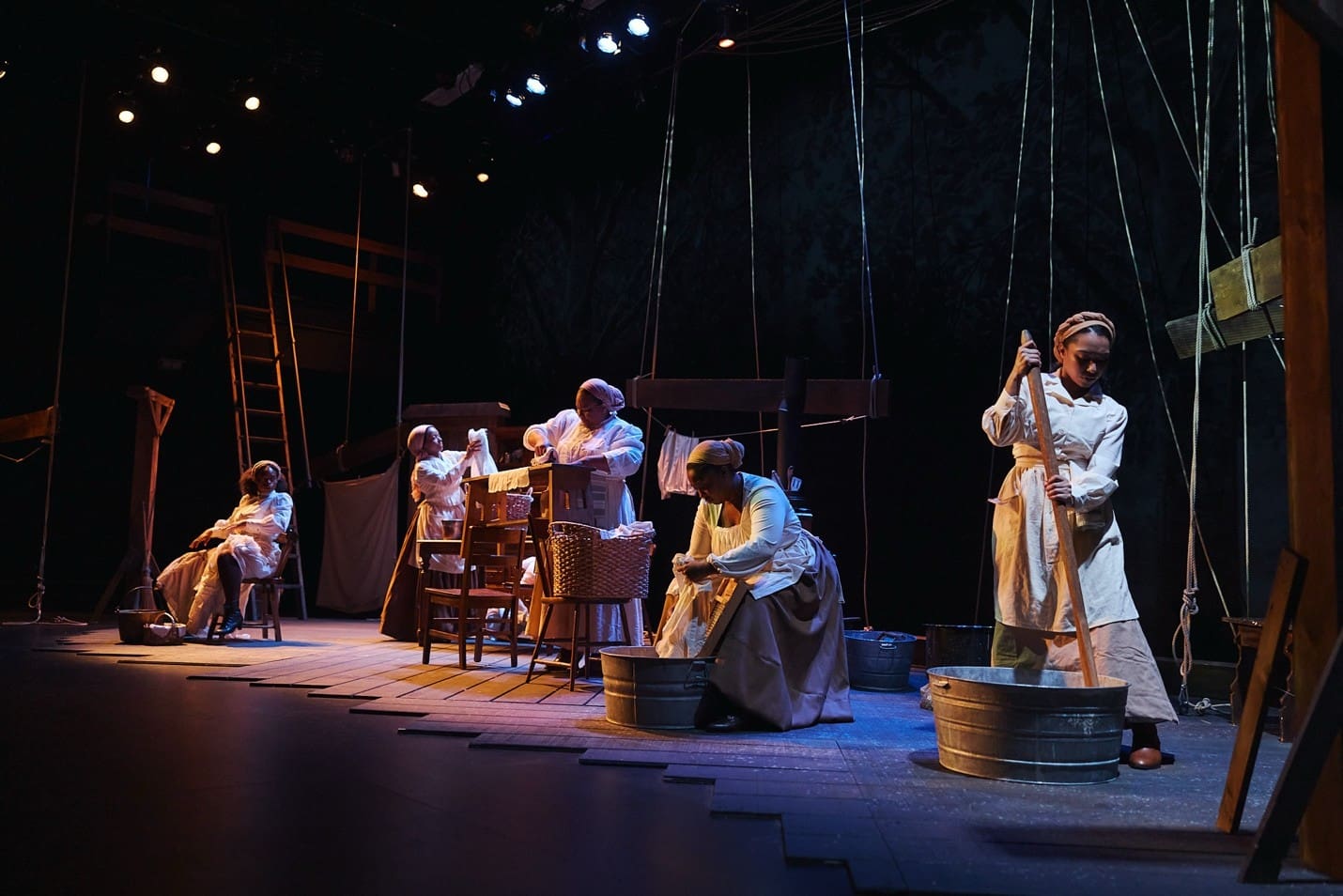
Marhadoo Effeh, Lindsey McWhorter, Maconnia Chesser, Jada Saintlouis, Keira Prusmack
Which is not to say that the actors, especially MaConnia Chesser as Jeanie and Lindsey McWhorter as Anna (McWhorter is also the choreographer), don’t do a fine job. We should and want to hear this story and see it enacted: a group of courageous women fed up with wage theft and inadequate compensation for their backbreaking work who risk their physical safety and financial futures to organize and call a strike. They are not part of a union. In July 1881, they form an organization which they call the Washing Society. Each character in the play has her own reasons for joining or not joining the initial effort, but eventually all of them come around. They win the support of local clergy and churches. Within a few weeks, they convince 3,000 women (including some white women, who constitute a small minority of Atlanta’s laundresses, represented in this production by Eliza Fichter as Mozelle) to sign up for the strike.
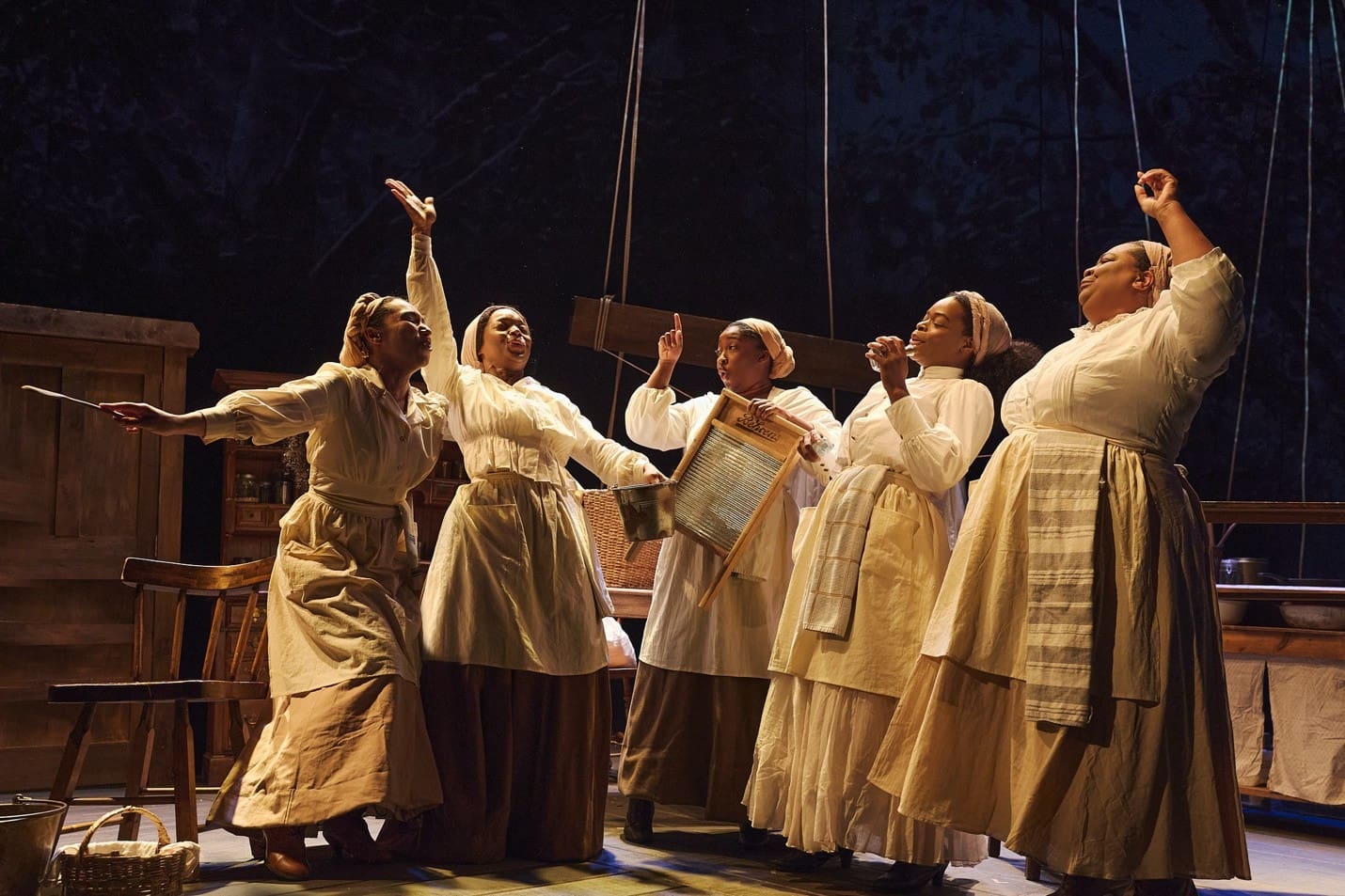
Keira Prusmack, Lindsey McWhorter, Jada Saintlouis, Marhadoo Effeh, McConnia Chesser
Atlanta’s laundry piles up in the summer heat. Things get stinky, both literally and metaphorically, as authorities and the press attack the women. The washerwomen face physical attacks as well. They overcome internal conflicts as well as external threats to emerge triumphant, establishing a standard rate of one dollar for twelve pounds of laundry. No longer will they tolerate customers who refuse to pay their bills or offer payment in rice and beans, and the white shirtwaists and solid-colored skirts the laundresses wore at the beginning of the play are transformed into brightly colored, African-inspired garments. As each character departs the stage for her happy ending, a historical note is projected onto hanging sheets: “The Atlanta Washerwomen’s Strike of 1881 became the blueprint for the labor movement of the early 20th century. This play is dedicated to the brave women who changed the course of history.”
Smith couches the play as a fantasy based on historical fact. I suppose this justifies elements that landed like a heavy bar of harsh soap on a galvanized bucket for me. Every character in this play achieves an unalloyed happy ending, overcoming obstacles like homophobia within the community, an abusive relationship, infertility, and the potential loss of property. Certainly the success of the strike and the power of these women leave us with much to celebrate, but the implication that all problems were magically solved for the Black women of Atlanta in 1881 undercuts the power of the production. The ending belongs to a simplistic morality tale rather than what has been an inspiring portrayal of creativity and courage.
✦ ✦ ✦ ✦ ✦ ✦ ✦ ✦ ✦ ✦
photos by Ken Yotsukura
The Wash
Front Porch Arts Collective
Roberts Studio Theatre at the Calderwood Pavilion, 527 Tremont St.
2 hours and 15 minutes, including intermission
Wed & Thu at 7; Fri at 7:30; Sat at 2 & 7:30; Sun at 2 (check individual dates)
ends on November 22, 2026
for tickets ($10–$60), call 617.933.8600 or visit Front Porch Arts Collective
for more shows, visit Theatre in Boston
✦ ✦ ✦ ✦ ✦ ✦ ✦ ✦ ✦ ✦
