


Areas We Cover
Categories

Chicago Theater Review: ANGELS IN AMERICA (Court Theatre in Chicago)
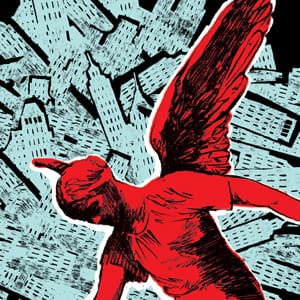
A LITTLE OUTDATED, ANGELS IS STILL MANNA FROM HEAVEN
In 1994, Tony Kushner’s two-part Angels in America plays – Millennium Approaches and Perestroika – opened locally at the Royal George Theatre where they provided a stunning viewing experience. In two sprawling works Kushner brought alive the American national scene of the 1980’s and early 1990’s, mixing raw naturalism with fantasy, dreams, visions, and hallucinations. It was a dazzling achievement that was worth every minute of nearly seven hours of cumulative playing time.
Now, the Court Theatre has accepted the enormous challenge of reviving the Kushner plays in a brilliant production that showcases the best in Chicagoland acting and stagecraft. The two plays still require that massive audience investment of time if seen on the same day; they can be enjoyed separately, but for the maximum impact, patrons should set aside over seven hours to absorb the experience in one shot. We may not see a production at this level again for a long time, so the moment should be seized.
The only question is: do the plays hold up after that astonishing 1994 Royal George premiere? The equivocal answer is: sometimes but not always.
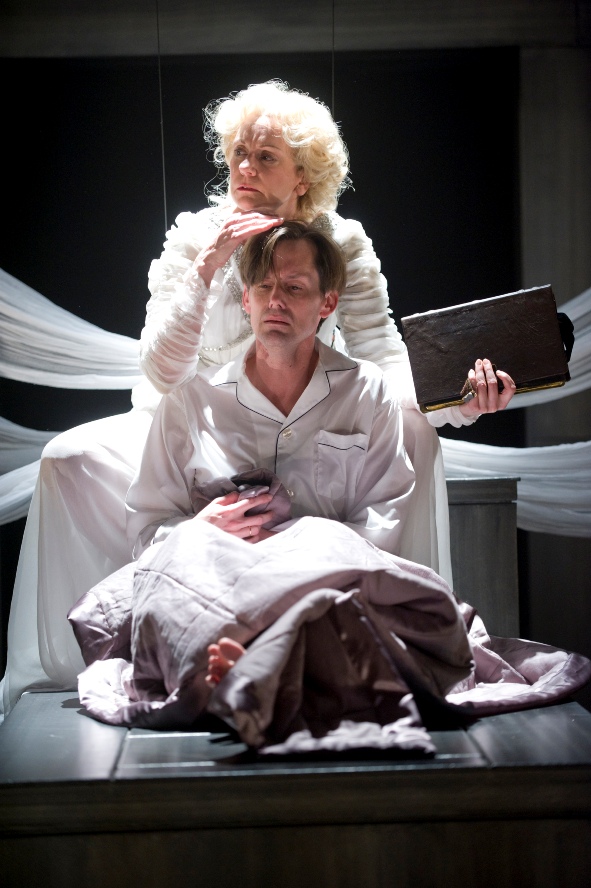 Kushner subtitled the two Angel plays “A Gay Fantasia on National Themes.” All the male characters in both plays are homosexual, though a couple of them are initially in denial. The plays are heavily weighted toward gay love affairs, often sexually graphic, but Kushner also injects trenchant observations on race and politics in America along with explorations of the nature of God and the topography of heaven – examinations which are are not very favorable toward their subjects.
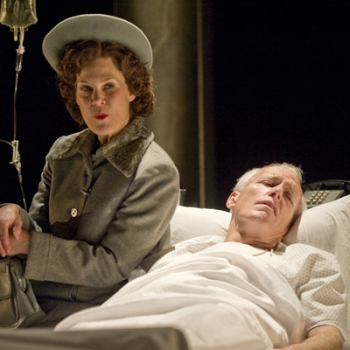 The core characters are a mix of real life and fictional figures. The dominant real life character is lawyer Roy Cohn, one of the most powerful and detested figures of the McCarthy era of the 1950’s. The major fictional character is a drag queen named Prior Walter, with his tangled romantic relations with politically liberal Louis Ironson and an arch-conservative Republican Mormon named Joe Pitt. The other key characters are Joe Pitt’s mentally unstable wife Harper, Joe’s mother Hannah, a black gay hospital nurse named Belize, and an angel who ascends periodically from the rafters in a blinding and deafening crescendo of light and sound.
The action takes place during the period of 1985 and 1986 with an epilogue set in January 1990. The play consists of a series of short scenes usually confined to two or three characters. The location centers mostly in Washington, D.C., but in the fantasy scenes shift to Antarctica and even heaven.
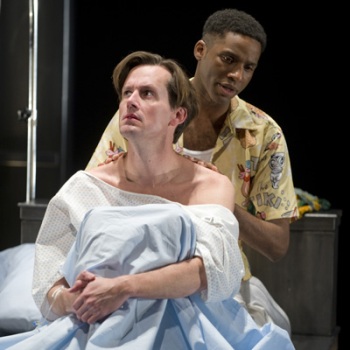 When the two plays first appeared in the early 1990’s, AIDS was a dominant and traumatic topic in American life, with the disease scourging the gay community. Prior Walter has AIDS and his death seems inevitable and imminent. Roy Cohn also has AIDS but refuses to consider himself a homosexual and insists that he is really suffering from liver cancer.
Kushner wears his liberalism on his dramatic sleeve. His commentary on the personalities of the conservative Reagan years is satiric and biting. In Angels, the Republicans of the Reagan administration are smug, power-hungry, greedy, and intolerant, and Roy Cohn is their poster boy. Cohn is a fascinating character study: a brutal, corrupt, and hateful figure, he is yet a man with wit and intelligence. In Larry Yando’s breathtakingly virtuoso performance, Cohn is almost endearing in his single minded lust for power and his open disregard for the niceties of the law, entertaining the audience his every moment on stage.
 The twin themes of AIDS and the Reagan years have retreated in the past two decades from national preoccupation to national history. Kushner’s plays exploded on the American scene 20 years ago to rub the country’s noses in the horror of the AIDS epidemic and the sleaze of right wing political manipulations. The language was raw and the visual images of gay sex were startling and controversial for the time. Today, the immediacy of the themes has diminished and that may cost something in audience emotional response.
In addition, scenes, especially in “Perestroika,” have a mystical quality that I found very elusive in 1994 and even more elusive at the Court. The second part of Kushner’s opus appears in a newly revised version, but the ambiguities remain and its long first act scene between Prior and the Angel is awash in apocalyptic purple prose that sounds eloquent and profound but makes little sense. Even when the dialogue of the fantasy scenes contains a murky quality, the writing holds the viewer, even as the clock ticks towards midnight on the evening performances of “Perestroika.” There is literacy, urgency and quirky humor in Kushner’s writing that will fascinate the attentive viewer, and the shifts from a surreal atmosphere to reality flow naturally. “Perestroika” – forty-five minutes longer than “Millennium” – could profit from blue penciling. But there wasn’t a moment in either play when I was bored, and given the density of the material, that’s quite a tribute.
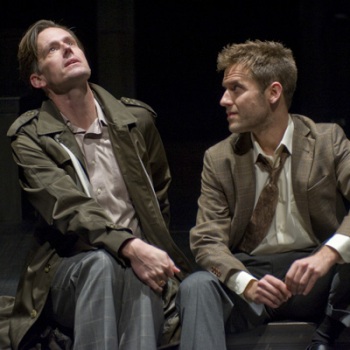 Charles Newell’s direction is fluid, resourceful, and in full control of the script. If there are scenes that are cloudy in their meaning, blame the writing and not Newell’s insightful guidance. He uses the entire theater, from the aisles (with the actors scooting across the back of the house to position themselves for their next entrance) to the bi-level set designed by John Culbert. Both plays are mostly talk, but the staging injects a feeling of movement that keeps the shows buoyant and energized.
Newell has assembled a flawless cast of eight, all playing multiple roles. First among equals is Yando as Cohn, from his cynical early scenes to his frightful death throes as the play concludes. But the story gradually focuses on Prior, a young man terrified by his agonizing approaching death and bitter at the departure of his lover when Prior needs him the most. Rob Lindley’s performance is a delicate balance of fear, anger, vulnerability, and finally, strength.
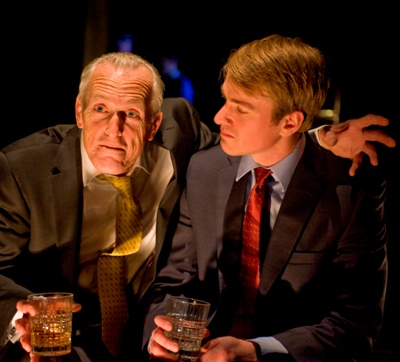 Heidi Kettenring superbly manages Harper Pitt’s shifts from reality into fantasy. Harper is trapped in a loveless marriage and her release into a world of Valium-induced fantasy is credible, funny, and painful. Geoff Packard is outstanding as Joe Pitt, the model of pristine Mormon conservatism who finally finds emotional liberation by recognizing he is a gay man imprisoned in a hyper-straight lifestyle. Mary Beth Fisher is a stylish Angel (among other roles), confidently floating in mid-air by barely visibly cables. Eddie Bennett is a tragi-comic figure of Jewish guilt and political passion as Louis Aronson. Hollis Resnik is excellent as Joe Pitt’s no-nonsense Mormon mother from Salt Lake City, and Michael Pogue is terrific as the cynical Belize, especially in his verbal sparring with the bigoted and hospitalized Roy Cohn.
The designers are required to make essential contributions to the production and they all come up big. In addition to Culbert, they consist of Nan Cibula Jenkins (costumes), Keith Parham (lighting), Joshua Horvath and Kevin O’Donnell (sound), and Mike Tutaj and Rasean Davonte Johnson (projections).
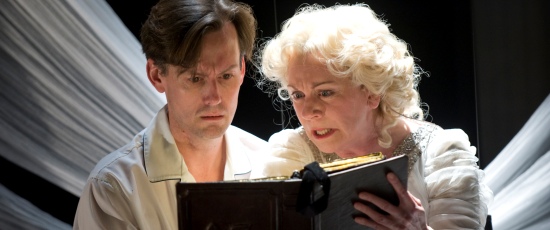 The Angel in America storyline may meander and Kushner’s more spiritual ideas are a long way from clear, but the shows still form some kind of masterpiece, for their ambition, their invention, and their vibrant writing. It is must-see viewing.
photos by Michael Brosilow
Angels in America
Court Theatre in Chicago
scheduled to end on June 3
for tickets, call 773.753.4472 or visit http://www.CourtTheatre.org
for info on this and other Chicago Theater, visit http://TheatreinChicago.com
