


Areas We Cover
Categories

Film Review: FACE 2 FACE (directed by Katharine Brooks)

by Jason Rohrer | July 14, 2012
in Film
VICTIM AS NARCISSIST AS ICON
It makes sense to someone who doesn’t like reality television that a person who makes it for a living (The Osbournes, The Simple Life, others) could feel that she has wasted her life, and that such a person could become a drug addict to escape such feelings. Add that on top of a childhood encompassing serial molestation, homelessness, gender identity issues and rape, and director Katherine Brooks may be understood as an excellent candidate for sympathy, but not necessarily an ideal choice as a video memoirist.
Her 2011 film, Face 2 Face, poses as a document of Ms. Brooks’s 11,000 mile road trip to meet 50 strangers during a bout of acute loneliness. Ms. Brooks tells us that, following a drug overdose and an unspecified surgery, despite her accumulating 5000 Facebook “friends,” nobody came to visit her during recuperation. Thus was born her idea to actually engage on-camera with one percent of her social network, as the title would have it, face to face.
It’s a potentially interesting idea, but the road trip is at best a secondary component. Face 2 Face really is a character study of an extraordinarily self-involved person, a description that also fits a typical addict. Nearly everything Ms. Brooks says is about herself: her feelings, her injustices, her state of mind, her weight, her addictions. And most of what her interview subjects have to say is also about her. When anybody talks about anything else – about themselves or their job or the weather – with a couple of exceptions, it happens in relation to something she wants to talk about, which, again, is usually herself. Musical montage is a prime motif of this feature, usually constructed from loving shots of Ms. Brooks communing with dogs, horses, and many weeping women, underneath a soundtrack of comfort songs like “The Rose.”

Ostensibly, then, Face 2 Face contains a very subjective and bittersweet feminine reverie on the nature of human interaction. And no doubt, there is value here for lonely people who feel marginalized and want to believe that communion is possible between them and an increasingly cyber-oriented society. It may be difficult, though, to listen to Ms. Brooks’ nonstop philosophical commentary. “I think technology is disconnecting us all,” she says, and “We spend more time with our computers than we do face to face,” and “People sit there face to face and they’re on their phones. And that concerns me.” To tolerate these observations, if one has already made them for oneself or heard such conclusions drawn ad nauseum in the public discourse of the Information Age, requires patience. So, for some, the so-what quotient of this movie will be an obstacle to getting through it.
To someone who has not had these same thoughts, and who can put up with the excruciating company of a depressive constantly saying Me Me Me, this movie may have a great deal to offer, specifically because of the problems Ms. Brooks brings to her narrative. Those who identify with her status as a mental health patient, or a victim of sexual predation, or a junkie, might revel in her apparent message of self-actualization through self-pity. There is no shortage of Americans who feel empowered by identification with their ailments.

One of the (again, potentially) exciting elements of this one-note movie is that its subject/auteur decides to stop smoking and popping Demerol and Xanax in the middle of this for-the-record road trip. As best one can tell from the fragmented narrative, the decision seems to come following a visit to the deathbed of a lung cancer victim. Ms. Brooks’ remarkable insensitivity is highlighted when, standing over the very conscious dying woman and flipping through snapshots of healthier times, she points to photos and says “Look. Smoking. She’s smoking in this one.” Astutely, Ms. Brooks notes that her own response to this dying person is primarily narcissistic. It is a paradox that a person mostly oblivious to her effect on others will miss very little else about herself. But there are components of Ms. Brooks that may escape some viewers.
An addict is, by way of function, a manipulator. When that addict is also a filmmaker, the opportunities for invention and self-promotion may overwhelm the responsibility to “document” independently occurring events. Face 2 Face contains several moments, starting with its opening images of a supposedly just-overdosed Ms. Brooks keening into a handheld camera, which feel staged and unconvincing, even if they’re “real.” This is because the entire movie is a scream for attention, of the “cry for help” variety. Yes, this is a woman who’s attempted suicide. Yes, she has problems. And yes, much of what she says and does on camera seems designed to heighten the drama of an essentially flat non-story.

So when is it okay to call a lesbian a drama queen? How appropriate is it to call bullshit on a person with serious issues? It’s appropriate when to support her and enable her seem like the same action, and when her movie’s just basically a mess. The editing makes unclear in what order events happen, and so the subject’s emotional journey – the central and only drama – never makes sense; exactly when a clip of Ms. Brooks crying, or one of her laughing, or peeing, took place matters greatly to the timeline of her “recovery.” Although at one point she insists that she got out of reality TV because it wasn’t as “real” as she wants this film to be, she makes it impossible to tell what’s genuine here and what’s by design.
Ms. Brooks includes in the film a phone call with her lawyer and agent, in which they tell her that her career will be ruined if she makes public this bravely vulnerable chronicle of her shortcomings. The conversation prompts a relapse. Ominous title cards indicate that production has come to a halt, and that “Kat” cannot continue the journey; we see her staring into space, staring into camera, threatening suicide. Then, with no explanation, the trip continues. The sequence feels so manufactured, contrived and convenient that it’s hard to sympathize with the obvious pain this woman is feeling. Watching her, I just wanted what even therapists want after spending an hour with a whiner. It’s not compassionate, maybe, or morally correct, but one just wants this person to start helping herself. By herself.
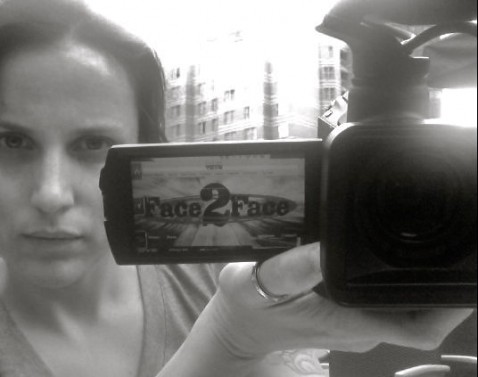
Instead, the movie forces us to watch a person so conscious of documenting a very difficult time that every frame feels like a performance, less raw honesty than unpolished, off-putting acting job. She says, at one point, “I feel like I’ve been through almost everything that you can imagine that hurts. So when people tell me what they’ve gone through I truly can say ‘I know how you feel.’ ”
Well, she knows how she feels, and she knows how other people’s trials make her feel. But when she listens to the story of a car-fire survivor, or looms over that deathbed, it’s not easy to believe she knows what these people have gone through. When her visit ends with a “friend” she has just emotionally sandbagged into telling her what she wanted to hear (that her trials have been those of Job), he looks relieved to see her go. This movie makes clear to me, if not to Ms. Brooks, that she is the kind of unwitting emotional vampire who’s lonely because few who know her can stand her company; she has reinforced her own misery by being miserable. Maria T. Senger, who rode all those miles in the car with her to film this journey (and did a nice job of it), must be a very resilient person.
Face 2 Face makes gestures toward bringing its wounded subject to a sort of stasis – her big healing moment takes place when the girl she had a crush on in high school apologizes for hurting her feelings, and lo and behold, Ms. Brooks owns that she, too, may have behaved other than perfectly back in the day. Then, after another montage, she watches the sunset over the Grand Canyon. Her take? She’s glad she didn’t kill herself, because she would have missed this journey that saved her life. How it saved her life is unclear. But hey. If it works for you, good. It does not work for me.
It’s important for a compassionate society to remember that every citizen is on his own trajectory and that not all of us arrive at or even desire the same destinations of emotional maturity. But norms exist for a reason, and to go too far in celebrating the awkward and confused is to risk emulating them.
Face 2 Face
Big Easy Pictures
screens at Outfest in Los Angeles on July 14, 2012
for more information, visit Face2Face
