


Areas We Cover
Categories

San Francisco Theater Review: STOREFRONT CHURCH (SF Playhouse)
by Tony Frankel | December 29, 2013
in San Francisco
(Bay Area)
DIME STORE PROPAGANDA
One of the problems with watching a play that has an agenda, political or otherwise, is the difficulty of enjoying with a good conscience even those parts that work; knowing the playwright’s intentions to be dishonest (in that he’s serving up propaganda as art), one feels foolish being affected emotionally, as though one has been duped by a cheap magic trick. Such is the case with John Patrick Shanley’s Storefront Church. Even with some effective writing from the author of Doubt, Joy Carlin’s well-paced direction and some very fine performances at SF Playhouse are wasted on a show whose existence is, at best, the result of an error in judgment.
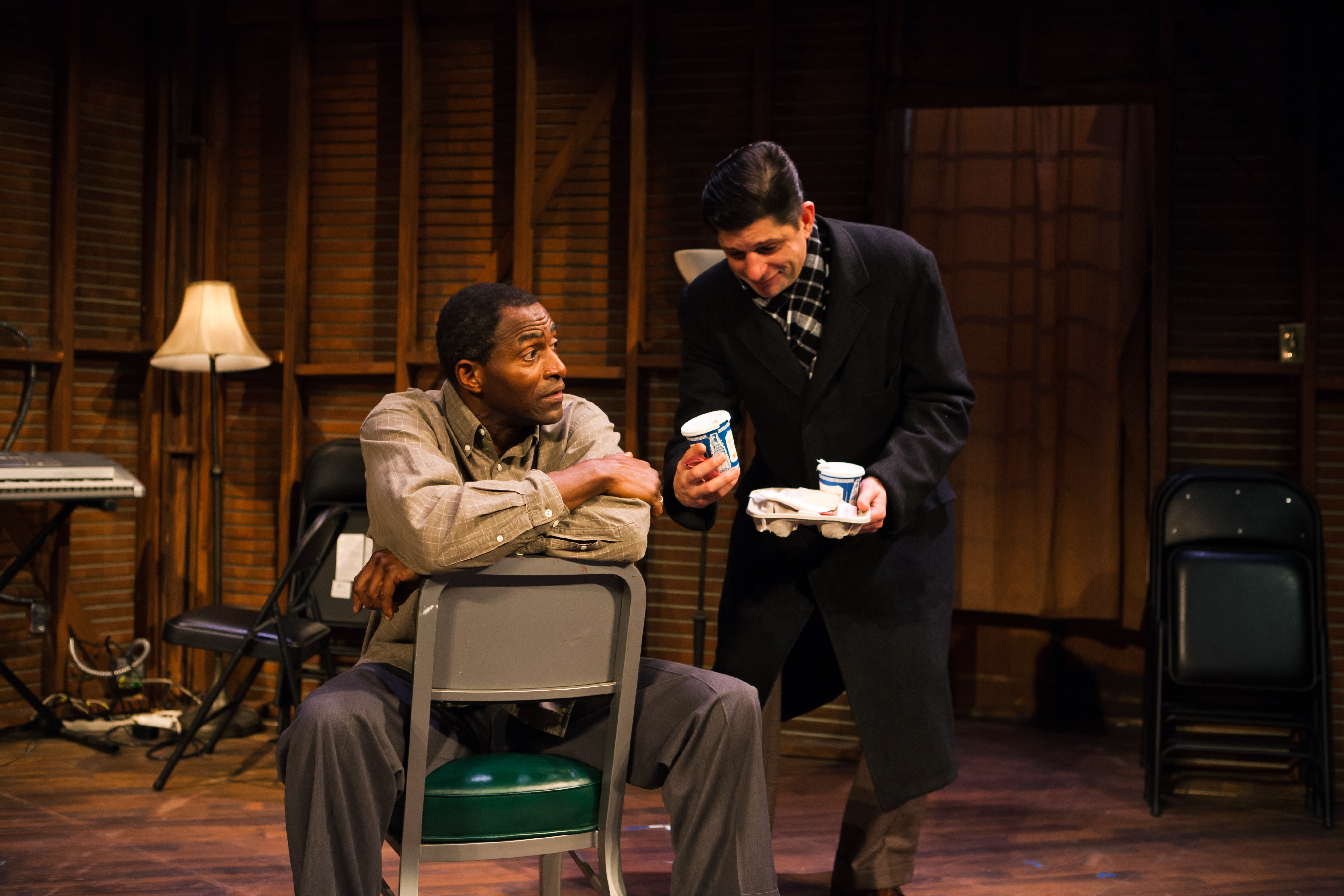
In the play, a bank is foreclosing on a pensioner couple, secular Jew Ethan Goldklang (Ray Reinhardt) and Jessie Cortez (Gloria Weinstock). Jessie tries to get the Bronx Borough President, Donaldo Calderon (Gabriel Marin), whom she’s known all his life, to help them. Donaldo is reluctant because his involvement may appear improper, but acquiesces after Jessie tells him that his own mother co-signed the loan. The bank CEO Tom Raidenberg (Derek Fischer) offers to forgive the loan in exchange for Donaldo’s help in getting the Council’s permission to build a mall in the Bronx.
In his meeting with Tom, Donaldo is conflicted, on the one hand looking out for himself, his friends and his family, on the other sympathetic with his constituents who would rather get a new community center than a mall. “Minimum wage jobs,” Donaldo states. ”My constituents are sick of that.” And subsequently, “This project needs to feel like the Bronx, not just anywhere U.S.A.”
 If this sounds sappy, that’s because Mr. Shanley’s play appears to be making the argument that banks are bad, poor people are good, and a couple of pensioners need neither income nor a dwelling, provided they have love and spirituality. (As a counter to that last point, my suggestion for Mr. Shanley would be to go live in a Bronx park for a few winter months when he’s seventy, with nothing but love and spirituality, and see what happens.) But the point is not that the argument is naïve, which it is, it’s that artistic works have no business arguing their creators’ political agendas at the expense of their dramatic integrity. An playwright’s responsibility is to the work, to see that it grows and blossoms into the best possible thing it can be, and not to bend and twist it into some monstrosity in order to serve his own personal vanity regarding life’s inequities.
To be fair, Mr. Shanley’s argument is a bit broader: he is arguing spirituality versus materialism. And he’s not talking about simple, everyday spirituality, but about the kind that takes you to a higher plane of being, the kind that moves you, lifting you up out of the prison of your own vanity and making you one with God and Man and the Universe. Unfortunately, Mr. Shanley doesn’t appear to have enough to say 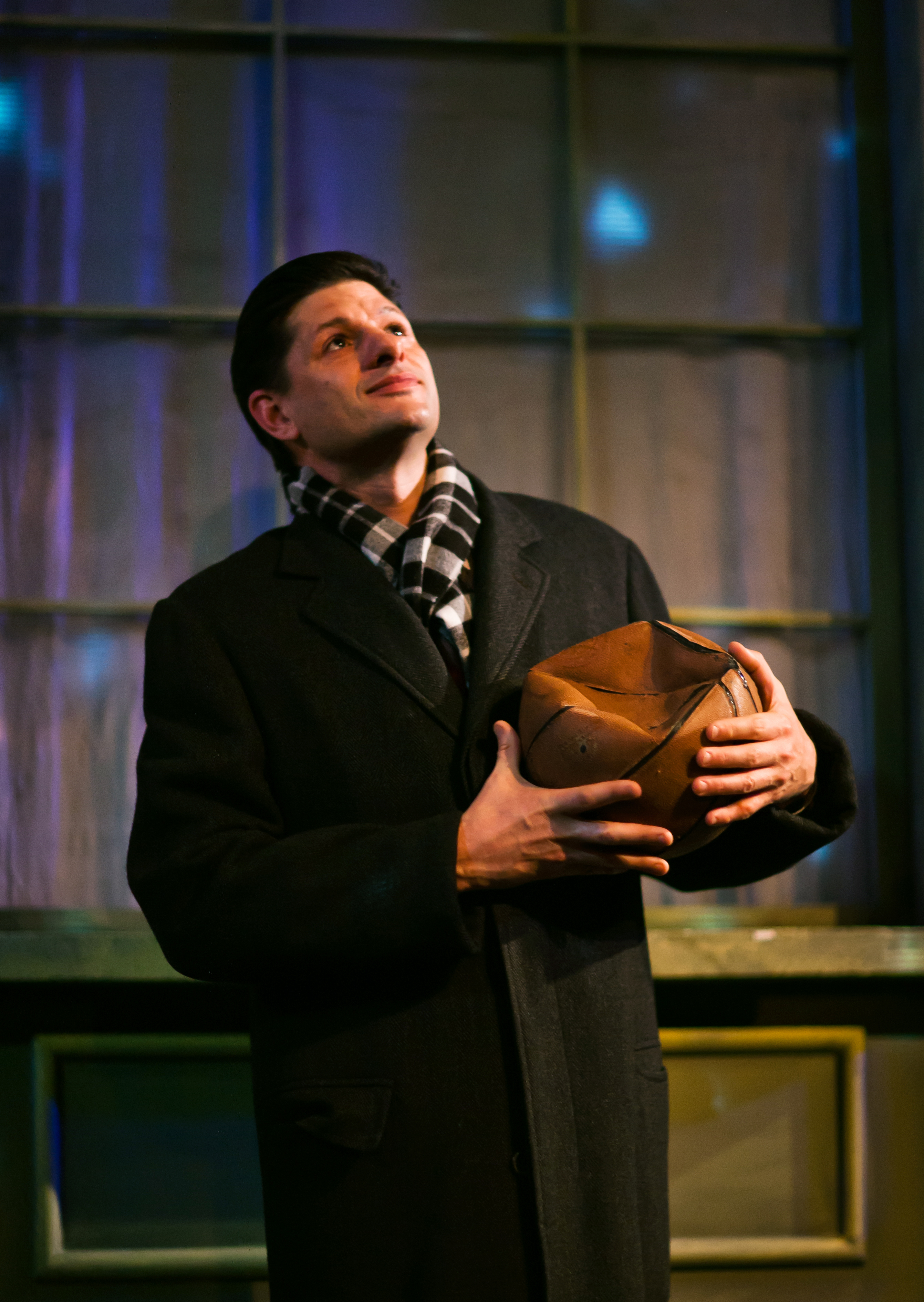 on this most difficult and elusive subject; he shows us nothing revelatory or profound. Instead, spirituality is presented more as an idea and used as a device, a counter argument to material pursuits.
Indeed, the slow-moving first act is used as a set-up for a revival meeting to be performed by the deeply spiritual Pentecostal pastor, Chester Kimmich (a very convincing Carl Lumbly in an underwritten part). Kimmich’s spiritual tumult after the wreckage of Hurricane Katrina drove him to New York to begin a new congregation only to be bound by lack of confidence. The reason Cortez is behind on her mortgage payments is that Kimmich is renting her property to begin this storefront church, but hasn’t paid her a dime. The pace really picks up in the second act as each of the characters ends up at this revival. But Shanley drops the ball with a domino-effect of transformations, none of which ring true because he is in such a rush to make his point that the 1% suck and the 99% are pawns in the businessman’s game.
There’s also some conspicuous playwriting devices: In one very entertaining scene, Tom, the bank CEO, destroys and chomps on a gingerbread house meant as a gift for his child while having a one-hand-washes-the-other type of discussion with Donaldo regarding the foreclosure. A gingerbread house. Get it? While the scene contains some fun acting from the devilishly charismatic Fischer, the obviousness of the metaphor destroys its effect and feels condescending.
 The loveliest moment actually occurred during a scene change. We espy Kimmich in his storefront church as Bill English’s gorgeous turntable set begins to move. Two massive set pieces move together to create the brick exterior of the church and video projections of a snowfall begin. David K.H. Elliot’s superb lighting design has Christmas strands lit in the windows above while a lowly loan officer, Reed Van Druyten (a vulnerable Rod Gnapp), half of whose face is paralyzed from an injury, weeps on a bench below (Gnapp is also reminiscent of John Spencer from The West Wing). With Teddy Hulsker’s bittersweet music playing, this is one of the most tender and heart-wrenching moments I have seen in the theater all year. The beauty of this theatrical wonder wins our empathy, and has more pathos than all of Shanley’s play. Technically, this production is a marvel.
There are moments in Storefront Church that are funny and moving, and Mr. Marin, just as he did in This Is How It Goes at Aurora earlier this year, brings an impressive range of emotions and heaps of likeable energy to the role of Donaldo. Sadly, Ms. Weinstock is entirely disingenuous and mannered as the landlady Cortez; so much so that it completely took me out of the play when she spoke.
Even with a fast-moving and diverting second act, Mr. Shanley’s attempts to weave the conflict between ecstatic spirituality and material reality into a plot incapable of sustaining it ultimately results in a deformed offspring, afflicted with sentimentality and leftist propaganda.
photos by Jessica Palopoli
Storefront Church
San Francisco Playhouse
scheduled to end on January 11, 2013
for tickets, call 415-677-9596 or visit www.sfplayhouse.org
