


Areas We Cover
Categories

Theater Review: BEAUTY’S DAUGHTER (OnWord Theatre at Diversionary Theatre in San Diego)
by Milo Shapiro | November 19, 2025
in San Diego, Theater
BEAUTY GETS MORE THAN SKIN DEEP
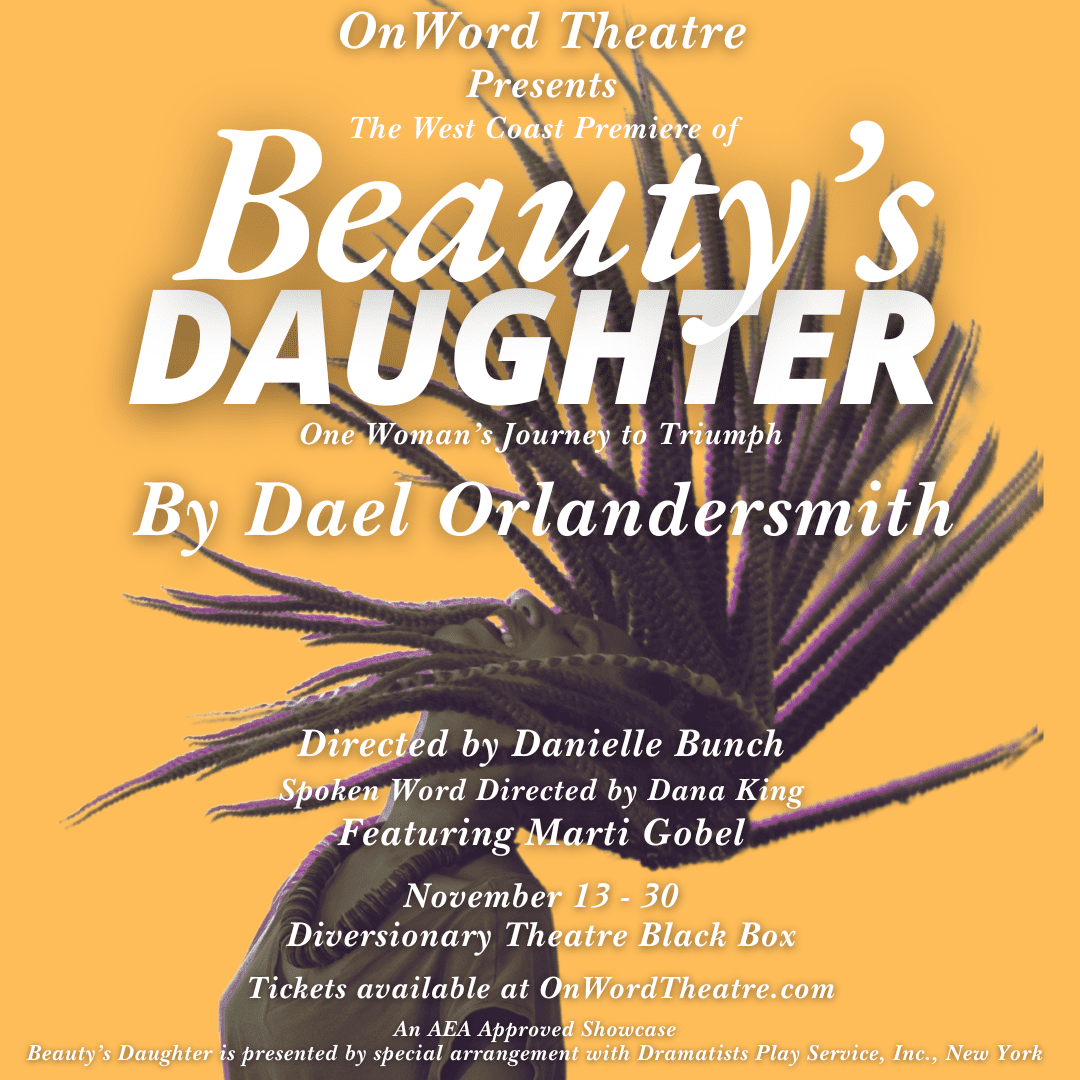
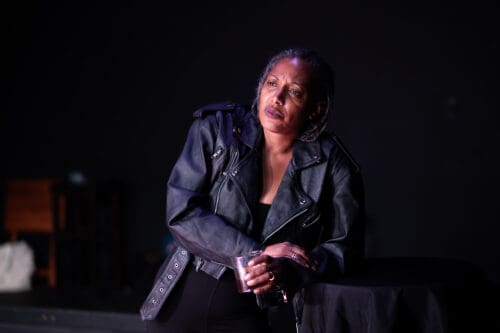
Beauty’s Daughter is a one-woman play by Dael Orlandersmith that centers on Diane, a young Black woman growing up in East Harlem, as she navigates a world marked by violence, beauty, trauma, and resilience. Marti Gobel portrays six different characters consecutively before returning to the first one, Diane. No other actor appears in her scenes, yet Gobel is almost always talking to someone. To call Diane the main character could be slightly misleading, since we only see her at the very beginning and the very end, but she is unquestionably the central figure; everyone else Ms. Gobel portrays is either talking to or about her. Through these six perspectives—family and neighbors—we gradually come to understand this somewhat successful 31-year-old poet living in Harlem, despite her rough history. As the story unfolds, we gain insight into the woman we first met, and a deeper appreciation for her strength.
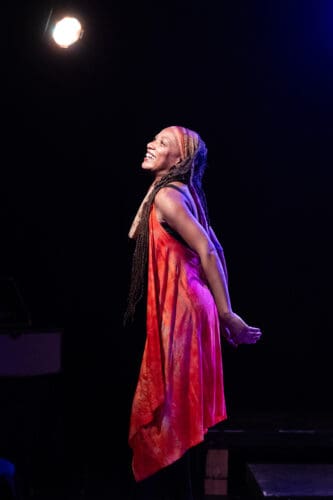
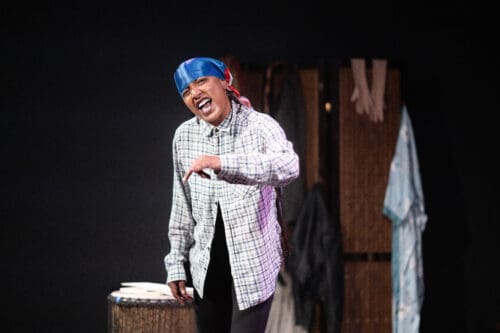
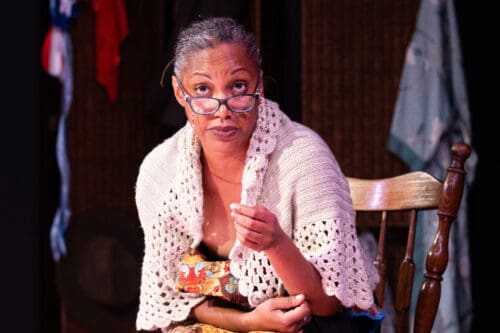
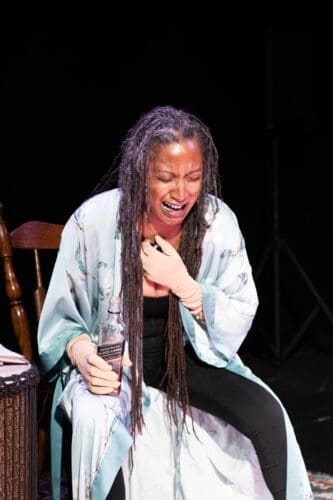
In the opening scene, Diane shares about a captivating Irish man she has met and her struggle to allow love into her life, debating whether it’s worth the risk. Diane talks directly to us, but she is the only character who does so. Papo, a Puerto Rican late-teenage boy who wrestles with the challenges of school and caring for his struggling family, talks to Diane, though we never see her. Mary, Diane’s beloved neighbor, speaks aloud to her late husband as if he were still in the room. Louis, Diane’s biological father—a blind junkie living on the street—talks to Diane as she stops to see him. Anthony, a blue-collar Guido, talks to a buddy in a bar about this chick named Diane he met the other day. And finally, we meet Beauty—the mother we’ve heard so much about along the way—who (stopping short of giving too much away) spills her thoughts aloud in a rush.
Tying all of this together are recordings of Diane’s vivid, poetic storytelling, which we hear during the costume changes between monologues, giving us further insight into both Diane and the folks we’re meeting. The narration poignantly recounts experiences of abuse, neglect, and the longing to be seen beyond her environment’s limitations.
Orlandersmith and Gobel are a masterful combination; though we know otherwise, it almost feels as if Gobel must have written the piece herself, given how intensely—and with such charm—she embodies each character. The stories range from dark to bittersweet to genuinely funny (especially poor, oblivious Anthony), creating a rollercoaster of emotion as the roles unfold. Despite the heaviness Diane confronts, she remains sharp, witty, perceptive, and—for the most part—quite likable.
The move from character to character with moving monologues is reminiscent of Whoopi Goldberg’s one-woman Broadway show—the one that brings her name to everyone’s lips in 1985. Lily Tomlin’s The Search for Intelligent Life in the Universe comes to mind as well, though Tomlin aims for more humor than would feel right in this writing. Gobel is remarkable in her differentiation of the characters through posture, voicing, and movement; it really is like watching a master class in character work unfold before us.
OnWord Theatre prides itself on choosing excellent, lesser-known scripts, and they succeed tremendously with this 80-minute one-act. The playbill warns that this “isn’t an easy story to sit through,” yet one barely shifts in their seat because of the production’s power. Gobel digs deep, finding tremendous energy in what could otherwise be bleak; instead, it becomes simply riveting, culminating in her blistering, venom-laced eruption as Beauty.
The language reflects the play’s origins in 1995. Words that are more taboo now appear in ways that suit the time and the locale. For example, younger attendees may never have heard the slur dago, a derogatory term for an Italian, yet everything is clear within context—even if a bit jarring at moments in today’s more culturally sensitive climate.
With both Diane’s biological father and stepfather referenced throughout the play, the choice of the name “Papo” for the teenage boy proves a bit unfortunate; in the final scene, I heard “Papa,” which greatly altered the meaning of the last monologue until it was sorted out in discussion afterward. A shame, but not enough to diminish one’s appreciation for the script or the performance.
Ultimately, Beauty’s Daughter is about self-creation — Diane claiming the right to her own life, voice, and future, transforming pain into strength through the act of storytelling itself.
✦ ✦ ✦ ✦ ✦ ✦ ✦ ✦ ✦ ✦
photos by Bernadette Johnston, Narrative Images
Beauty’s Daughter
OnWord Theatre
Diversionary Theatre Black Box, 4545 Park Blvd
Thu and Fri at 7; Sat at 4; Sun at 2 (dark November 27)
ends on November 30, 2025
for tickets (PWYC-$40), call 619.892.8123 or visit OnWord Theatre
✦ ✦ ✦ ✦ ✦ ✦ ✦ ✦ ✦ ✦
