


Areas We Cover
Categories

Theater Review: THE TRIP TO BOUNTIFUL (Lamb’s Players Theatre)

by Milo Shapiro | January 25, 2026
in San Diego, Theater
TENDERNESS IS BOUNTIFUL
IN LAMB’S PRODUCTION
A Horton Foote gem, staged with patience, grace, and heart
The Trip to Bountiful began as a staged-for-TV play in early 1953 and then had a very brief Broadway run later that year, a limited one-month production that yielded critical accolades for Horton Foote’s touching script (Lillian Gish played elderly Carrie, and Jo Van Fleet won a Tony as her daughter-in-law). Many years later, in 1985, the movie version was released and Geraldine Page won the Oscar for the lead role. Although neither the play nor the movie states the actual year, early-fifties references and costuming from that time (here, done effectively by Jemima Dutra) establish the period.
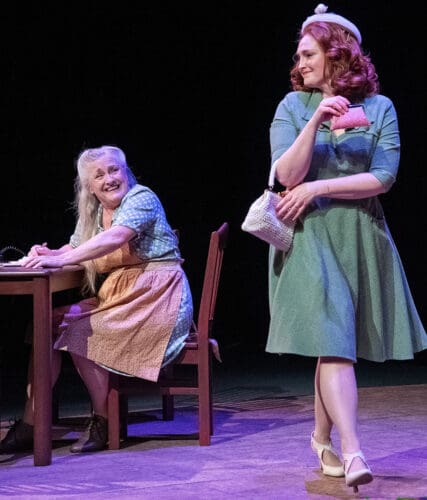
The play opens in a cramped Houston boardinghouse where Carrie Watts (Deborah Gilmour Smyth), an elderly woman with a heart condition, lives uneasily with her son Ludie (Andrew Oswald) and his self-absorbed wife, Jessie Mae (Kelsey Venter). The setting immediately conveys confinement—physical, emotional, and spiritual. Carrie longs obsessively for Bountiful, the rural Texas town of her youth, which she remembers as open, rooted, and alive. Houston, by contrast, feels loud, crowded, and deadening to her.

Family tensions surface quickly. Jessie Mae resents Carrie’s presence and her constant talk of leaving, masking hostility behind practical concerns about money and inconvenience. Carrie’s pension check becomes a point of control, with Jessie Mae insisting it supports the household while Carrie sees it as her only means of escape. Beneath the argument is a deeper struggle over autonomy and emotional territory, which leaves Ludie stuck in the middle—loving his mother but avoiding confrontation and repeatedly postponing her dream of returning to Bountiful. His passivity wounds Carrie more than Jessie Mae’s blunt antagonism.
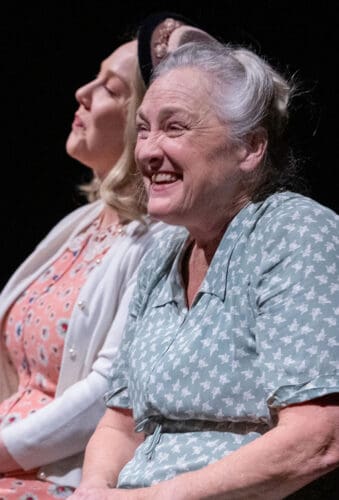
Realizing no one will help her, Carrie quietly plans her escape back to Bountiful—the town frozen in her mind, even as the real place has likely changed with time. The opening establishes the play’s core journey: a struggle for identity, independence, and the right to return home before life ends.
As so many times before for Lamb’s, the dynamic married duo of the Smyths get it right here: director Robert Smyth refuses to rush anything (without allowing anything to drag, either), while Deborah Gilmour Smyth beautifully captures Carrie’s mix of styles and emotions—from longing to fear to impishness to sweetness… but mostly sweetness. It’d be hard not to love Carrie and root for her to reach her goal against great odds, as the world seems determined not to let her have this simple gift.

In the role of Carrie’s nemesis, Venter walks the line beautifully—making Jessie Mae dislikeable and selfish without overplaying it into Cruella de Vil. Jessie Mae doesn’t desire to be mean; she just wants what she wants and isn’t particularly flexible or empathetic in that intention, even for something as simple as allowing Carrie to sing hymns when Jessie Mae is in the house. Not to give away too much, but Lauren King Thompson comes into Carrie’s life as a stranger who reminds our aging hero just how tender people can be—in striking contrast to Jessie Mae.
Some of the loveliest moments are when Carrie has time to ponder to herself and others, such as when she wonders why God allows us to have bad days if He cares about us, concluding that perhaps it’s so we can appreciate the good days all the more.
Part of what makes this story and the performances so charming is that it’s not a play of great action or tremendous plot changes; it’s an examination of the longing we all have for more—whether that’s something we’ve not had before, or something we’ve left behind.

As an aside, this year marks the retirement of five key leaders in Lamb’s organization—folks who have been with them close to forty years. Both of the Smyths are in this departure, along with the inimitable Kerry Meads, Production Team Director Nathan Peirson, and Chris Turner, wearer of many hats (including dealing with the antics of press folk like me). Stage and Cinema thanks them for the countless hours spent making theatre shine, and wishes Lamb’s Players every success in carrying that legacy forward.
✦ ✦ ✦ ✦ ✦ ✦ ✦ ✦ ✦ ✦
photos courtesy of Lamb’s
The Trip to Bountiful
Lamb’s Players Theatre
1142 Orange Ave, Coronado, CA 92118
Wed at 2 & 7; Thu & Fri at 7; Sat at 2 & 7; Sun at 2 & 7
ends on March 1, 2026
for tickets, call 619.437.6000 or visit Lamb’s Players
✦ ✦ ✦ ✦ ✦ ✦ ✦ ✦ ✦ ✦
