


Areas We Cover
Categories

Film Commentary: THE PARTICIPANTS (Directed by Ray Munro)
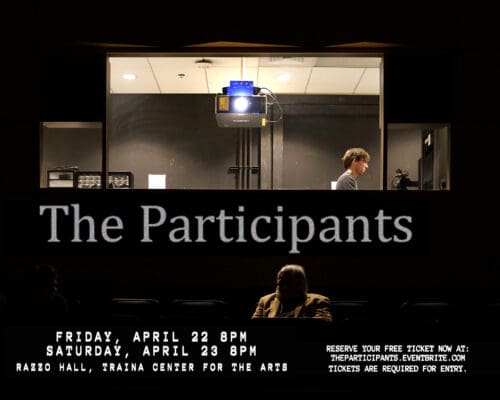
![The Participants Poster[1].jpg](https://stageandcinema.com/wp-content/uploads/2026/02/The-Participants-Poster1.jpg-scaled.jpeg "The Participants Poster[1].jpg")
by Emily Brenner | February 12, 2026
in Extras, Film
PARTICIPATING WITH THE PANDEMIC
Creating a work of theatre and film
during the height of COVID-19
A true artist possesses not only the ability to meaningfully create, but the deep need and desire to make something, even — and especially — through difficult times. Kudos to the dedicated artists who continued in earnest their various forms of creation during the recent pandemic.
Like many art forms, theatre was a tough one to translate into the world of quarantine and virtual life. Rehearsing together in person was impossible, let alone presenting a finished piece to a live audience. Thankfully, over at Clark University in Worcester, MA, seasoned theatre professor and director Ray Munro found a way to continue creating meaningful work in community during this time. This was not an easy feat, but one that he relished. In fact, in recalling the experience years later, Munro attests, “every second was a great project and a pleasure.”
Because of his decades-long career, Munro already had a solid foundation of established relationships with colleagues and students to draw from, even when folks were ZOOMing in from disparate places. He also had a tried-and-true way of working, and to top it all off, a great inspiration of source material — a piece by the American writer and satirist CJ Hopkins.
Munro had been in correspondence with Hopkins to see if there were any pieces the writer would be willing to have adapted into a work of theatre. Hopkins agreed to take a piece he originally wrote in 2008 entitled The Simulation of Culture Within the Mimetic Arts for the Enjoyment of the Bourgeoisie and rework it a bit to reflect the current COVID-laden moment in time we were all living. In what some might call art imitating life or life imitating art or simply synchronicity, the piece translated quite perfectly. He renamed it The Participants.
The Participants packs a punch, and to summarize it is to reduce it to one person’s interpretation. Broadly, it addresses themes of connection and disconnection, voluntary participation versus unwitting participation (in what, exactly?), how we direct our attention, and trying to create meaning in a potentially meaningless world. When we lose meaning, as Munro states, we lose our telos — our purpose or reason for being. “When you lose a telos… because there’s no meaning, everything gets reduced to power.” This leaves a perfect vacuum for existential fear to swoop in, and in Munro’s words, “the existential fear is then weaponized to keep you as a participant.” The piece serves as an excellent reminder to pay attention — something the ancients taught that has proven consistently throughout history as well as today to be exceedingly important. Again, pay attention to what, exactly? You decide.
Munro calls his adaptation a “performance piece” because he originally constructed it as a multimedia piece for the stage with aspects of film and music woven in. In April 2022 it was presented onstage at Clark University, partially thanks to an arts and humanities grant there. Munro and his talented team continued to rework it to make a 45-minute film that we are still able to enjoy today and is highly recommended (link here).
The fact that The Participants reads simultaneously as uniquely current and eternally evergreen is both thanks to Hopkins’ brilliant writing and to the skilled creative team that Munro assembled. He agrees with the adage that casting is 90% of the job. “Starting out with really good work and then working with really good people” is his recipe for success. From there, he gets to “weave all of their great work together.”
Though Munro is quick to credit the text and the team, hearing him describe his clearly embodied role as a director is a masterclass in directing itself:
“You provide the initial zeitgeist or what you’ll be working into, talk through all of that, and then [the actors] go off and create these performances. When you’re working with an actor, you’re seeing what’s there and maybe you’re seeing stuff that they don’t see yet, but you’re not telling them. You’re just trying to draw it out of them, which is what education is supposed to be. Educare [the Latin root] means ‘to draw out.’ You’re working with that energy, trying to get them centered in their own center, in the sense that — once it’s theirs — you’ll get so much more than if people are just doing what you told them. You’re trying to get them incorporated into the piece and get their own lives and creativity incorporated into that process.”
So yes, 90% of creating a successful work is casting — including casting the right director whose priority is guiding and weaving folks to making meaningful art together. Munro knows that he is “the major driver of the rehearsal process in the beginning,” but that as the process continues, “it should be gradually more and more of my disappearance. I disappear into the work. I don’t leave any strings.” Each step of the way, he stays true to his dictum that the “main job of the director is to protect and further the work from the first rehearsal.”
The journey from having Hopkin’s piece in hand to completing the short film proved quite different in the pandemic era than the rehearsal-to-performance rhythm Munro and his team were used to. Munro’s signature meticulous approach — first combing through each line in close concert with the actors to draw out (again, from the root of “educate”) meaning and deepen the work, then putting it on its feet to see how those early discoveries played in motion — had to be recalibrated.
Similarly to how he conducted his seminar classes at Clark, Munro met virtually with the two main actors (Wyndham Maxwell and Eliza Ryan) to review the text line-by-line. The difference is that, instead of next getting to play that out in person, vibing off each other’s energy and seeing what emerges, the two actors went off on their own to let those insights marinate. Then they would each independently film themselves (Maxwell from his home in New York, Ryan in southern Massachusetts) in ways that would illuminate the text, or act as a counterpoint, or further the work in some way.
In his role as director, Munro compared it to “playing chess by mail” as he would wait for each little video segment to come in piecemeal, give his feedback, wait for the next revised iteration of it, and then see how each piece could be integrated into the whole. This process involved not only the actors, but the music composer, cinematographers, editors, stage designer, production manager, and creative consultants as well.
The final product reflects this detailed work of the whole creative team working through the challenges of making art during the pandemic, and yet still feels cohesive and purposeful. In fact, even though the final piece was finished a couple of years ago, it still rings as pertinent as if the finishing touches were made today.

What a beautiful honoring of a talented director and professor
Thank you, Amarylis! 😊💕