


Areas We Cover
Categories

Opera Review: GILGAMESH: THE OPERA (Cerritos Center for the Performing Arts)
by Nick McCall | April 4, 2026
in Los Angeles, Music, Theater
EPIC SOURCE, EPIC SCORE, EPIC PRODUCTION
An ambitious new opera that struggles to
connect its spectacle to a coherent narrative

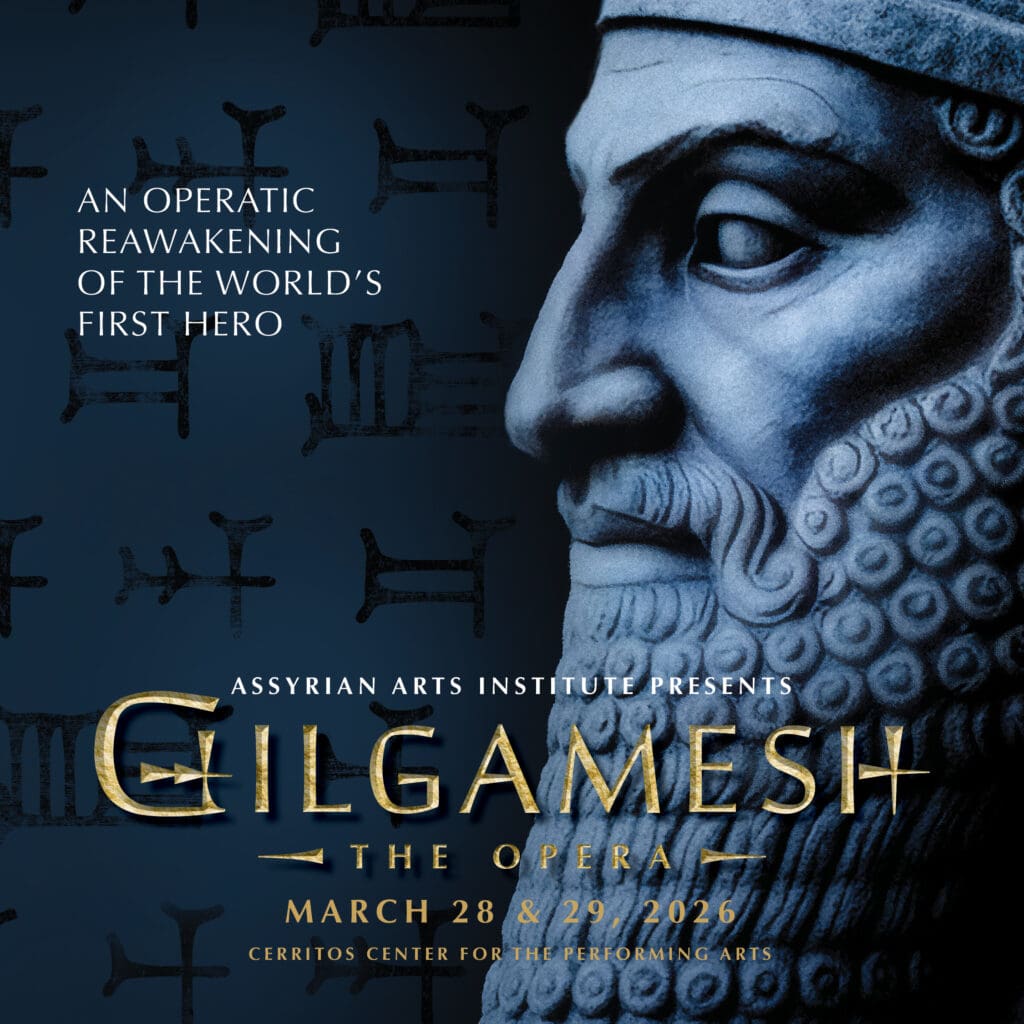
Want to know the quickest way to make me hesitate seeing a new musical? Append “: The Musical” to the title. So, here we have Gilgamesh: The Opera (which seems oblivious to at least seven prior operas based on the Epic of Gilgamesh), an ambitious new opera by composer Derrick Skye and librettist Diana Farrell, produced by Assyrian Arts Institute in partnership with Bridge to Everywhere and Lyric Opera of Orange County, which premiered last weekend at Cerritos Center for the Performing Arts for two performances.

The opera begins with the goddess Ninsun giving birth to Gilgamesh, who is two-thirds divine and one-third mortal. He grows up to be king of the city of Uruk, terrorizing his subjects and calling dibs on every eligible young maiden. Meanwhile, Ishtar, goddess of love and war, creates from clay a horned man named Enkidu as a brother for Gilgamesh. But before they meet, Enkidu has to have sex with some woodland nymph. Back in Uruk, Gilgamesh interrupts a wedding to exercise his right of the lord when, suddenly, Enkidu appears. Gilgamesh and Enkidu bond instantly, and everyone in town is happy. Ishtar, however, now wants Gilgamesh for herself, but he spurns her, unleashing her wrath. The two men then go on a series of adventures until Enkidu dies in a fight. Grieving, Gilgamesh goes on a journey to achieve immortality for the second half of the opera.

It has the ingredients for an exciting opera, but the story is confusingly told. The character of Gilgamesh is split into two roles: “Young Gilgamesh” for a dancer, and “Aged Gilgamesh” who speaks for Young Gilgamesh. Some minor characters are dancers with other people singing over them, while Enkidu is played by a dancer who doesn’t have any vocal counterpart. It’s hard to follow, and I was never sure on whom to focus, causing me to miss vital information. Librettist Farrell, who also directed, approached the story like a pageant, assuming that I was already familiar with it (I was not). Characters don’t get developed. Major plot points land without warning. The many gods, who play a major role, cycle on and off and are indistinct from each other, with only Gilgamesh’s mom and Ishtar making any kind of impression. Farrell plunges into banalities, such as when characters describe Gilgamesh as someone who will “change the story of mankind.” The sparse, haphazard use of ancient Akkadian—a dead language—didn’t add much beyond forcing me to look up at the translation. By the time I realized the performers were no longer singing English, most of the words had already flashed by. Frankly, it shouldn’t have been translated at all. Diction was fair. The ending, clichéd.

Composer Skye structured this, his first opera, as a series of disconnected scenes. To his credit, the music is lively and energetic, unlike a lot of new operas. María Fátima Corona del Toro conducted the large 44-piece ensemble, which included tamboura, nay, and qanun, lending a feeling of Middle Eastern authenticity. However, Skye also included jarring electronic percussion, which removes a sense of time and place. Musical pacing is off-balance. The first half is all bombast, like seeing a third-world knockoff of a Hollywood action movie—that is to say, relentlessly loud and flashy without much reason. The second half, however, is quiet, with similarly little variation. There are no real emotional peaks and valleys, nor much in the way of arias.
Neither is there anything to bridge the dead silences between each scene. Every time it builds momentum, the music and the visuals stop, leaving us in awkward darkness.

Disappointingly, the opera was amplified. Ian Smith’s sound design brought everything to the same volume, removed directionality, and discouraged epic acting, given that everyone was performing for the microphone. Kristin Serena took on too many duties—three of which were technical direction, lighting design, and scenic design. Her lighting repeatedly failed to guide my eye to whoever was singing, leaving me lost. For the two Gilgameshes, she put a bright white spotlight on the speaking, stationary Aged Gilgamesh instead of focusing on Young Gilgamesh, where all the action was happening. The set consisted primarily of a castle made of bricks that resembled the top of a baked cheesecake. It wouldn’t have been too bad had it not looked like it was built in a shop and then thoughtlessly sawed up for transport. It desperately needed spackle and paint to fill in the cuts. Extensive, washed-out projection design by Greg Mitchel was mostly concerned with displaying ancient artifacts instead of telling the story.

Costumes by Joy Omiesh were varied, sparkly, and sexy, taking every possible chance to show skin, just like a good Italian sword-and-sandal picture. However, Enkidu and the Gilgameshes wore distracting, chunky foam-rubber shoes, whereas everyone else had thin footwear that went with the costumes. Choreography by Stephen Martin Allan was all over the place and needed to be sharper. For all the aggressive masculinity and fighting on display, it felt restrained (Enkidu’s death by a wimpy rope slap on the shins is an example). Young Gilgamesh’s choreography felt only loosely connected to Aged Gilgamesh’s monologues. A mass-dance a bit done in the Bollywood style was a particularly low point. In his favor, Allan’s choreography was surprisingly erotic, such as having the entire dance ensemble stroke Young Gilgamesh’s shimmering bare torso—not once, but twice. I was prepared to start counting.

Ahmad Joudeh played Young Gilgamesh, gleefully bounding across the stage as the character who, literally, is superior to all around him in every way. Vitor Luiz played Enkidu and held his own against Joudeh, with whom he shared genuine chemistry. Alas, both were gone after intermission. (It says something when the most charismatic performers in an opera are mute.) As Aged Gilgamesh, Laurence Varda looked about the same age as Joudeh; I found him unconvincing. Why are local companies so reticent to cast older actors? Of the singing actors, only soprano Anne Elise Teeling as the hot-tempered Ishtar got much to do, but she always held my attention whenever she was on stage.

The second half was devoted to Aged Gilgamesh’s quest for immortality, but there was such a disconnect between the two Gilgameshes, and such a lack of character development, that I found it difficult to care. And then it became all about his “legacy,” and I really didn’t care. The program explains all this in terms of identity, cultural respect, survival of the Assyrian diaspora, and a seemingly endless parade of academic obsessions that, I would think, general audiences don’t tend to care about. Which comes to the major problem of Gilgamesh: The Opera: by leading with the message, the creators neglected to craft a story that can be enjoyed on its own.

photos by Christina Gandolfo for Assyrian Arts Institute
Gilgamesh: The Opera
The Assyrian Arts Institute, Lyric Opera of Orange County, and Bridge to Everywhere
Cerritos Center for the Performing Arts; 18000 Park Plaza Drive
played March 28 and 29, 2026
follow Gilgamesh: The Opera on Facebook and Instagram


Want to know the quickest way to make me hesitate to read a review? Take a superior, snide tone, act as if you should have been the target audience, and turn the few positive assessments into negatives. I don’t care that you didn’t care about things. Yes, the libretto assumed you know the story–and in case you didn’t, that you would use the program to inform yourself of the scenes to come. There were uneven aspects to the production but this mean-spirited, petty condescension does no justice to the landmark collaboration and cultural expression of this work, which is SO meaningful to experience right now, given what is happening in the world–the world that exists outside the narrow perspective of this reviewer.
I saw this production as well and I’ve been totally baffled by the glowing reviews. The emotional energy of the whole show evaporated after the intermission.
An Assyrian here, agreed!
Thank you for your professional and honest opinions. This Assyrian agrees with you.