


Areas We Cover
Categories hhhh

Off-Broadway Review: THE ADDING MACHINE (The New Group at St. Clement’s Theatre)

by Gregory Fletcher | April 14, 2026
in New York, Theater
MAN VS. MACHINE,
STILL LOSING
Rice’s century-old warning
lands with unsettling familiarity
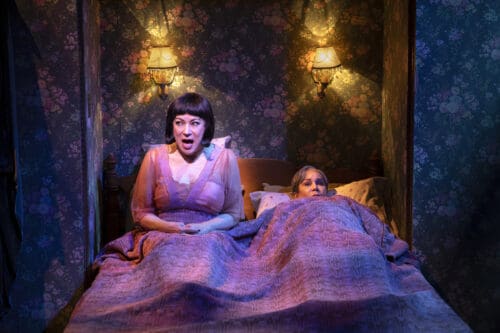
Jennifer Tilly and Daphne Rubin-Vega
In its inaugural production at the newly claimed St. Clement’s Theatre, The New Group launches its next chapter with a revival of The Adding Machine that feels both like a nod to the past and a wary glance toward the future. Written by Elmer L. Rice in 1923 and here revised by Thomas Bradshaw, the production preserves much of the original language while attempting—per Bradshaw’s program note—to extend a measure of clarity to its characters for a modern audience. The result is a biting evening of theater that underscores how little has changed in a century defined by technological acceleration and economic unease.
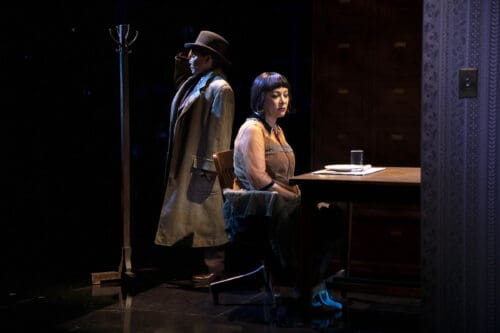
Daphne-Rubin Vega and Jennifer Tilly
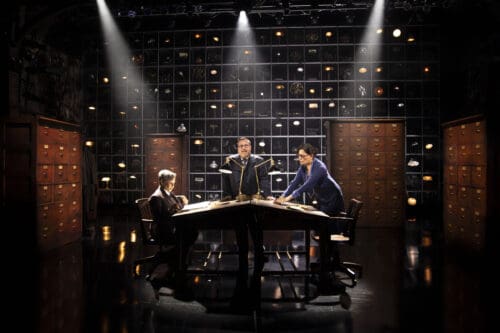
Daphne Rubin-Vega, Michael Cyril Creighton and Sarita Choudhury
Rice’s expressionistic world—free of kitchen-sink realism—exposes the darker impulses that surface when human beings feel cornered by progress. Scapegoating, blame, and existential dread bubble up in the wake of mechanization, and the parallels to our current anxieties are unmistakable. Director Scott Elliott leans into a fluid, playful staging with a star-studded cast. Michael Cyril Creighton serves as host, narrator, and a chameleonic presence across roles of varying ages and genders. Creighton appears to relish every moment, guiding the audience with a wink that never quite dulls the play’s sharper edges. For a more heartfelt, grounded performance, Sarita Choudhury’s Daisy offers a touching portrait of monotony, disappointment, and hope.

Daphne Rubin-Vega and Michael Cyril Creighton
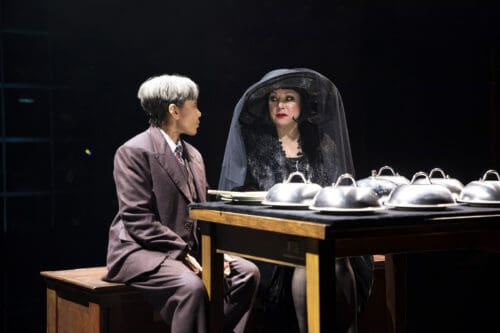
The evening begins with Jennifer Tilly as Mrs. Zero, who faces the formidable task of opening the play with a lengthy monologue that must establish tone, style, and stakes all at once. Tilly rises to the challenge with remarkable control. Her singular vocal quality—so often a comic asset—proves equally effective in this expressionistic register, allowing her to balance humor, pathos, and dissatisfaction in equal measure. Her full leap of commitment throughout Act I is total, making her absence in Act II all the more keenly felt.
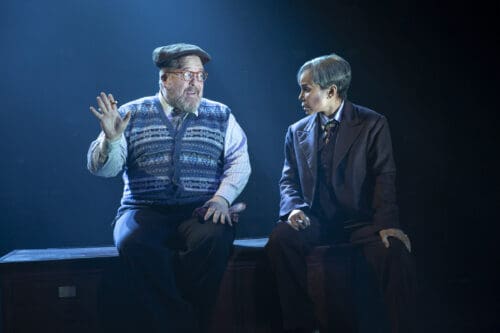
Michael Cyril Creighton and Daphne Rubin-Vega

Daphne Rubin-Vega, Michael Cyril Creighton and Sarita Choudhury
Costumes by Catherine Zuber strike a deft balance between period grounding and theatrical flourish—none more memorable than Tilly’s striking black ensemble (both glamorous and comedic) for her character’s farewell to her husband. Yet Zuber’s most astonishing transformation is that of Daphne Rubin-Vega, who disappears entirely into the role of Mr. Zero. Aided by wig designer Tom Watson, Rubin-Vega constructs a performance that is physically, vocally, and emotionally complete. There is no trace of self-consciousness here, no flicker of the performer beneath the character’s worn exterior. It is a feat of total embodiment, and one that seems destined for recognition—and rightly so.

Daphne Rubin-Vega and Sarita Choudhury

Daphne Rubin-Vega and Sarita Choudhury
Visually, the production is a victory of ingenuity. Derek McLane’s set makes striking use of tall wooden file cabinets that transform with elegant simplicity into a stand-up coffin, a garden, a bedroom—an entire world of shifting realities. The upstage expanse of shelves, lined with desk lamps, typewriters, and adding machines, gives Jeff Croiter’s lighting design many advantages to enhance the environment. With additional side lighting of evocative blue patterns, his design weaves narrative elements into moments of vivid electrocution and static. Stan Mathabane complements the visual language with a score that ranges from subtle to boldly electric, with contemporary music—his use of “Creep” during a dance sequence lands as the evening’s most tender moment.
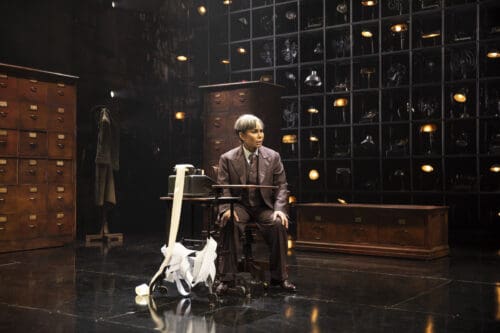
Daphne Rubin-Vega
A century on, The Adding Machine remains disturbingly relevant, its vision of human obsolescence and moral compromise echoing loudly in our own era. It is a strong, assured start for The New Group in its new home—one that anticipates a promising future as the company settles into its 30-year lease and forthcoming renovations.
✦ ✦ ✦ ✦ ✦ ✦ ✦ ✦ ✦ ✦
photos by Monique Carboni
The Adding Machine
The New Group
St. Clement’s Theatre, 423 West 46th Street, New York
Tue–Sun at 7; Sat at 2
livestream on Tue, May 5 at 7
ends on May 17, 2026
for tickets, visit The New Group
✦ ✦ ✦ ✦ ✦ ✦ ✦ ✦ ✦ ✦
