


Areas We Cover
Categories

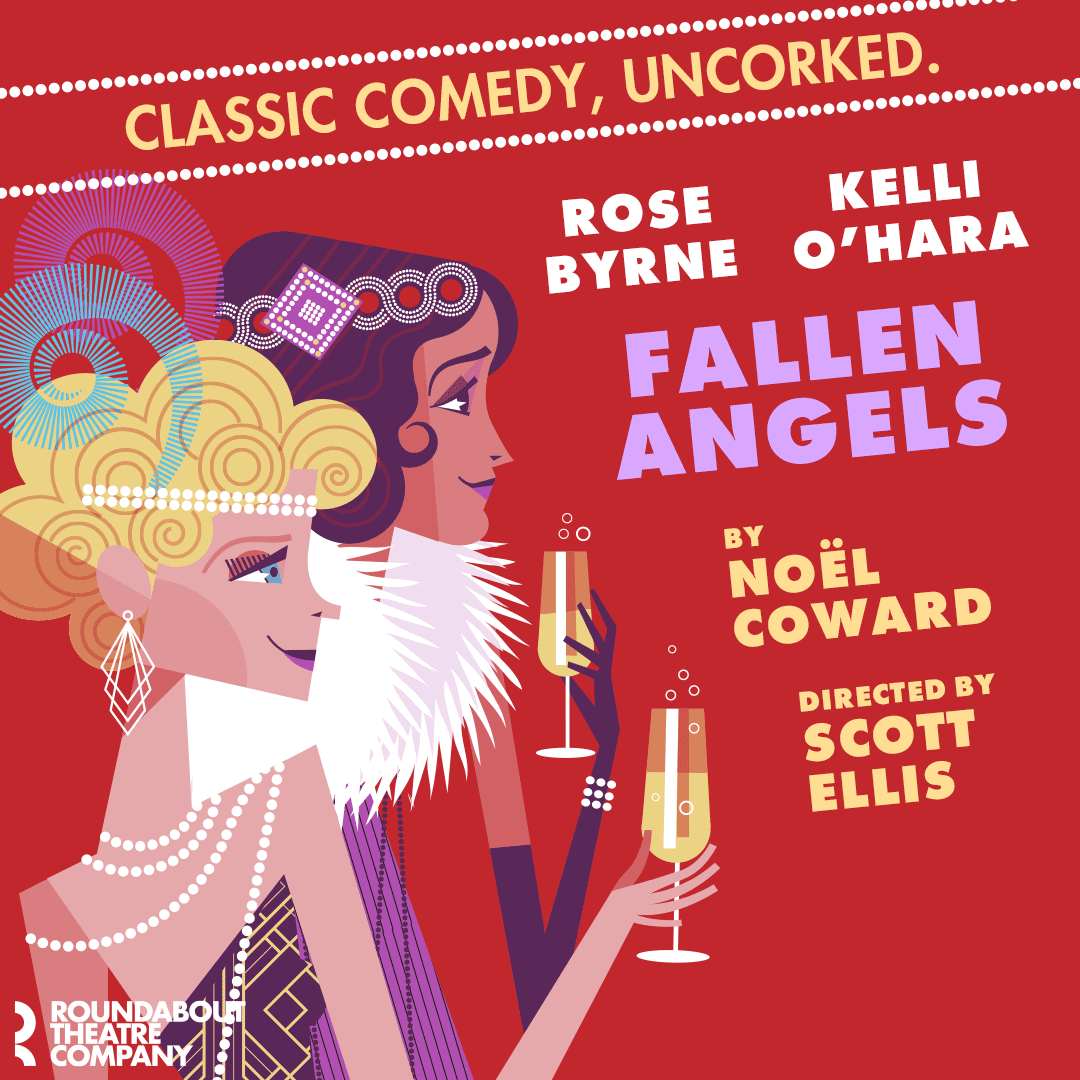
Broadway Review: FALLEN ANGELS (Roundabout Theatre Company at Todd Haimes Theatre)
by Paola Bellu | April 22, 2026
in New York, Theater
A LITTLE SIN, A LOT OF GIN
A fizzy Noël Coward comedy where anticipation
—and alcohol—do the heavy lifting
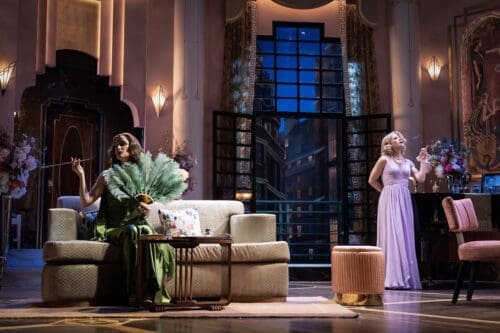
There is a particular kind of overupholstered, well-mannered, and suffocating living room that exists primarily so that someone may eventually misbehave in it. In Fallen Angels, now at the Roundabout’s newly renovated Todd Haimes Theatre, writer Noël Coward fills such a room with anticipation, alcohol, and two wealthy women who are far more interesting than their husbands. Written 100 years ago, in 1925, it has a trivial premise: Julia (Kelli O’Hara) and Jane (Rose Byrne) learn that Maurice (Mark Consuelos), a French lover they had in common before they married, will be passing through London and wants to see them. Nothing much happens, and yet everything happens because Coward understands anticipation: Maurice is arriving, delayed, imagined, feared, desired, and blamed without even being there. After hours of steady drinking, Julia and Jane reach a pleasantly wobbly state where their friendship is revealed to be a sport, complete with scoring, rule-breaking, and emotional injuries.
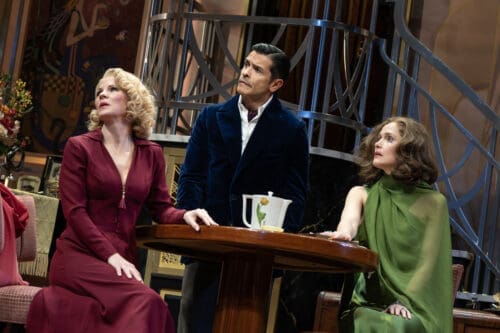
Director Scott Ellis manages to give the actors plenty of room to lean into the clownishness of their roles while still keeping them neatly contained inside a very tasteful, very grown-up Art Deco sandbox. Composed, matter-of-fact, wryly funny yet impeccably refined, O’Hara anchors Julia, a role originally played by Tallulah Bankhead. Byrne’s Jane opens a little stiff and stylized, but the actress quickly reveals a more layered presence, simultaneously graceful and absurd, commanding and off-pace, never quite losing the faint dignity she carries even during the many falls. She is so comical that, at one point, even O’Hara loses composure for a few seconds.
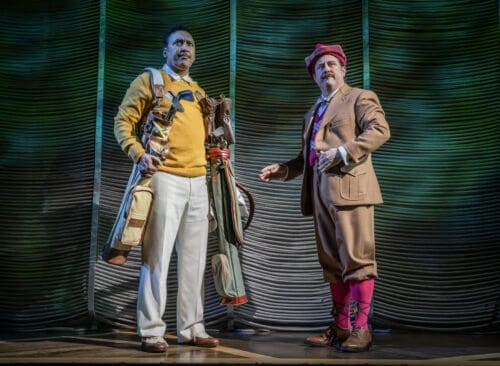
We see Julia’s husband Fred (Aasif Mandvi) packing his things at the beginning, ready to go off for a golf weekend with Jane’s husband Willy (Christopher Fitzgerald), both pleasant, oblivious, and insignificant men. They exist mostly to confirm that marriages used to be—and still are—a long-term commitment of convenience for too many people. Coward sketches both characters with affectionate indifference, but the actors do their best to animate them. Mandvi’s Fred is a walking endorsement for routine—cheerful, uncurious, and restless—while Fitzgerald’s Willy has the same demeanor but a more fastidious, humorous edge.
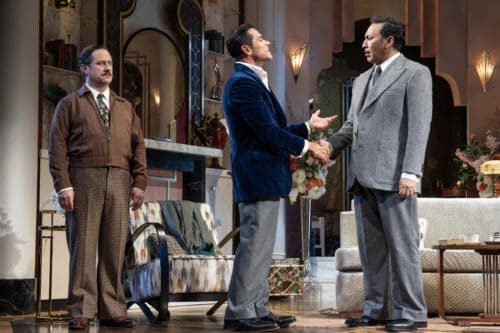
Maurice, instead, is a carefully curated recollection of a Frenchman, the symbol of effortless charm born only to disturb marriages. By the time Consuelos appears, near the finale, he cannot possibly compete with the version the two women have created, but he does his best to fulfill the cliché as Coward intended. Saunders the maid is another trope, although this one is ancient. Played by Tracee Chimo, Saunders is puzzlingly well-educated, knows more about golf than Fred, plays the piano better than Julia, and speaks French better than anybody in the wealthy home. The trope of the clever servant goes back to ancient Greek comedy, then ancient Roman comedy, where the role had a name, servus callidus, but it still works in 2026, and Chimo is a delightful know-it-all. My favorite line of hers: “If you’ll allow me to say so Madam, several drinks never did any harm; it’s only the first drink which is dangerous; after that the damage is done.”
The entire play unfolds in Julia and Fred’s Art Deco living room, designed by David Rockwell. He plays cleverly with levels: a curvilinear floor plan softens the rigid geometry, creating a “salon” atmosphere; a raised platform upstage contrasts with a sunken living area downstage, and a raised mezzanine with a chrome-finished geometric railing—all giving the actors different territories to inhabit. The furniture is low, curved, and indulgent, softening the room’s sharper architectural lines. Upstage center is claimed by a grand, stepped-arch window with a dark grid of muntins that gives it graphic authority over everything else, setting a romantic cityscape in view that makes clear place and time. It is a perfect set, both practical and strikingly theatrical.
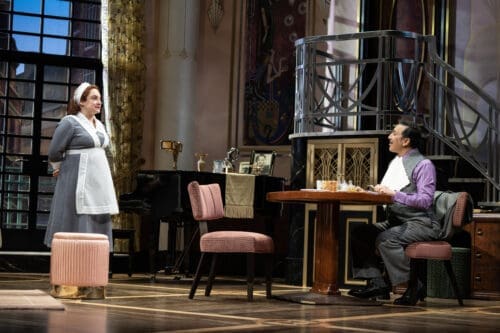
Costume design by Jeff Mahshie is a lesson in how fabric should behave under stage lights. Everything is cut to move, to catch the light at the right moment, and both actresses use their dresses almost as props. Byrne is all shimmer in forest-green satin, cut on the bias and glowing as she moves. O’Hara keeps it lighter in a floor-length lavender dress, all soft pleats and vertical lines that nod to the set. And there is a sly elegance to Kenneth Posner’s lighting, a very important part of the atmosphere. Outside, from the stepped-arch window, we see the day progressing until a rich cobalt light announces evening. Inside, things relax into a warm amber haze: the large chandelier serves as the primary motivated light source, frosted sconces send a soft glow upward, flattering the columns and vertical design. The actors, meanwhile, are kept in impeccable focus with discreet front lighting, just enough to make sure no raised eyebrow goes unnoticed. Sound design by John Gromada completes the extremely professional work of the creative team.
While Fallen Angels may strike us as frivolous, remember that Noël Coward wrote it at 24, and it opened in 1925, well before the 1970s turned its themes into clichés. At the time, the play was even threatened with censorship by the Lord Chamberlain’s office in London. Sexual desire, marital boredom, premarital sex, possible adultery, and alcohol abuse were male prerogatives unless you were a “wretch.” Farce was perhaps the only viable way to stage them if you wanted to portray wealthy women and male sexual hypocrisy. There are no withering barbs here, no Wildean sparkle or Shakespearean flourish—but go anyway. The acting is absolutely first-rate, the staging delights, and you will certainly leave feeling better for it.
✦ ✦ ✦ ✦ ✦ ✦ ✦ ✦ ✦ ✦
photos by Joan Marcus
Fallen Angels
Roundabout Theatre Company
Todd Haimes Theatre, 227 W 42nd Street, New York
ends on June 7, 2026
for tickets, call 212.719.1300 or visit Roundabout
✦ ✦ ✦ ✦ ✦ ✦ ✦ ✦ ✦ ✦
