


Areas We Cover
Categories

Broadway Review: JOE TURNER’S COME AND GONE (Barrymore Theatre)

by Paola Bellu | April 25, 2026
in New York, Theater
FINDING YOUR SONG
Debbie Allen’s revival honors Wilson’s
depth with a richly realized production
Cedric the Entertainer, Taraji P. Henson
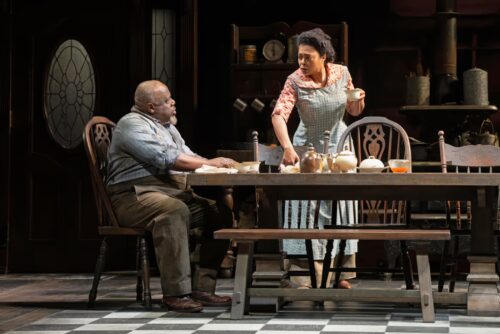
The Barrymore Theatre’s revival of August Wilson’s Joe Turner’s Come and Gone, directed by the very talented Debbie Allen, is an exquisitely crafted classic production brought to life by a thoughtfully assembled cast and creative team. Set in 1911, the story unfolds in a Pittsburgh boarding house run by the unswerving Seth and his wife, the epitome-of-motherhood Bertha. Their home offers refuge to Black travelers navigating the upheaval of the Great Migration, when, from 1910 through 1970, five million Black Southerners had to move to Northern cities to escape systemic racism, sadistic Jim Crow laws, and widespread economic oppression, only to encounter new forms of hardship.
Taraji P. Henson
To fully grasp the play’s title and emotional stakes, it’s important to know that Joe Turner (or Turney) was the brother of Peter Turney, the Governor of Tennessee from 1893 to 1897. His deputies would create traps like crap games, drinking parties, anything that would give them the excuse to arrest Black men and then force them into chain gangs, to work as slaves on white-owned “farms”. They didn’t call it slavery because it was abolished on paper; they called it peonage, but it was a similar racist abomination. The title of the play is a line from “Joe Turner Blues”, an early song by W.C. Handy (1873-1958) that describes how easy it was to be kidnapped, to be “disappeared”, with no trace for family or friends to follow.
Savannah Commodore, Joshua Boone
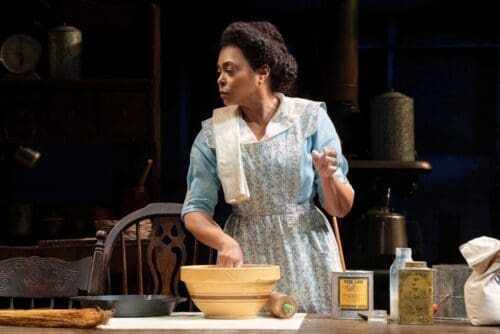
The play starts, and one by one the main characters are introduced. Seth and Bertha, the owners of the boarding house, stand in the main room watching Bynum, one of their guests, outside in the backyard. Seth grumbles about Bynum’s odd spiritual rituals, killing pigeons, throwing their blood, while Bertha insists he should leave him alone since he causes no trouble. Wilson cleverly establishes all three personalities within the first ten minutes, a rarity in contemporary plays and films. The roles of Bertha and Seth feel almost tailor-made for Taraji P. Henson and Cedric “The Entertainer”; Henson disappears so completely into lovely Bertha that the performance feels effortless and vividly real, while Cedric’s Seth embodies the perfect pragmatic, no-nonsense, hard-working husband.
Ruben Santiago-Hudson
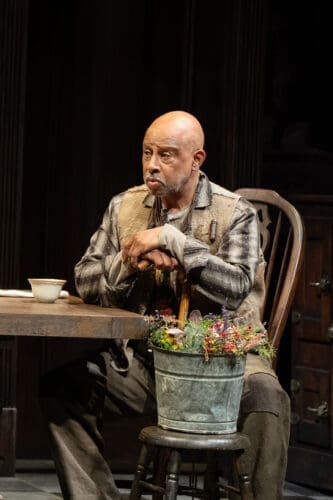
Bynum, instead, represents a metaphysical sensibility rooted in African cosmology, a cheerful folk healer, and Ruben Santiago-Hudson delivers a splendid, often scene-stealing performance. At one point, Bynum drops a story about meeting a glowing “shiny man” who told him to find his life’s purpose, his own “song” that in his case binds people together like some kind of spiritual glue. His father was a healer, he is a binder, and an extremely patient life coach for the spiritually disoriented.
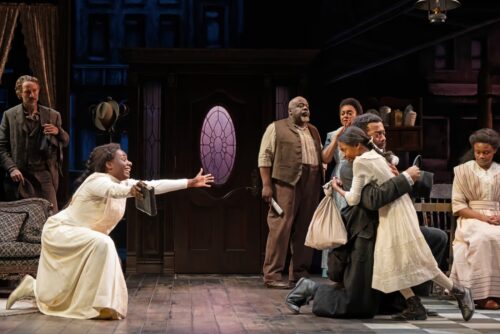
The Cast of JOE TURNER’S COME AND GONE
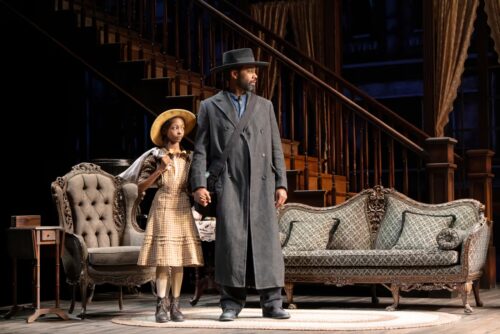
A younger guest, Jeremy (Tripp Taylor), has just been arrested for drinking, which leads Seth into a full “the North is not what it promised” speech, complete with the reasonable worry that opportunity is about to get snatched up by the waves of starving white folks arriving everyday from Europe. Enter Selig, literally a traveling “People Finder” played by a very convincing Bradley Stryker, a grubby white dude who buys the dustpans Seth makes. Jeremy returns to the boardinghouse complaining about being detained for drunkenness despite being sober, and that’s when preacher Herald Loomis arrives, played by an ominous Joshua Boone, with his young daughter Zonia (Savannah Commodore), under a heavy cloud of mystery. His search for his wife, Martha, drives the play’s narrative.

Joshua Boone and the Cast of JOE TURNER’S COME AND GONE
Seth distrusts Loomis on sight, Bynum hopes to rescue his spirit, and Bertha just wants to feed him and settle everyone down; she is the unifying force and the guiding conscience. Things get even messier when humble Mattie (Nimene Sierra Wureh) shows up hoping Bynum can fix her love life, only to be told that you cannot magically bind a man who has left you (everybody seems to leave Mattie). Jeremy immediately says “I am available” to her, solving heartbreak with questionable timing, while children Zonia and Reuben (Christopher Woodley) casually discuss scary stories like pigeon blood rituals, ghosts, and dear dead friends in the backyard. The more afraid they become, the more they cling to each other, soon deciding they will one day marry, a very tender scene well played by the two young actors.

Maya Boyd, Tripp Taylor
A few days go by, and the boardinghouse is still running on anxiety when fancy Molly (Maya Boyd) makes her entrance in her vibrant pink-accented dress and elaborate millinery as the newest young guest. She is the opposite of Mattie, anything but modest, but brings a new spark to the “family”. So much spark that Seth suggests a “juba,” an African-style call-and-response song and dance, marking a lively and joyful interlude in the play, but Loomis shuts it down with a dark spiritual breakdown that escalates into speaking in tongues and collapsing. Bynum has to step in and manage the weird situation like a spiritual first responder, the only one with a clue. That is when Seth, a practical man in a deeply impractical world, decides Loomis has crossed the line from “eccentric” to “liability,” and gives him a deadline to pack up and disappear.
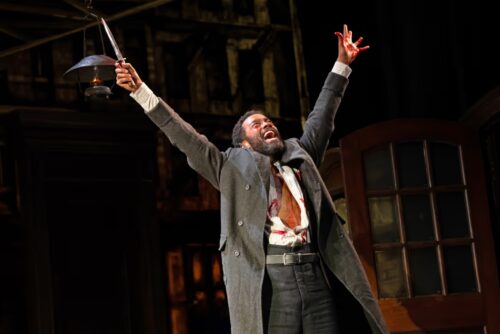
Joshua Boone
To make things harder, Jeremy returns freshly unemployed after refusing to pay a completely unfair 50-cent “job insurance fee” to a white foreman, which Seth, in his pragmatic view, immediately classifies as a stupid decision. Jeremy and Molly, vivaciously portrayed by Taylor and Boyd, embody youthful ambition and total defiance, the new generation, loud and fearless, ready to escape traditional roles and unfair rules.

Cedric the Entertainer
One of the most powerful scenes is when Bynum and Seth are playing a game of dominoes and Bynum starts to sing the Joe Turner song. Loomis loses it again but this time he reveals that he was kidnapped by Joe Turner’s men while trying to preach to a group of gambling Black folks. Arrested on the spot with the gamblers, he was forced into seven years of hard labor. When he finally returned home, he found his daughter living with her grandmother and no trace of his wife, Martha, who had gone searching for him and never came back. Boone delivers a dark, potent performance as a man who is already dead inside and deeply resentful of it. When Martha (Abigail Onwunali) finally arrives, ready to hug her husband and daughter, things don’t go as expected. Go see it, the long finale is powerful and I will not spoil it for you.
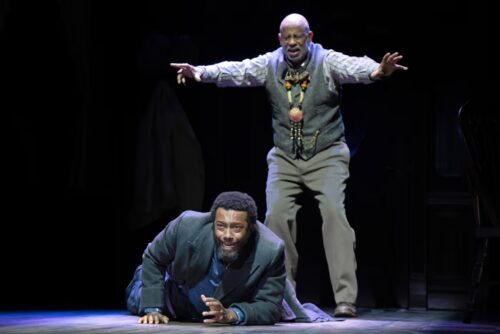
Joshua Boone, Ruben Santiago-Hudson
In David Gallo’s design, the boardinghouse becomes a kind of “refuge,” contrasting the tight, industrial world of 1911 Pittsburgh, shown through a brooding backdrop of smokestacks, metal bridges, and grey sky. A prominent, wooden staircase with an ornate banister anchors the left side of the frame, while the background features only a main door and high windows with lace curtains. Even without walls, it is a true home, complete with side entrance, a large farmhouse-style wooden table, couches, a heavy cast-iron stove and the shelving filled with period-accurate kitchen accessories.
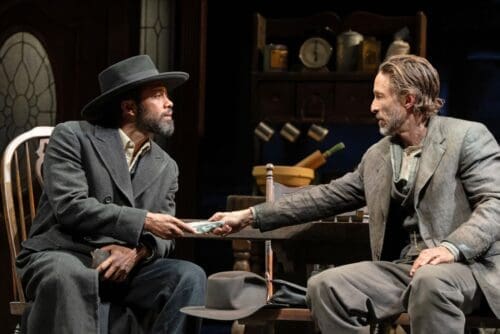
Joshua Boone, Bradley Stryker
Paul Tazewell’s costume design uses texture and silhouette to distinguish between those who have “found their song” and those still searching. Bertha’s floral-patterned dresses and crisp aprons signify her role as a provider of life and warmth, while Seth’s heavy vests and durable shirts ground him in the material world of property and business. Herald Loomis is the production’s visual centerpiece of displacement. His heavy, double-breasted grey overcoat and wide-brimmed black hat act as a literal and figurative burden. The fabric is weathered and dust-caked, contrasting sharply with the attire of the residents. Stacey Derosier’s clever lighting design and Justin Ellington’s sound design finalize the interplay between the grounded reality of the kitchen and the looming shadows of the industrial city, the outside cruel world, creating a visual pressure that mirrors the characters’ struggles.
Joe Turner’s Come and Gone is a play about the aftermath of liberation, about what it means to be free when the structures of oppression persist in the lives and memories of its victims. Wilson avoids tidy resolutions, choosing instead to tell many smaller stories, each with its own arc. He transforms this modest setting into a microcosm of the African American experience, where history is not merely recounted but embodied. The only issue I noticed was during the two spiritual communal moments, where movement alone doesn’t fully convey what is happening, but it only amounts to a few minutes within the 140 minutes. Worried it might be too heavy? Relax, there are plenty of laughs, lively moments, and a first-class production brought to life by an exceptionally talented team.
✦ ✦ ✦ ✦ ✦ ✦ ✦ ✦ ✦ ✦
photos by Julieta Cervantes
Joe Turner’s Come and Gone
Barrymore Theatre, 243 West 47th Street, New York
2 hours and 20 minutes, with intermission
ends on July 26, 2026
for tickets call 212.239.6200 or visit Telecharge or Joe Turner Bway
✦ ✦ ✦ ✦ ✦ ✦ ✦ ✦ ✦ ✦
