


Areas We Cover
Categories

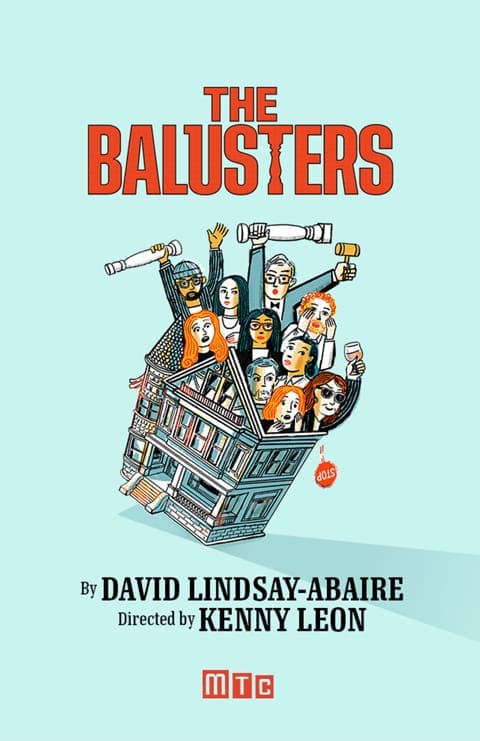
Broadway Review: THE BALUSTERS (Manhattan Theatre Club at the Samuel J. Friedman Theatre)
by Gregory Bernard | April 26, 2026
in New York, Theater
STOP SIGNS AND
SOCIAL SIGNALS
Sharp, humane, and richly acted, this
new comedy lands with both wit and weight
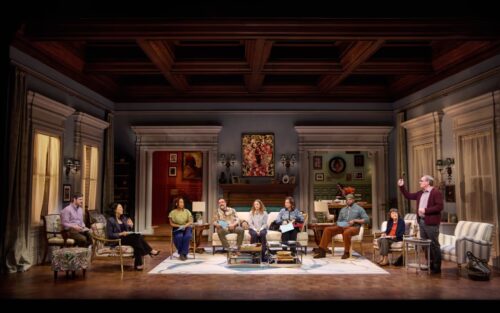
Michael Esper, Jeena Yi, Anika Noni Rose, Ricardo Chavira, Kayli Carter, Margaret Colin, Carl Clemons-Hopkins, Marylouise Burke, Richard Thomas
In The Balusters, playwright David Lindsay-Abaire once again proves himself a master of tonal tightrope walking—balancing biting social critique with deep wells of empathy, all wrapped in the polished veneer of a parlor room comedy.
Set in the manicured, tree-lined enclave of Vernon Point, a landmarked East Coast suburb clinging to its identity, the play unfolds within the elegantly appointed parlor of a grand Victorian home. Beyond the neighborhood borders lie apartment blocks and discount stores—a constant reminder that the world is changing too fast. The immediate crisis? Speeding traffic cutting through side streets to avoid a newly installed traffic light on a neighboring road—necessitating, at least to some, the urgent addition of three stop signs. But as ever in Lindsay-Abaire’s work, the ostensible issue is merely kindling for a much larger fire.
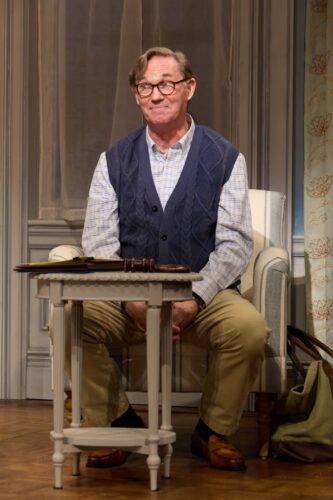
Richard Thomas
At the center sits Elliot Ermson, played with remarkable nuance by Richard Thomas. Yes, he is the old white man resistant to change—but Thomas, aided by impeccable casting (Caparelliotis Casting, Kelly Gillespie), imbues him with such decency and lingering warmth that his eventual unraveling arrives not as inevitability, but as heartbreak. By the play’s end, the audience is caught in a complicated emotional bind: we recognize that Elliot must step aside, even as we understand, perhaps uncomfortably, why he cannot.
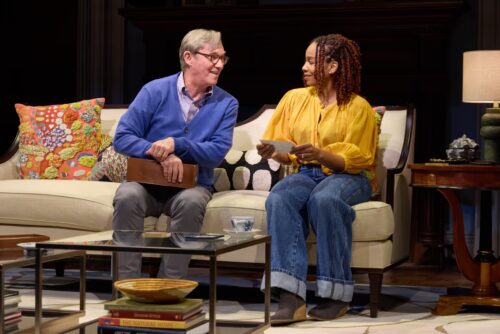
Richard Thomas and Anika Noni Rose
The Neighborhood Association itself is a microcosm of a shifting America. Its members include Brooks Duncan (Carl Clemons-Hopkins), a married Black gay man; Melissa Han (Jeena Yi), a lesbian Asian American; Isaac Rosario (Ricardo Chavira), Latino and pragmatic; and Kyra Marshall (Anika Noni Rose), the Black female newcomer to the board whose presence shifts the room’s power dynamics. Even Willow Gibbons (Kayli Carter), ostensibly the “safe” white liberal female, has her own complexities via a newly transitioning partner.
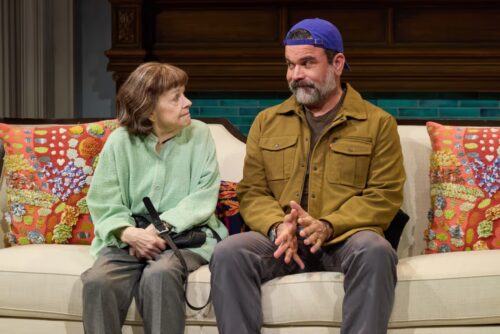
Marylouise Burke and Ricardo Chavira
And then there is Penny Buell, the Association’s secretary, played by the incomparable Marylouise Burke. A longtime Lindsay-Abaire collaborator, Burke is nothing short of a theatrical treasure. She doesn’t need witty dialogue to elicit laughs. With a single “interesting” or “anyway,” she detonates laughter, her impeccable timing turning throwaway lines into comic landmines.
What distinguishes this production, however, is its true ensemble nature. No single performance dominates; rather, each actor contributes a fully realized, deeply human portrait. Even the housekeeper, portrayed by Maria-Christina Oliveras—a role too often relegated to the margins—commands a pivotal, applause-worthy moment of transformation. The ensemble (also including the strong stage veteran Margaret Colin and the subtle Michael Esper) operates with such cohesion that one leaves hoping awards will be bestowed collectively.
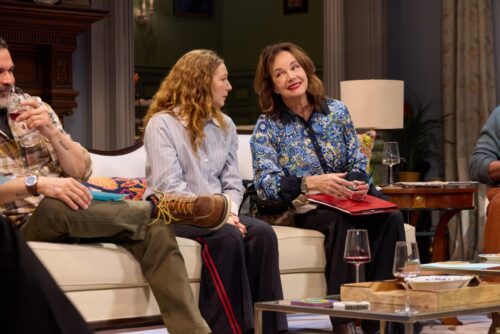
Ricardo Chavira, Kayli Carter and Margaret Colin
Visually, the production is a feast. Derek McLane’s parlor set is nothing short of magnificent, extending into a visible foyer and dining room that suggest an entire world beyond the immediate action. Allen Lee Hughes’s lighting and Dan Moses Schreier’s original music and sound design elevate scene changes into something almost cinematic—fluid, rhythmic, and distinctly contemporary.
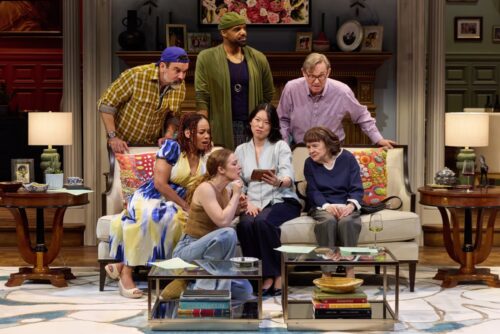
Ricardo Chavira, Carl Clemons-Hopkins, Richard Thomas, Anika Noni Rose, Jeena Yi, Marylouise Burke and Kayli Carter
Spanning four months, the seven scenes offer four board meetings, keeping director Kenny Leon busy with the frequent changes of furniture and props, but accomplishing the feat with precision and inventiveness, using nightclub-like transitions that keep the energy pulsing even as the characters reset props and make costume changes. The play is said to run one hour and fifty minutes without intermission, though my performance was closer to two hours. While maintaining momentum, it does raise the question of why a break wasn’t inserted after the third scene when Kyra delivers a thunderclap ultimatum that feels like a natural act break.
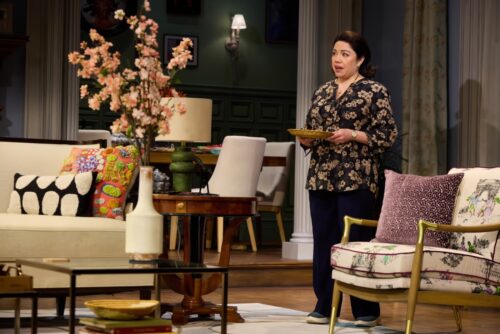
Maria-Christina Oliveras
Lindsay-Abaire’s script thrives on subtext. Every character arrives armed with history—alliances, grudges, half-buried resentments—and the audience leans forward, eager to decode the shifting dynamics. Importantly, no one is without flaw. Each vote cast, each stance taken, emerges from a tangle of personal bias and lived experience, rendering the debates both maddening and deeply recognizable.
Comparisons to Eureka Day by Jonathan Spector are apt and deserved. Like that play, The Balusters captures the absurdity and high stakes of well-meaning people attempting governance in a fracturing world. And while it nods to the grand tradition of comedies of manners—think Hay Fever, The Philadelphia Story, or The Man Who Came to Dinner—it updates the form for a 21st-century audience, where identity, privilege, and progress are no longer subtext but central battlegrounds.
By the time the board reconvenes for its July meeting, nothing is quite the same. Alliances have shifted, façades have cracked, and Vernon Point—like the country it mirrors—stands on the precipice of transformation.
The Balusters is not just a fabulous new play; it is a vital, invigorating reminder that even the most polite rooms can contain seismic change.
✦ ✦ ✦ ✦ ✦ ✦ ✦ ✦ ✦ ✦
photos by Jeremy Daniel
The Balusters
Samuel J. Friedman Theatre
261 West 47th Street, New York
two hours, no intermission
ends on June 7, 2026
for tickets, visit MTC
✦ ✦ ✦ ✦ ✦ ✦ ✦ ✦ ✦ ✦
