


Areas We Cover
Categories

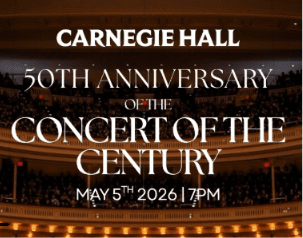
Concert Review: CONCERT OF THE CENTURY (Carnegie Hall / New York City)
by Paola Bellu | May 12, 2026
in Concerts / Events, Music, New York
FIFTY YEARS LATER,
STILL MAKING HISTORY
A glittering lineup of musical giants
turned Carnegie Hall’s anniversary
celebration into an overwhelming
tribute to artistic endurance
Move over MET Gala: Carnegie Hall has just celebrated its Concert of the Century with another once-in-a-lifetime summoning of all-stars. Organized 50 years ago by Isaac Stern, the original event brought together some of the world’s greatest musicians for a legendary concert-celebration, marking the anniversary of the Hall’s opening on May 5, 1891. Fifty years later, a new lineup of amazing music icons made history of its own.
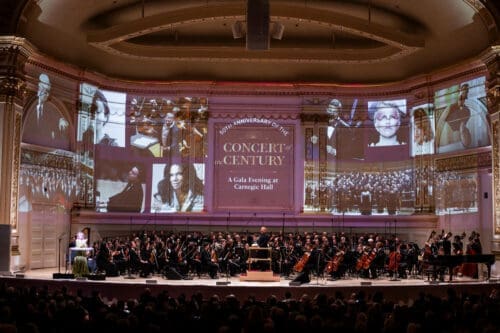
The first notes came from Leonard Bernstein’s Candide Overture, with its unmistakable mix of sophistication and showmanship, an invitation into New York’s busy night life. The mood pivoted into another restless piece, Tchaikovsky’s Allegro molto vivace from Symphony 6 Pathétique, where driving rhythms and the many racing strings captured an almost breathless intensity. At the center stood the dynamic maestro Yannick Nézet-Séguin, conducting the remarkable NYO-USA All-Stars orchestra and the distinguished Oratorio Society of New York.
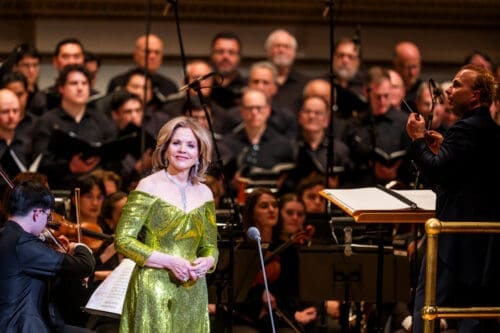
Between the two orchestral works, Renée Fleming appeared as master of ceremonies to remind the audience of the occasion itself. Behind her, large projections traced the history of the Hall through photographs, posters, ticket stubs, and yellowing press clippings, as a scrapbook set to music. When she began singing Mozart’s “Laudate Dominum,” the mood shifted from nostalgia to reverence. Fleming’s soprano entered gently, smooth in texture, silver at the top, unfolding in celestial phrases that seemed to hover over the Hall like mist.
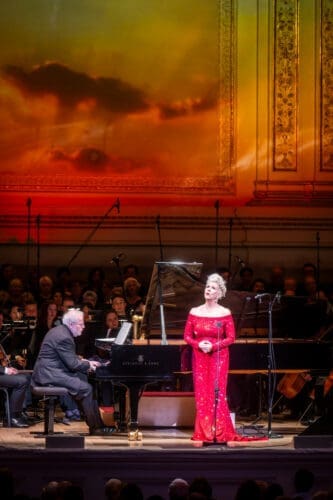
The program then turned introspective with two songs by Mahler: “Ich atmet’ einen linden Duft” and “Ich bin der Welt abhanden gekommen,” performed by Joyce DiDonato. She defies categorization: a coloratura mezzo-soprano who often visits soprano territories, celebrated for her agility and expressive bel canto singing. Interpreting Mahler, she displayed extreme delicacy and restraint, joined by Emanuel Ax whose masterful piano playing brought elegance to every phrase.
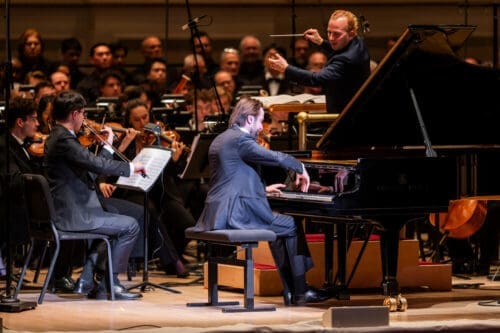
Mahler’s reflective atmosphere gave way to the restless vitality of George Gershwin’s Allegro agitato from the Piano Concerto in F, where syncopated rhythms and jazzy trims restored the evening’s metropolitan pulse. Daniil Trifonov played it spectacularly, combining precision with fearless energy. His playing felt volatile in the best sense of the word, shifting from extreme delicacy to explosive intensity in a single phrase, radiating technical control and rhythmic sharpness in every note.
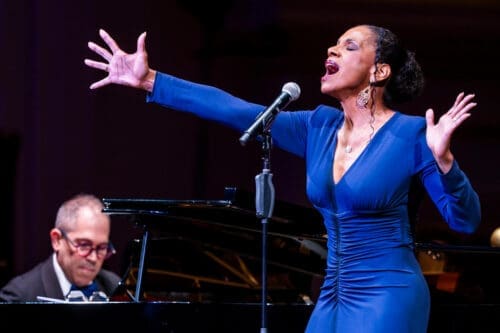
That lingering jazz aura found a natural continuation in Audra McDonald, the most Tony-awarded performer in history and a classical soprano. In Duke Ellington’s “Sophisticated Lady,” she took the work’s elegant melancholy and reframed it through a brilliant use of its lyrics. It came across less as a smoky jazz torch song and more as brilliant storytelling delivered by a radiant, incomparable voice. She continued with Gershwin’s “Fascinating Rhythm” from Lady, Be Good!, all propulsive syncopation and charm, injecting joy into the Hall with the help of Andy Einhorn’s responsive piano work, grounded in flawless collaboration.
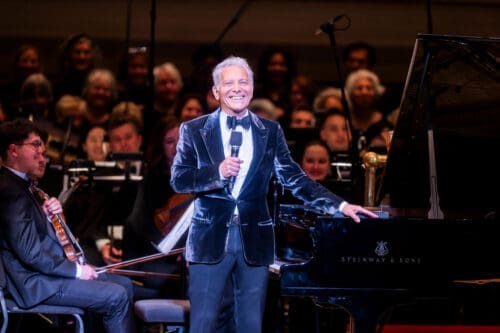
The program then slipped into Hollywood glamour, with Michael Feinstein as its smooth ambassador. Arthur Schwartz and Howard Dietz’s “That’s Entertainment” served as the right ode to performing, followed by the gentle melancholy of Bergman & Legrand’s “How Do You Keep the Music Playing?” Feinstein always tells you a story; his playing was polished, intimate, and completely tailored to his voice. More than a pianist, he is a custodian of the Great American Songbook.
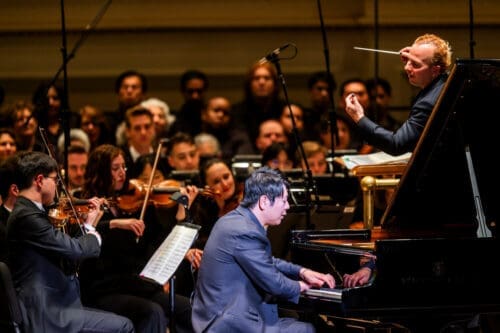
The evening’s pulse quickened with Tchaikovsky’s Allegro con fuoco from Piano Concerto No. 1, dispatched with fire by Lang Lang, and it was memorable. He remains classical music’s great extrovert; few pianists embrace spectacle so wholeheartedly and successfully, but beneath the grand gestures lies an artist of genuine imagination and dazzling technical ability. Then came Opera’s turn with Rossini’s “Non più mesta,” the final aria from La Cenerentola, sung by Isabel Leonard. She completely embraced Cinderella’s transformation from neglected servant to joyful heroine, giving us fast coloratura passages, cascading runs and, most of all, infectious, breathless energy.
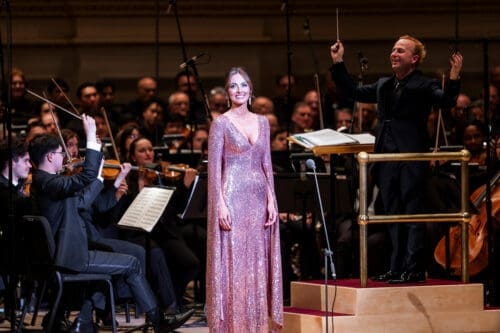
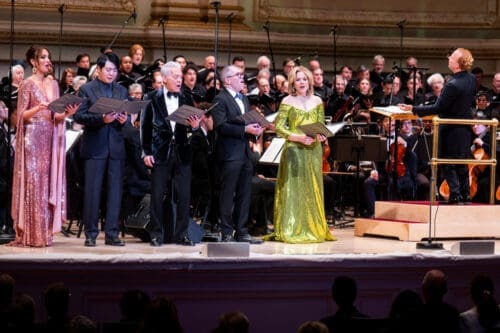
Valerie Coleman’s Seven O’Clock Shout, inspired by the dedication of COVID-era essential workers and the heartwarming custom of 7 PM window-side tributes, briefly pulled us back to when applause from balconies replaced applause from audiences—a bleak period that nonetheless inspired a work of striking beauty. The concert concluded with Bernstein’s “Make Our Garden Grow” from Candide, a deceptively simple finale that swelled into something far larger, gathering orchestra, choir, and soloists into one final embrace. Outwardly optimistic, yet a reminder of all it has taken to arrive where these phenomenal artists are, it was the best way to close the evening. Together, these artists embody the past, present, and future of classical music, and they transformed this anniversary celebration into a living tribute to Carnegie Hall’s enduring legacy, perhaps more necessary now than ever.
✦ ✦ ✦ ✦ ✦ ✦ ✦ ✦ ✦ ✦
photos by Chris Lee
Concert of the Century
Carnegie Hall, 881 Seventh Avenue, New York City
a one-night-only event on May 5, 2026
for more at the landmark venue, visit Carnegie Hall
✦ ✦ ✦ ✦ ✦ ✦ ✦ ✦ ✦ ✦
