


Areas We Cover
Categories hhhh

Off-Broadway Review: THE MAIDS (St. Ann’s Warehouse / Brooklyn)
by Gregory Fletcher | May 27, 2026
in New York, Theater
MIRROR, MIRROR, ON THE WALL
Kip Williams delivers a visually stunning assault
on the senses, even when the drama struggles to keep pace

A co-production with London’s Donmar Warehouse, The Maids arrives at St. Ann’s Warehouse in a blistering new adaptation written and directed by Kip Williams, closing out the season with a production as dazzling as it is merciless. Playing through June 14, Williams once again pushes the boundaries of his evolving “cine-theatre” aesthetic, blending live performance with video technology into something feverish, hyper-stylized, and unmistakably modern.


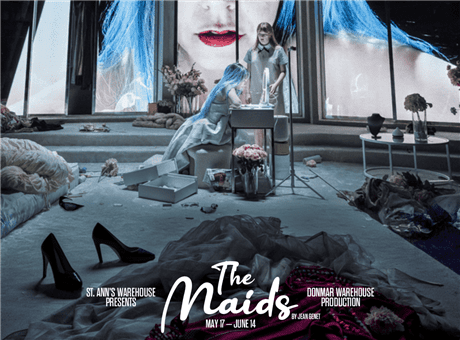
Jean Genet’s work has long existed in a theatrical world of ritualized cruelty, roleplay, and class warfare—this time with the boss from hell and the two maids who keep her life in order. Or do they? Williams embraces all the twists and turns with punishing intensity. Like his celebrated stage version of The Picture of Dorian Gray, cameras are ever-present onstage, though here they emerge organically from the characters’ cell phones and vanity mirror. Video designer Zakk Hein transforms these live feeds into towering projections across mirrored closet doors, layering distorted beauty filters, enlarged lips, fractured reflections, and digital hallucinations over the performers’ faces. The result is among the most technically astonishing uses of multimedia I’ve witnessed—seductive, grotesque, and astonishing.


The sensory assault is heightened by the extraordinary contributions of composer D.J. Walde and sound designer Dan Balfour. Delicate classical passages swell unexpectedly into cinematic orchestration, while nervous ticks and electronic hums keep the audience trapped in a state of perpetual unease. The games people play, the crime, and the injustice are underscored like a psychological thriller.


The cast attacks the material with fearless commitment. Yerin Ha brings an icy glamour to Madame—ruthless and psychotic. Phia Saban and Lydia Wilson deliver wild, ferocious performances as the two maids, Solange and Claire. The latter two barely leave the stage during the 100-minute runtime, sustaining a level of physical intensity that borders on exhaustion. All three performers operate at such a heightened pitch that the production rarely allows itself a breath.

That relentlessness is both the production’s triumph and limitation. The evening crackles with electric energy from beginning to end, yet the play’s central ideas—class resentment, servitude, power, privilege—arrive with such blunt force that the audience grasps the point early on. There are surprises embedded within the narrative, but mostly it feels as though we are waiting for the play itself to catch up to the conclusions we have already drawn. Oddly enough, the final turning point involving the tea should feel devastating, but because it is anticipated early on, the act is witnessed but not felt.


Still, Williams keeps the eye constantly engaged. Rosanna Vize’s lavish bedroom set, sprawling across the thrust stage in luxurious disarray, overflows with clothes, cosmetics, and accessories. Marg Horwell’s costumes add another layer of theatrical pleasure, with garments endlessly pulled from closets, worn, and discarded. By the end, the stage resembles the aftermath of a tornado—a glorious nightmare, especially for the stage manager and prop crew.


This is not a warm evening of theatre, nor is it intended to be. Tears are unlikely. Instead, Williams delivers an experience that is cold, charged, confrontational, and visually intoxicating. Fascination and exhaustion replace intimacy and heart, though the production overwhelms as much as it illuminates. Certainly, there is no denying the artistry on display. It is theatre as sensory bombardment: highly theatrical, intensely performed, and impossible to ignore.


✦ ✦ ✦ ✦ ✦ ✦ ✦ ✦ ✦ ✦
The Maids
St. Ann’s Warehouse
45 Water St. in Brooklyn
100 minutes with no intermission
ends on June 14, 2026
for tickets, call 718.254.8779 or visit St. Ann’s Warehouse
✦ ✦ ✦ ✦ ✦ ✦ ✦ ✦ ✦ ✦
Gregory Fletcher is a writer and director. His publishing credits include a craft book on playwriting entitled Shorts and Briefs, as well as a collection entitled A Playwright’s Dozen: 13 short plays. Other publishing includes two YA novels (Other People’s Crazy, and Other People’s Drama), 2 novellas in the series Inclusive Bedtime Stories, 2 short stories in The Night Bazaar series, and five essays. Website, Facebook, Instagram.
