


Areas We Cover
Categories

Off-Broadway Review: GIRL, INTERRUPTED (The Public Theater)
by Gregory Fletcher | June 4, 2026
in New York, Theater
LESSONS INTERRUPTED
A haunting memory play finds its
strongest voice in music, memory,
and an exceptional ensemble
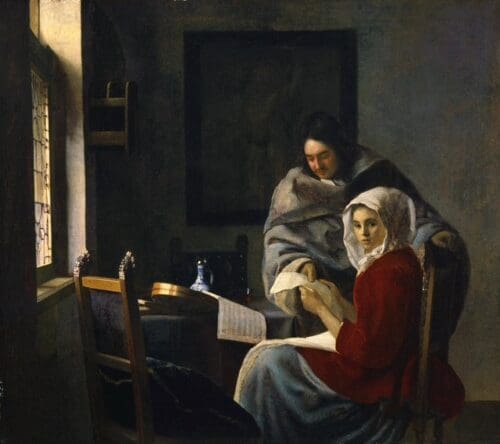
Girl Interrupted at her Music | Johannes Vermeer | c. 1658–1659 | Medium Oil on canvas (15.5 in × 17.5 in) | Frick Collection, New York
There is a painting at the Frick—a Vermeer—of a girl at her music lesson, her teacher’s hand resting on the back of her chair. Not quite touching her. Not quite letting her go. It is a small, suffocating gesture, and seventeen-year-old Susanna sees it clearly. The girl in the painting looks up from her work, her expression a warning across the centuries: Don’t. But Susanna doesn’t listen.
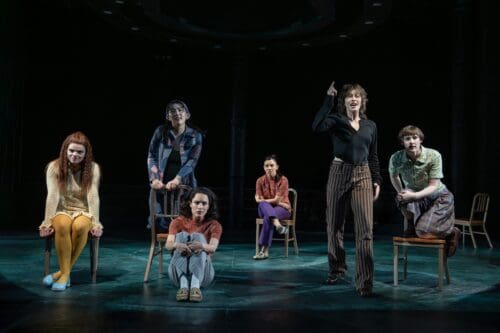
Katherine Reis, Mia Pak, Juliana Canfield, Gabi Gampo, King Princess, and Sally Shaw
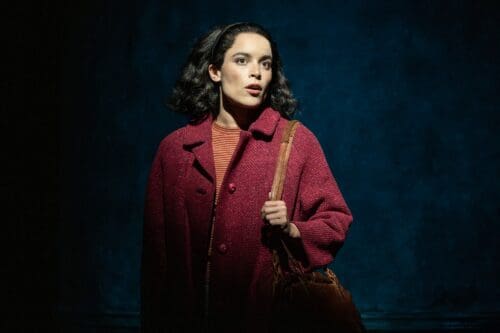
Juliana Canfield
That haunting image opens and closes Girl, Interrupted, the new musical now in performances through July 12 at The Public Theater, and it earns those bookend moments. What unfolds between them is a memory play with music—fractured, raw, and occasionally ragged.
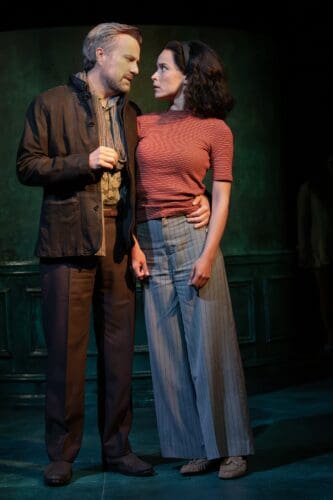
Manoel Felciano and Juliana Canfield
Martyna Majok‘s book adapts Susanna Kaysen‘s memoir with fidelity to its fragmentary spirit. We are in 1967, and Susanna (Juliana Canfield, in a performance of unguarded vulnerability) narrates, looking back at the events that landed her in a psychiatric institution—a father’s persistent authority, her own signature on the admittance form, or perhaps it was the bottle of aspirin she swallowed. Majok wisely refuses to tidy the ambiguity. Susanna doesn’t entirely know why she’s there, and neither, for a long while, do we. Memory, the production insists, is not a straight corridor but a revolving stage—and designer Dots has literalized that beautifully, with a turntable that glides between recollections while worn green ironwork frames the action like the bones of an institutional building long since neglected. There is something post-nuclear about it at first, something almost post-human, before the space settles into a late-1960s mental ward.
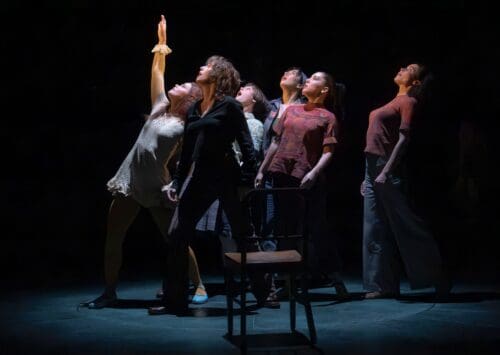
Katherine Reis, King Princess, Sally Shaw, Mia Pak, Gabi Campo, and Juliana Canfield
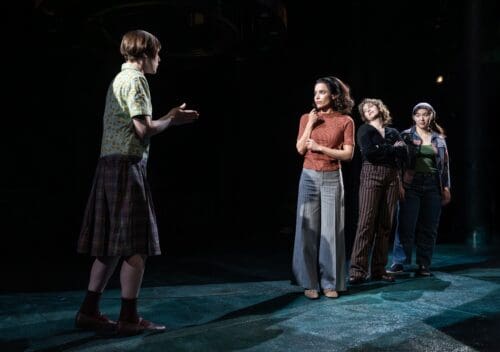
Sally Shaw, Juliana Canfield, King Princess, and Mia Pak
The score is Aimee Mann‘s, and it is the production’s most consistent triumph. Unplugged, character-driven, and threaded with lovely harmonies, it moves through the ensemble with democratic generosity—each character given her moment, her testimony, her song. Music Director Andrea Grody anchors the sound from the keys and guitar, joined by cast members who double as instrumentalists: Lauren Jeanne Thomas (the student nurse Judy) moving seamlessly between bass, flute, and violin; and Manoel Felciano (the Male Presence—playing every male figure in Susanna’s orbit) contributing guitar, bass, and violin with fluidity and skill. The staging of the three musicians feels lived-in rather than performed, creating something full and fresh.
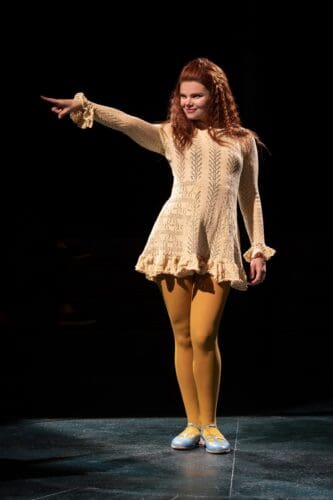
Katherine Reis
The ward itself is populated by five patients whose stories orbit Susanna’s: Mia Pak‘s Grace, King Princess‘s Lisa, Sally Shaw‘s Polly, Katherine Reis‘s Daisy, and Gabi Campo‘s Tori—each arrives fully formed, each given her due. The casting by Heidi Griffiths and Kate Murray is impeccable; the ensemble of nine women and one man is uniformly excellent.
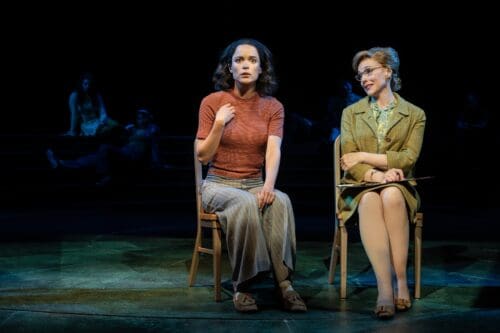
Juliana Canfield and Emily Skinner
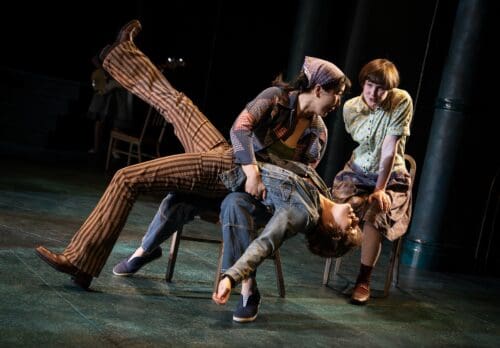
Mia Pak, King Princess, and Sally Shaw
If the patients form the beating heart of the piece, the staff provides its conscience. Ta’Rea Campbell‘s head nurse Valerie and Emily Skinner‘s psychiatrist Dr. Wick are two fully realized authority figures in a world that could easily have portrayed them as one-dimensional. Neither are cartoon villains nor saintly advocates; they are human beings navigating impossible situations with imperfect tools. Their complexity is a pointed counterweight to the Male Presence, who functions less as a character than as an atmosphere of danger and diminishment: the music teacher, the father, the doctor, the fiancé, all collapsed into one body and one recurring threat.
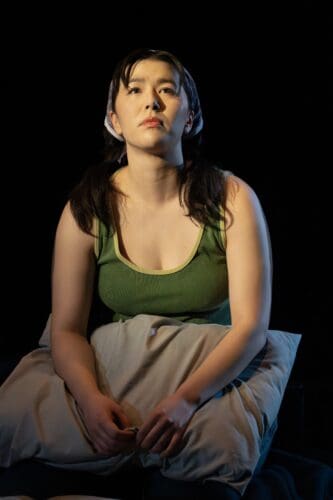
Mia Pak
Jo Bonney‘s direction brings genuine theatrical flair to the material, keeping the piece in an effectively presentational register. The cast remains onstage for much of the running time, watching and remembering, witnesses to their own shared history. Sonya Tayeh‘s choreography operates in the same mode: not dancing but rather a precise grammar of bodies in constrained space, movement that reads as meaning rather than spectacle or jazz hands.
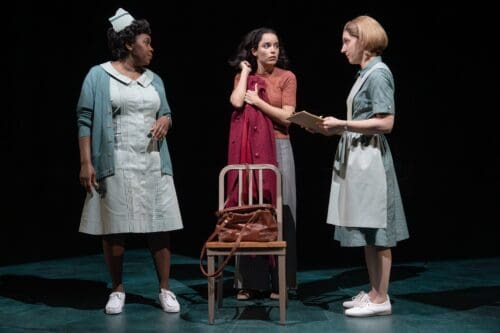
Ta’Rea Campbell, Juliana Canfield, and Lauren Jeanne Thomas
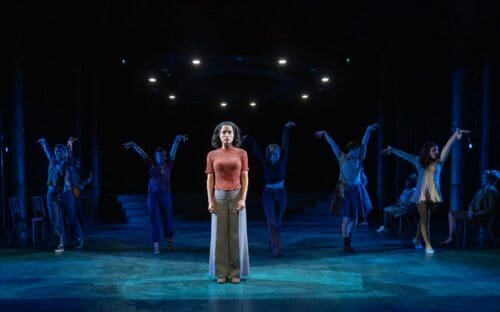
Juliana Canfield (center) and Mia Pak, Gabi Campo, King Princess, Sally Shaw, and Katherine Reis (background)
A large mechanical contraption hangs above center stage—a circle of bars and two half-circles, one serving as the Frick museum, the other as an isolation cell—an engineering achievement whose dramatic payoff doesn’t quite justify the effort. More pressingly, Bonney might persuade Majok to find ten minutes to trim. Occasionally, book scenes extend past their natural dramatic resolution, tipping the balance toward a play with songs rather than a fully integrated musical. When the music reasserts itself after an extended dialogue passage, the relief is palpable.
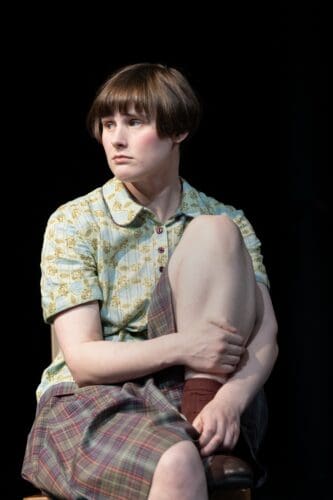
Sally Shaw
But these are not indictments. Girl, Interrupted is doing something genuinely difficult: rendering the texture of a disordered memory with theatrical and musical honesty, without sentimentality and without exploitation. The Vermeer painting, that girl interrupted at her lesson, keeps returning—a figure who survived by seeing clearly what Susanna could not then bring herself to see. By the time the production circles back to her for the last time, the image has accumulated a weight that is quietly devastating.
Listen to her. She’s trying to warn you—and this time, take note.
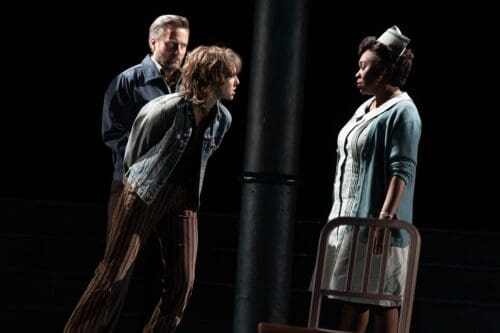
Manoel Felciano, King Princess, and Ta’Rea Campbell
✦ ✦ ✦ ✦ ✦ ✦ ✦ ✦ ✦ ✦
photos by Joan Marcus
Girl, Interrupted
The Public Theater
Martinson Hall at The Public Theater in New York City
2 hours, 15 minutes
Tue–Sun at 7; Sat & Sun at 1
ends on July 12, 2026
for tickets, call 212.967.7555 or visit The Public Theater
✦ ✦ ✦ ✦ ✦ ✦ ✦ ✦ ✦ ✦
Gregory Fletcher is a writer and director. His publishing credits include a craft book on playwriting entitled Shorts and Briefs, as well as a collection entitled A Playwright’s Dozen: 13 short plays. Other publishing includes two YA novels (Other People’s Crazy, and Other People’s Drama), 2 novellas in the series Inclusive Bedtime Stories, 2 short stories in The Night Bazaar series, and five essays. Website, Facebook, Instagram.
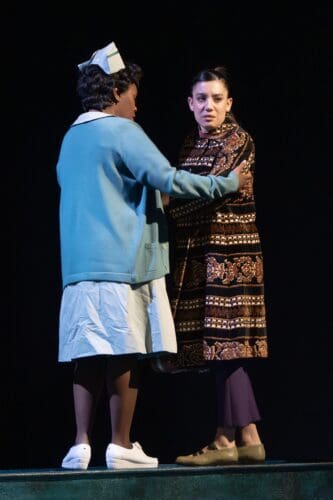
Ta’Rea Campbell and Gabi Campo
