


Areas We Cover
Categories

CAN AI DIRECT A FILM? A CRITIC’S TAKE ON AI-GENERATED CINEMA IN 2026
by Leonard Bertram | June 7, 2026
in Extras
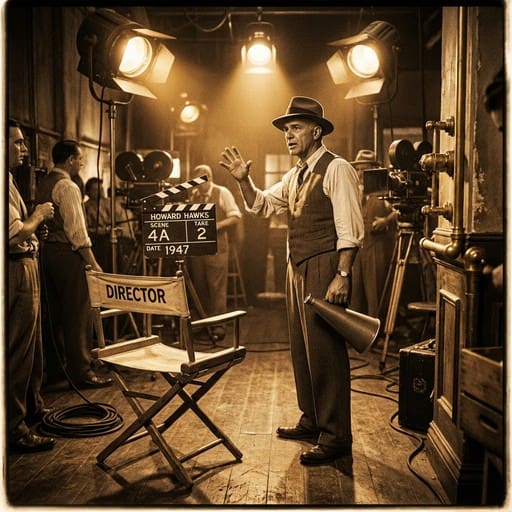
Who is really in the director’s
chair when the camera
was never switched on?
Type a single sentence: “a woman in a red coat crosses an empty train platform at dawn, the camera drifting slowly behind her” into a generative video platform like ImagineArt’s AI Film Studio, wait about a minute, and a cinematic shot exists. The light is soft and directional. The lens appears to breathe. The coat is exactly the right red. No camera was loaded, no crew was called, no actor stood shivering on a cold platform at five in the morning. The image is undeniably there. And yet a question hovers over it, the same one I keep circling back to as a critic: a machine produced this shot, but did anyone actually direct it?
It helps to remember that cinema has met this kind of anxiety before. When synchronized sound arrived with The Jazz Singer in 1927, purists mourned the death of the silent image as a pure visual art. Technicolor was dismissed by some as garish and unserious. When Jurassic Park let a computer conjure living dinosaurs in 1993, a generation of practical-effects artists wondered whether craft itself was being automated out of existence. Each time, the medium absorbed the new tool and carried on being an art form. So before we rush to either panic or celebration, it is worth asking precisely what we are afraid a machine might take from us.
What we actually mean by “direction”
Generation is not direction. This distinction sits at the heart of the whole debate, and it is easy to blur.
A director’s real work is a long, unglamorous chain of decisions. Where should the eye travel within the frame? What should be withheld from the audience, and for how long? When do you cut, and when do you let a shot hold past the point of comfort? How should a line land — swallowed, thrown away, or weaponized? This is the grammar of mise-en-scène, rhythm, performance, and subtext. Composing a beautiful frame is the easy part. Deciding what that frame means, and how it speaks to the frame before and after it, is the actual job.
That is the standard I apply to any film, and it is the same standard a theatre critic brings to a stage director. So it is the standard AI has to answer to.
What AI genuinely can do in 2026
The generation half of that equation has become genuinely astonishing, and it would be dishonest to pretend otherwise.
Today’s text-to-video models assemble coherent scenes from a written prompt, maintain a character’s face and wardrobe across multiple shots, and respond to instructions about lighting, lens choice, and camera movement that until recently demanded a grip truck and a week of preparation. Tools built for this — scene-based platforms that turn a description into a sequence without a camera or a crew — have collapsed the barrier to producing moving images almost entirely. A teenager with a laptop can now generate footage that, a decade ago, would have required a studio, a budget, and a union call sheet. That is not a small development, and any honest critic has to sit with how large it really is.
Where it breaks down, the part a critic cares about
And yet. For all their fluency, these systems optimize for the plausible, not the purposeful. They can hand you a shot that looks like grief. They cannot decide that a scene should be about grief — or, more tellingly, that the grief should go unspoken, buried in a glance the audience only understands an hour later. The machine has no reason to choose the harder, quieter option, because it has no intention to express in the first place.
The same gap shows up in performance. The thing this publication’s critics prize most — the held breath, the flicker of doubt behind an actor’s eyes, the true emotional beat that lands because a human being meant it — still slips through the model’s fingers. So does continuity of vision: the connective tissue that makes ninety minutes feel authored by one sensibility rather than stitched from a thousand handsome fragments. And so does taste, which in the end is just the artist’s capacity to say no — to reject the easy image in favor of the right one.
A stage director’s authority was never in operating the lights. It was in knowing which cue means something. By that measure, the most advanced AI of 2026 is a prodigious cinematographer’s assistant and a blank-eyed director.
The honest middle — what changes either way
None of this makes the technology a gimmick. The more interesting truth is that AI has become a remarkable instrument — a collaborator rather than an author.
Independent filmmakers now use it to previsualize sequences they could never afford to shoot on spec, turning a financing pitch into something a backer can actually see. Small and regional theatre companies — exactly the kind this site champions — can produce a trailer, a teaser, or a piece of projection design without remortgaging an entire season. Platforms like ImagineArt have effectively handed a virtual production department to people who never had access to one. That is a genuine democratization, and it deserves to be named as a gain, not a threat.
The honest worry is not that the director disappears. It is homogenization — the quiet risk that when everyone draws from similar models trained on similar films, everything drifts toward the same glossy, prompt-shaped sameness. The antidote, as ever, is a point of view. A tool cannot supply one.
So — can it direct?
Can AI direct a film? It can generate one, sometimes dazzlingly. It can compose, light, and move a camera that does not exist. What it cannot yet do is mean something — and meaning, the deliberate human decision that this particular image matters in this particular way, is the whole of direction.
The honest verdict for 2026 is not that the machines are coming for the director’s chair. It is that they are changing who gets to sit near it. AI is widening the door to who can make films; it has not changed what it takes to make one matter. And that is the film I will be watching for at the festivals this year — the one where a person clearly chose every frame, even if a machine was the one that drew it.
