


Areas We Cover
Categories hhhh

Theater Review: THE PIANO LESSON (Pennsylvania Shakespeare Festival / Center Valley, PA)

by Gregory Fletcher | June 7, 2026
in Regional, Theater
KEYS TO THE PAST
Directed by James Ijames, August Wilson’s
masterpiece resonates powerfully
in an exceptional PSF production
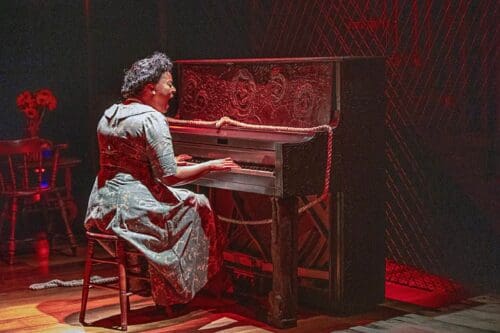
Jessica Johnson as Berniece in PA Shakespeare Festival’s production of August Wilson’s The Piano Lesson
As the fourth installment in August Wilson‘s immense American Century Cycle, The Piano Lesson continues the playwright’s exploration of the Black American experience throughout the twentieth century. Set in Pittsburgh in 1936, Wilson’s Pulitzer Prize-winning drama wrestles with questions of heritage, ownership, generational trauma, and the weight of ancestral history. Through a deceptively simple family dispute over a treasured heirloom, the play asks whether the past is something to be preserved, escaped, or transformed. The lessons learned are invaluable to witness.
At the center of the story is a beautifully carved piano bearing the faces of ancestors etched into its wood. More than a musical instrument, it is a living record of a family’s history—one preserved through sacrifice, devotion, and, as Wilson’s characters repeatedly remind us, the polish of spit and blood of those who came before them.
Boy Willie (Akeem Davis) arrives in Pittsburgh from Mississippi with his friend Lymon (Christopher James Murray), hoping to sell a truckload of watermelons and to convince his sister Berniece (Jessica Johnson) to sell their family piano. Boy Willie intends to use the money to purchase land once owned by the Sutter family, the same white family who enslaved their ancestors. To him, owning that land represents long-overdue justice and economic freedom. But Berniece refuses. The piano, housed in the home she shares with her uncle Doaker (Kash Goins), is far too sacred to be reduced to a financial transaction.
Complicating matters further is the lingering presence of white James Sutter. Following his mysterious death after falling into a well, his ghost haunts both the piano and the household itself. Berniece has not touched the instrument since taking responsibility for it, allowing its history to remain silent rather than confronting its power.
Running a little over three hours, including one intermission, The Piano Lesson is rich with stories, memories, and character histories. Wilson’s dialogue remains endlessly captivating—spirited, lyrical, humorous, and deeply human—all of which reveal profound truths about identity, family, and survival. Listening to Wilson’s characters tell their stories is a pleasure, a reminder of why he remains one of the most important American playwrights of the late twentieth century.
Director James Ijames, best known as the Pulitzer Prize-winning playwright of Fat Ham, guides the production with remarkable ease and clarity. Staging the play in the Pennsylvania Shakespeare Festival’s black box—in a thrust configuration with audience seated on three sides of the stage—Ijames navigates the space with skill. The intimacy created by the staging draws the audience directly into the Charles family conflicts, allowing Wilson’s language and emotions to resonate from every angle.
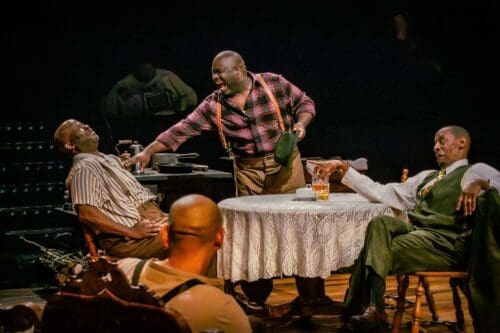
Kash Goins (Doaker), Akeem Davis (Boy Willie), and Terrence Clowe (Wining Boy)
The cast delivers first-class performances across the board. Davis brings both swagger and vulnerability to Boy Willie, making him far more than a stubborn antagonist. Johnson’s Berniece carries the emotional weight of generations, her resistance rooted in grief, responsibility, and reverence. Their sibling conflict drives the play with compelling intensity.
Murray provides much of the evening’s humor and charm as the wide-eyed Lymon, a man experiencing northern city nightlife for the first time. Jerrilyn Lanier Duckworth‘s costume design contributes to some of his funniest moments, particularly when he proudly dons a silk suit that doesn’t quite fit but nevertheless boosts his confidence.
The supporting cast is equally strong. Goins anchors the production as the grounded and caring Doaker, while Johnnie Hobbs III‘s Avery offers spiritual conviction and romantic ambition toward Berniece. Jessica Money makes the most of her appearance as Grace with a winning silly giggle, and Leonice Diaz plays the 11-year-old Maretha, the one taking piano lessons while remaining unaware of the profound family history embedded within it.
Terrence Clowe is particularly memorable as Wining Boy, the aging former recording artist and drifter attempting to coexist with his past, though his addiction to drink is getting the better of him. His relationship to history mirrors the larger struggle facing both Berniece and Boy Willie. Through Wining Boy and the siblings alike, Wilson examines how descendants carry inherited trauma while trying to build futures of their own.
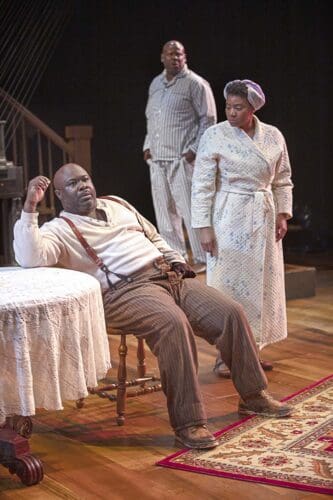
Akeem Davis (Boy Willie), Kash Goins (Doaker), and Jessica Johnson (Berniece)
The production’s technical elements are equally impressive. Thom Weaver‘s scenic and lighting design beautifully establishes the world of the play. The open living room with adjoining kitchen counter and upstage staircase creates a welcoming realism, while more artistic touches elevate the storytelling. Most striking is the arrangement of multi-piano wires extending upward from the instrument in a dramatic V-shape overhead. The image is both artistic and symbolic, and the way the wires vibrate and respond to the actors’ touch becomes a visual extension of the piano’s living history.
Sound Designer and Composer Liz Filios skillfully crafts both the supernatural atmosphere and the everyday rhythms of the household. The ghostly manifestations land effectively, while period music from the radio helps ground the audience firmly in the world of the 1930s.
By the final act, the sibling dispute evolves into a full-fledged ghost story. Yet Wilson’s resolution is never merely about defeating a spirit. When Berniece finally returns to the piano and plays while calling upon her ancestors for help, the moment becomes a powerful act of reconciliation, remembrance, and spiritual affirmation. While confronting and embracing her family’s history, she discovers a path forward, cleansing her home.
The acting, direction, and production values throughout are top-notch. With its superb cast, thoughtful staging, and profound emotional impact, Pennsylvania Shakespeare Festival’s The Piano Lesson is an exceptional production and a strong start to its offerings this season. Act quickly: closing June 14, this is a must-see. Don’t let this outstanding production pass you by. Lessons will be learned.
✦ ✦ ✦ ✦ ✦ ✦ ✦ ✦ ✦ ✦
photos by Kristy McKeever
The Piano Lesson
Pennsylvania Shakespeare Festival
2026 Summer Theatre Series, “Legends and Legacy”
Schubert Theatre, Labuda Center for the Performing Arts
DeSales University in Center Valley, Pennsylvania
3 hours with intermission
ends on June 14, 2026
for tickets, call 610.282.WILL (9455) or visit PA Shakes
✦ ✦ ✦ ✦ ✦ ✦ ✦ ✦ ✦ ✦
