


Areas We Cover
Categories

Theater Review: CATCH AS CATCH CAN (Steppenwolf Theatre Company / Chicago)

by C.J. Fernandes | June 20, 2026
in Chicago, Theater
GETTING CAUGHT UP
WHEN THERE’S A CATCH
A baffling experiment eventually
reveals a powerful emotional core
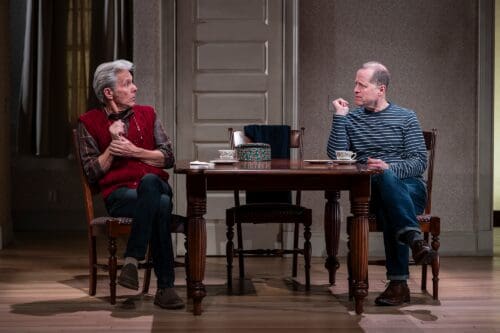
Gary Cole, Tim Hopper
Why?
That one-word refrain was what repeatedly popped up in my head through most of the first hour of Mia Chung‘s Catch as Catch Can, the final production of Steppenwolf’s mostly excellent 50th season. The show features three actors—two men and one woman—playing two roles apiece. There seems to be some point to be made about identity, genetics, transgenerational trauma, and mental illness, but the gimmick doesn’t quite work, and neither, for that matter, do two of the three older characters, at least not until the shattering last forty-five minutes or so of the play.
But I’m getting ahead of myself.
Let’s start at the beginning.
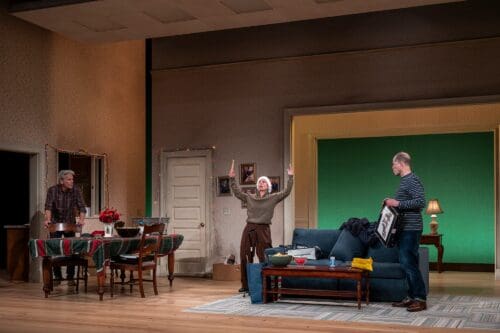
Gary Cole, Audrey Francis, Tim Hopper
We open in a middle-class home in New England, on a living room set that seems deliberately devoid of personality or charm. Two chatty—and catty—persons of a certain age are sitting across a kitchen table. Not having read anything about the play prior to watching it, I assumed that they were two middle-aged gay men and I was suitably appalled by the stereotypes, which would have been horribly dated in the 1980s. A few minutes into their conversation, I realized that they were not gay men, but two middle-aged women in the present day—take that as you will—and I was only slightly less appalled. While they’re not quite as risible as when they were caricatures of gay men, they are caricatures nonetheless. Roberta Lavecchia (Gary Cole) and Theresa Phelan (Tim Hopper) are good friends and are sitting around the table discussing the love lives of their two sons, Robbie and Tim respectively, who both seem to be besotted by the charms of Korean women. Theresa is widowed and Roberta’s husband Lon (Audrey Francis) and daughter haven’t made their appearance yet.

Gary Cole, Tim Hopper and Audrey Francis
The children are played by the same actors. Robbie is married (or dating or separated—I couldn’t quite figure out which) but cannot seem to let go of his Korean ex-wife, while Daniela is at loose ends, unsure what she wants to do with her life. The return of Tim throws both families into turmoil and is the inciting event that drives the play. Tim’s back, and Roberta is throwing a pre-Christmas party with four kinds of pasta and ninety bread rolls. Lon is hanging up pictures and sneaking beer while the three adult children run errands and sneak off together to get away. As shallow as the older characters are, Chung gets quite a bit of humor out of them and the initial proceedings are consistently amusing, even if they’re rather predictable. There is also an alarming amount of anti-Asian racist language from the two older women—again: why?—that seems to have no point other than to shock us a bit and score a few cheap laughs at their expense. Even though it all ticks along nicely, I found myself repeatedly checking my watch and waiting for something to happen.
And just around the midway mark, it does.
During a brief monologue where Tim Hopper expertly toggles between the mother and son, there are flashes of a shift in the son’s personality. With barely any time given to process what we’ve just seen, the play whiplashes from a comedy into a grim and unsettling examination of mental illness.
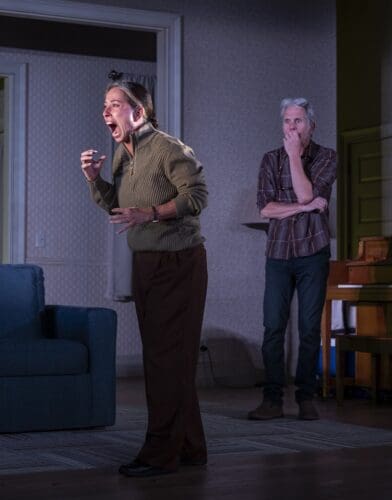
Audrey Francis and Gary Cole
Director Amy Morton has her hands full here balancing two drastically different tones, but she pulls them both off with aplomb, much to my surprise. That’s not a knock on her talents but the fact that the first half of the play is so cringey, I’m surprised that anyone could make it work, even slightly. It clearly helps that the three actors beautifully mesh with each other. The characters may not quite work, but the comic timing is flawless. Of the three older characters, Audrey Francis fares the best, bringing a genuine sense of masculinity to Lon, even if the walk is a bit much. Cole and Hopper—fine, fine actors both—do nothing with Roberta and Theresa that would make them feel out of place in a Hell in a Handbag production.

Tim Hopper and Audrey Francis
All three actors, however, are absolutely astounding in the parts of the young characters. As Daniela, Francis’s emotional collapse is excruciating to watch, and the final scene between Robbie and Tim, clearly meant to evoke the opening conversation between their mothers, is one of the most effective bits of writing and acting that I’ve seen on stage this year. Cole doesn’t get a big actorly moment like the other two do, but he doesn’t need one. His mostly silent, shifting expressions over the long conversation as he slowly takes in the ruined husk that used to be his best friend is some of the finest acting he has ever done.

Tim Hopper and Gary Cole
I spent an inordinate amount of time mulling over the casting—not gender-neutral, not gender-conscious; gender-blind, perhaps, or even gender-swapped in part—and I’m sorry to say that it simply does not work for me here. Shattered Globe’s Eelpout! used gender-conscious casting to smartly subvert the patriarchal stereotypes embedded in its characters. Trap Door’s Cuttlefish… sidestepped gender altogether in the casting process, giving us a fascinating non-normative look at the male libido and the artistic muse. Catch as Catch Can gives us three talented actors camping it up when gender-swapped and settling down to the real thing when not. Do we all turn into our parents? Are we doomed by our upbringing before we even know it? Is Chung trying to say something about toxic parent-child dynamics and the burden of expectations? I do not know and I’m not sure she does either.
The phrase “catch as catch can” broadly refers to a free-for-all where the rules don’t matter anymore. Its origins lie in a centuries-old form of wrestling where you’re allowed to do pretty much anything to win. If you squint, you can extrapolate its meaning to the gimmick here. If you squint further, you could possibly stretch it to the three younger characters.
But there really aren’t any rules broken here; maybe just nudged a little.
✦ ✦ ✦ ✦ ✦ ✦ ✦ ✦ ✦ ✦
photos by Michael Brosilow
poster photo by Sandro Miller
Catch as Catch Can
Steppenwolf Theatre Company
Downstairs Theater, 1650 N. Halsted St. in Chicago
ends on July 12, 2026
for tickets ($20–$120), call (312) 335-1650 or visit Steppenwolf
for more shows, visit Theatre in Chicago
✦ ✦ ✦ ✦ ✦ ✦ ✦ ✦ ✦ ✦
