


Areas We Cover
Categories

Theater Review: A MIDSUMMER NIGHT’S DREAM (Commonwealth Shakespeare Company / Boston)
by Lynne Weiss | August 5, 2026
in Boston, Theater
SOME ENCHANTMENT REQUIRED
Thirty years on, Commonwealth Shakespeare
still knows how to charm a crowd
A lot is unknown about William Shakespeare, including the order and dates in which he wrote Romeo and Juliet and A Midsummer Night’s Dream. What is clear, however, is that the two plays serve as mirrors to one another: in one, love is a tragedy; in the other, a comedy.
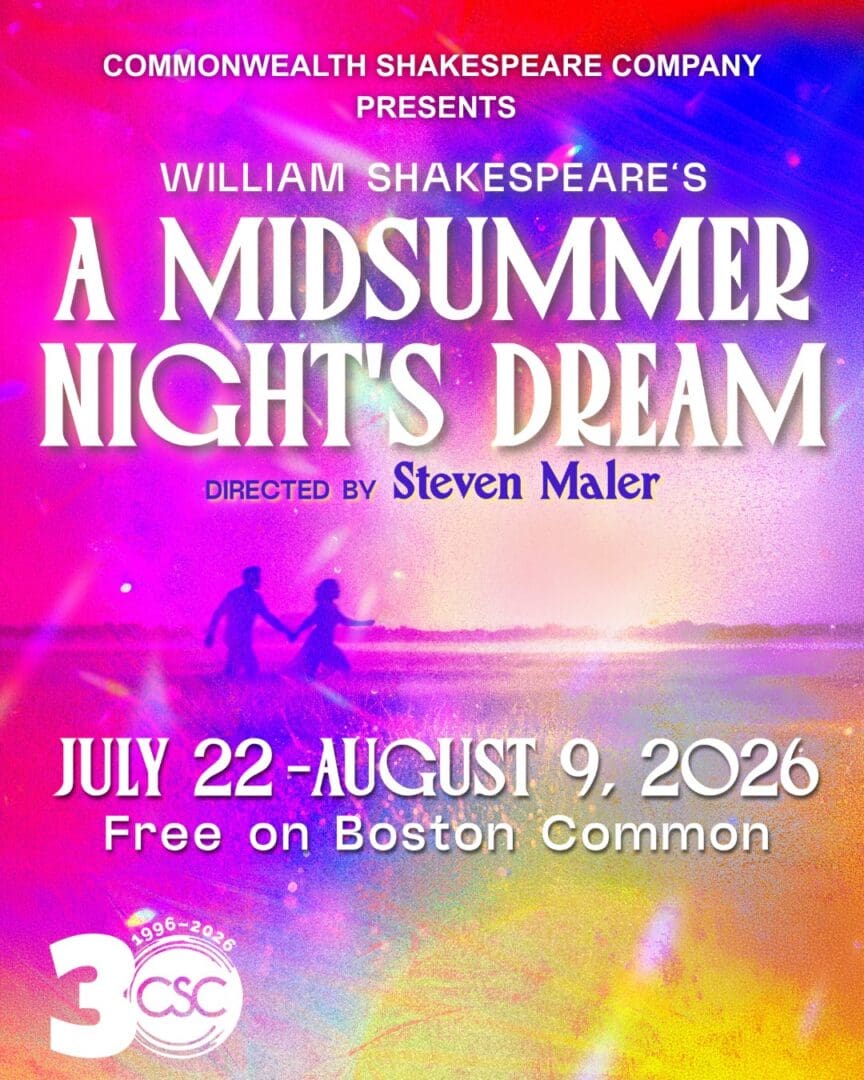
Both plays feature young lovers. In Romeo and Juliet, those lovers suffer and die. In A Midsummer Night’s Dream, multiple sets of lovers suffer—and we laugh—until, to cite another Shakespeare title, All’s Well That Ends Well, and they end up with their preferred partners. In Commonwealth Shakespeare’s 30th anniversary production at Boston Common, helmed by founding Artistic Director Steven Maler, double-casting underscores the parallels between the mortal and fairy worlds. Versatile De’Lon Grant plays both the measured and noble Theseus, Duke of Athens, and the scheming Oberon, king of the fairies.

The Company of A Midsummer Night’s Dream
The focus of the play is on Hermia (a spirited Meghan Carey) and Lysander (Jaime José Hernández), whose desire to marry is blocked by Hermia’s father, the patriarchal and pig-headed Egeus (Brooks Reeves, who also plays the fairly dim Robin Starveling).

Jaime José Hernández and Meghan Carey
Egeus wants his daughter to marry Demetrius (Jack Greenberg), despite the fact that Lysander is every bit as suitable a mate for his daughter as Demetrius. Meanwhile, Helena (Annika Burley) is smitten with Demetrius, who has no interest in her because his heart is set on Hermia. In an effort to escape the laws of Athens, which require Hermia to obey her father, Hermia and Lysander take off to the forest. Demetrius and Helena soon follow. King Oberon, annoyed with Queen Titania (Nora Eschenheimer) and observing Helena’s suffering, directs his henchman Puck (a ripped Nick Cearley in revealing black leather) to employ a love potion to get Demetrius to fall in love with Helena. He also directs Puck to use the potion on Titania while she’s asleep. Oberon wants to humiliate Titania by making her fall in love with the first creature she sees after she wakes up, so he has Puck transform Nick Bottom (the always hilarious Paul Melendy) into a donkey.

De’Lon Grant and Nick Cearley
In Romeo and Juliet, the juice of a plant leads to the deaths of the young lovers. In A Midsummer Night’s Dream, such a potion brings mayhem, but ultimately happiness, and allows exploration of the mysteries of erotic attraction. Why do people fall in love, perhaps only for one crazy night, with the people they do? A beautiful queen falls for an ass; a lovely young woman chooses one suitor over another; and a charming young man insists he will have only the woman who has no interest in him. Such dynamics make no sense and may bring pain, but Shakespeare turns them into comedy so we can laugh at those fools as well as ourselves.

Jack Greenberg, Annika Burley, and Jaime José Hernández
I give Commonwealth five stars for accessibility on every level. Each production includes open captions and a variety of other services too numerous to list here. David Wilson‘s sound reinforcement was consistently clear. Scenic designer Amy Rubin‘s multi-level set, with its giant heart backdrop, is oddly reminiscent of Broadway in Boston’s recent Moulin Rouge!. Still, a cleverly conceived ball pit allows characters to hide, tumble, and create comic business.

Nora Eschenheimer (center) and company
I do have a few quibbles, however. Why is Petra Quince (the talented Karen MacDonald) portrayed as Romanian? And why do Bottom and Puck sometimes—but not always—have Boston accents? While the costumes (by Brooke Stanton and Rachel Padula-Shufelt) as a whole bring the magic of fairyland to the stage, Bottom’s transformation into an ass is barely recognizable. The play is familiar enough that most of the audience knows what has happened, but his costume fails to convey his transformation. I never thought I would say that there is too much Paul Melendy, but the Pyramus and Thisbe play-within-the-play goes on way too long, seemingly to give him more time to indulge.

Nora Eschenheimer (center left) and Paul Melendy (center right)
But enough with the kvetching. Commonwealth Shakespeare’s excellent production offers a wonderful opportunity to enjoy some of Shakespeare’s funniest moments and most beautiful language under the stars.

Commonwealth Shakespeare at Boston Common (Sam Carruthers)
✦ ✦ ✦ ✦ ✦ ✦ ✦ ✦ ✦ ✦
photos by Nile Scott Studios
A Midsummer Night’s Dream
Commonwealth Shakespeare Company
Boston Common in Boston
Tue.–Fri. 8; Sat.–Sun. 1 & 8
ends on August 10, 2026
2 hours and 30 minutes, including intermission
for tickets (free; reserved premium seating available), visit Commonwealth Shakes
for more shows, visit Theater in Boston
✦ ✦ ✦ ✦ ✦ ✦ ✦ ✦ ✦ ✦
