


Areas We Cover
Categories hhhh

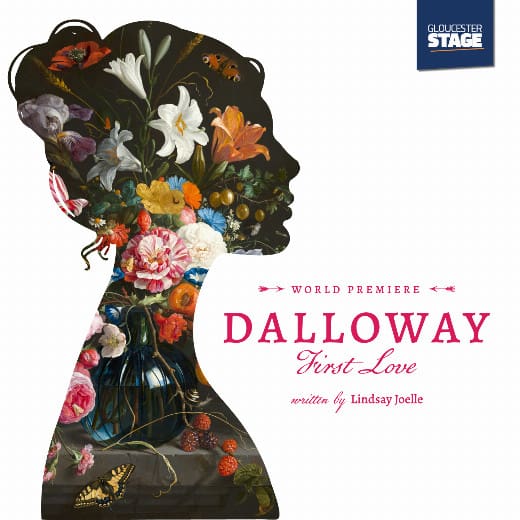
Theater Review: DALLOWAY: FIRST LOVE (Gloucester Stage Company)
by Lynne Weiss | August 17, 2026
in Boston, Theater
BEFORE SHE WAS MRS. DALLOWAY
A beautifully written and well-performed
prequel imagines the summer when Clarissa
Perry begins choosing a life of her own

Josephine Moshiri Elwood and Shobhit Piasa
Our first look at Dalloway: First Love is a magnificent thick-trunked tree full of nooks and crannies, gnarled and fissured with steadying footholds and reaching roots and seeking branches that dominates Kristin Loeffler‘s set of this world premiere at Gloucester Stage Company. Created by the same team that brought us last year’s much-praised The Garbologists (playwright Lindsay Joelle; director Rebecca Bradshaw), Dalloway portrays the backstory of Virginia Woolf’s Mrs. Dalloway as it might have occurred in the course of a single summer: the summer in which Clarissa Perry (magnificently portrayed by Josephine Moshiri Elwood) rejects a marriage proposal from Peter Walsh (appropriately anxious Shobhit Piasa), is kissed by and kisses Sally Seton (Haley Dyana Schwartz), and first meets her future husband, Richard Dalloway (Jesse Garlick).

Jesse Garlick as German conductor; Josephine Moshiri Elwood, Shobhit Piasa, Haley Dyana Schwartz
That tree? It’s a tree that, according to Joelle’s script, led to tragedy for Clarissa the year before. It’s also a tree that allows Clarissa to escape when she is overwhelmed by the expectations and demands of her friends and that lets her indulge in risky behavior. Finally, it’s a tree that may represent, with its crannies and crevices and offshoots, the mind of sensitive Clarissa, seeking a way forward through grief and longing.
The play opens with the famous first line of Mrs. Dalloway: “Mrs. Dalloway said she would buy the flowers herself,” spoken in a voice-over by an unspecified narrator. From there, we meet Clarissa and her childhood friend Peter, who arrives on a bicycle. Clarissa wants to try riding, but Peter knows her father would object, so he won’t allow it. Peter is obviously smitten with Clarissa, and it’s important for him to stay in her father’s good graces. When she leaves the stage to fetch tea for her father, Peter stumbles all over himself attempting to ask Clarissa’s father for her hand. He is dismayed to learn that Clarissa’s father is counting on her to marry a wealthy man to save her family’s property.

Jesse Garlick as Hugh Whitbread; Josephine Moshiri Elwood, Shobhit Piasa
While Peter is portrayed in Woolf’s novel as a presumably white Englishman who has been living in India, Joelle’s character is a man with a white father and an Asian mother, complicating his status in the eyes of Clarissa’s father.
Misunderstanding Peter’s effort to put himself forward as Clarissa’s future husband, Mr. Perry instead asks Peter to help vet the “slew” of suitors who will be arriving at Bourton, the family home. Things get worse for Peter when Hugh Whitbread, heir to a coal fortune, arrives to court Clarissa, though he arrives with a bouquet of wilted roses.

Shobhit Piasa, Haley Dyana Schwartz, and Josephine Moshiri Elwood
Neither Peter nor Hugh appeals to Clarissa, nor do the other suitors who arrive. Garlick is excellent as the “slew”: Whitbread, Mr. Perry, and later as Richard Dalloway; however, his portrayal of a German conductor—who for some reason has come to Bourton to court Clarissa—is a disaster. This character is one of the few flaws in a generally well-written play: a buffoon out of place. Garlick’s accent is more French than German, adding to the confusion.

Haley Dyana Schwartz and Josephine Moshiri Elwood
The person who does appeal to Clarissa is Sally Seton, who shows up unexpectedly, inviting herself to stay the night. Sally jumps on Peter’s bicycle without waiting for his permission, triggering erotic speculation on the part of Hugh and Peter.
Sally is full of inspiring ideas: she dismisses marriage as a trap and urges Clarissa to join her in forming “a utopia of spinsters,” women who will live without the limitations of patriarchal control. Clarissa is intrigued by this idea, so intrigued that when Sally kisses her, she returns the kiss.

Jesse Garlick and Josephine Moshiri Elwood
Clarissa is also intrigued by Peter’s invitation to come to India, apparently unaware that an invitation to meet his family is another nod toward the possibility of marriage. Sally invites herself to join in this adventure, which of course is not at all what Peter had in mind, though it appeals to Clarissa. In a desperate attempt to win Clarissa, Peter creates an elaborate festoon of flowers he has picked himself to show to Clarissa—in the middle of the night.

Josephine Moshiri Elwood and Jesse Garlick
Complications multiply. Peter, Hugh, and Sally all have secrets, and in the competition for Clarissa, they use them against each other. Peter and Sally drive Hugh and the German conductor away, and eventually Richard Dalloway arrives, the last suitor arranged by Clarissa’s father. Here Joelle’s script veers away from the premise of the novel: Richard Dalloway, who appears buttoned-up and emotionally controlled compared to the expressive yet poor Peter Walsh in Woolf’s novel, is the first person able to listen and empathize with Clarissa as she talks about her grief over events of the summer before. Some might consider this a flaw in the script; I was so taken with the quality of the performances and the wit of the dialogue that I suspended my disbelief, open to the possibility that a younger Richard Dalloway might have had a different relationship to his emotional life than the middle-aged man we meet in Woolf’s novel.
Artistically, however, what elevates Richard Dalloway is the fact that he does not bring Clarissa flowers, and Dalloway ends with Clarissa making it clear that while she wants to pursue a relationship with Dalloway, she will always buy her own flowers. It’s a lovely conceit, and one that allows Joelle’s imagined Clarissa to arrive at Mrs. Dalloway not simply as Woolf left her, but on terms she has begun to choose for herself.
✦ ✦ ✦ ✦ ✦ ✦ ✦ ✦ ✦ ✦
photos by Shawn G. Henry
Dalloway: First Love
Gloucester Stage Company
267 East Main Street in Gloucester, MA
Wed and Thurs at 7:30; Fri at 8; Sat at 3 & 8; Sun at 3
ends on August 29, 2026
2 hours, including intermission
for tickets ($18–$74), call 978.281.4433 or visit Gloucester Stage Company
for more shows, visit Theatre in Boston
✦ ✦ ✦ ✦ ✦ ✦ ✦ ✦ ✦ ✦
