


Areas We Cover
Categories

Concert Review: CÉCILE MCLORIN SALVANT: WITH EVERY BREATH I TAKE (Carnegie Hall)
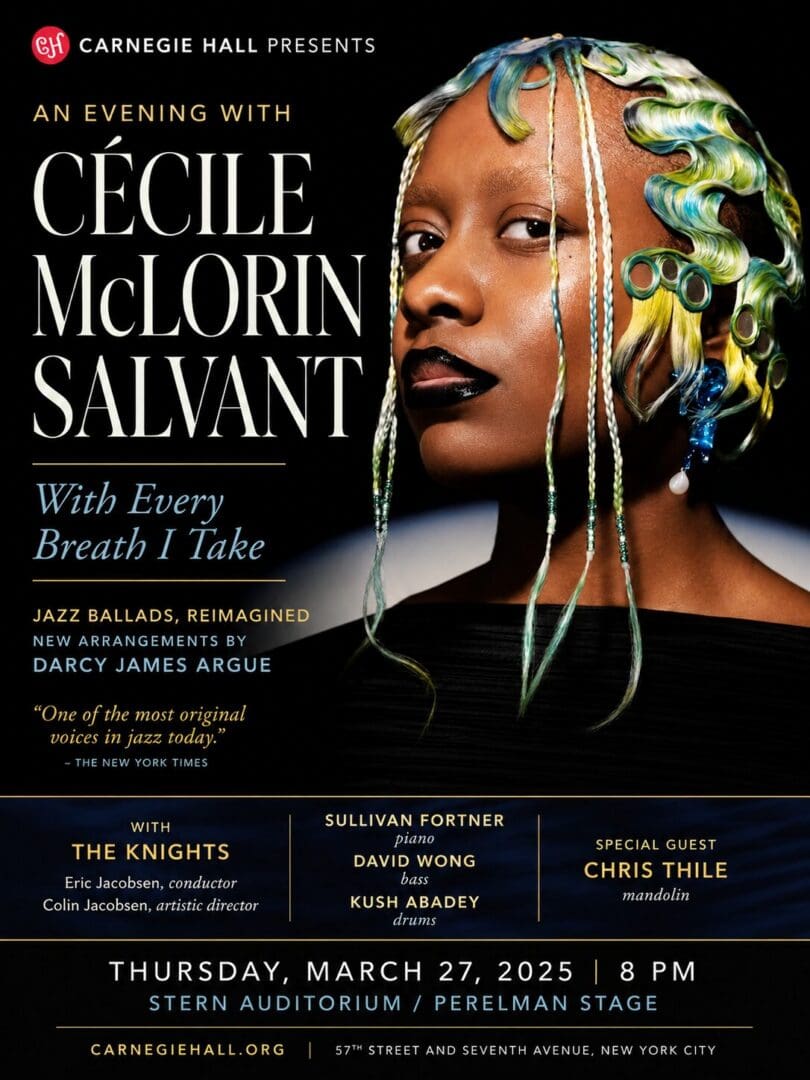
by Tony Frankel | August 20, 2026
in Concerts / Events, New York
EVERY BREATH WAS BREATHTAKING
Cécile McLorin Salvant, Sullivan Fortner
and The Knights turn a night of ballads
into the greatest concert I have ever seen
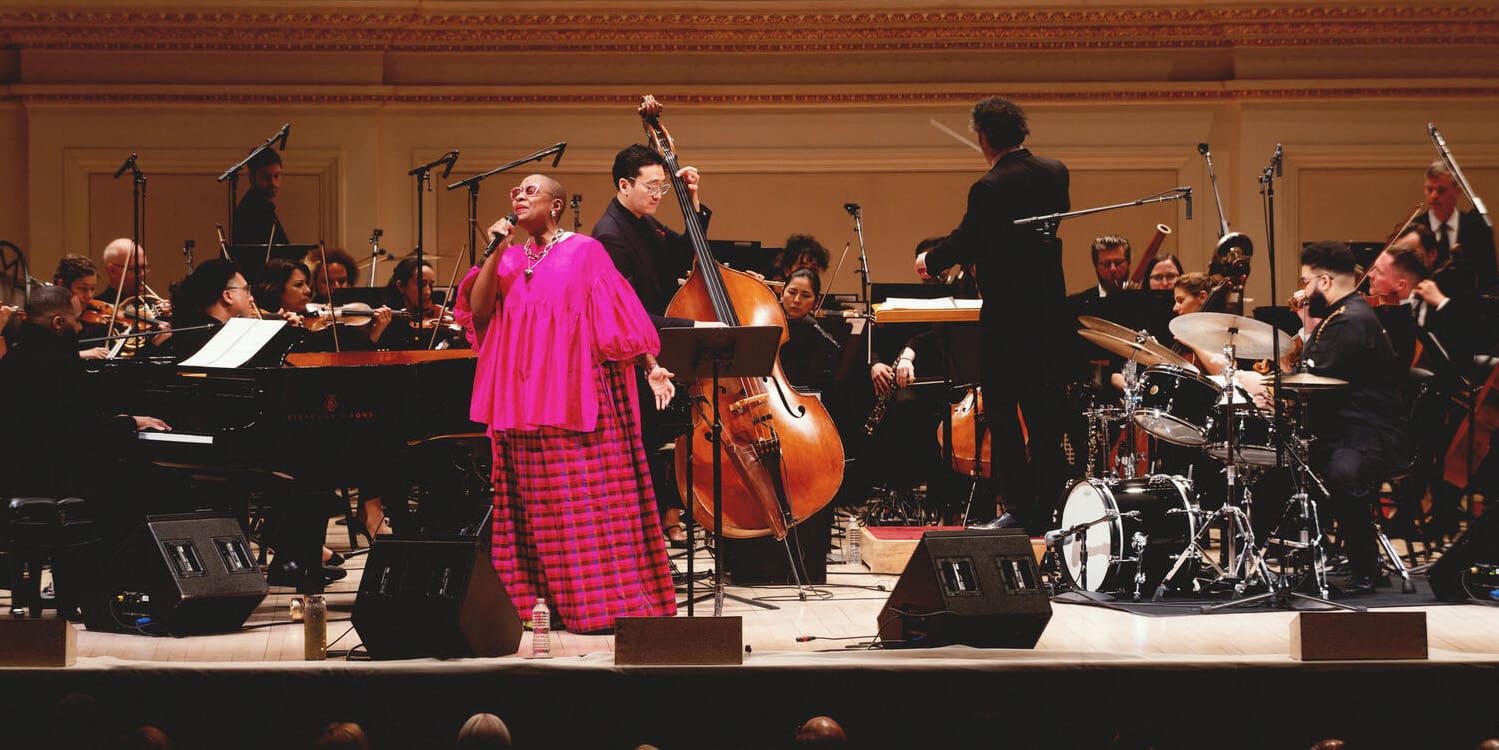
Cécile McLorin Salvant in Every Breath I Take, the concert at Carnegie Hall which led to her scintillating new album of the same name
I thought I knew Cécile McLorin Salvant. I had seen this extraordinary singer in different incarnations, from the intimacy of a trio to the sweep of a big band, and was even lucky enough to catch her incomparable pianist Sullivan Fortner at the tiny Smalls Jazz Club. So I arrived at Carnegie Hall’s Stern Auditorium over a year ago for With Every Breath I Take expecting something exceptional. Nothing prepared me for what happened. With Fortner, bassist David Wong, drummer Kush Abadey, special guest Chris Thile and the genre-defying orchestra The Knights, Salvant gave me the greatest concert I have ever seen.
That is an absurdly large statement. I mean every word of it. It has haunted me to this day, and I felt it important to finally put it into words.
And something rather wonderful has happened since I saw this magical evening: Salvant and her arranger carried the concert’s orchestral idea forward into With Every Breath I Take, her first orchestral album, released 7 weeks ago in June 2026 (although the recording uses the Metropole Orkest conducted by Jules Buckley rather than The Knights). Salvant says the project had been a dream of hers for years. So this review of the Carnegie Hall concert is less like a belated notice and more like a record of an important step in something that has now fully blossomed.
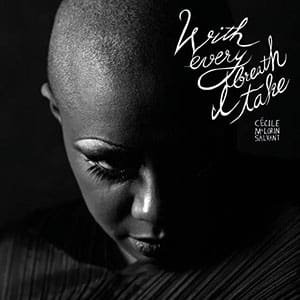
The cover of Cécile McLorin Salvant’s first orchestral album
What astonished me first on March 27, 2025, was the scale. Salvant is one of our most intimate singers—not because her voice is small (it most certainly is not), but because she makes a lyric feel as though it is being discovered between singer and listener at that particular instant. Now put that sensibility on the 2,790-seat Stern Auditorium stage with some 40 musicians behind her and lush arrangements by Darcy James Argue (who was sitting right behind me), and you’d expect something to get lost. Instead, the opposite occurred. The immensity somehow magnified the intimacy. Argue understood that an orchestra needn’t announce itself simply because it is there. Strings could hover, retreat, surge or wait; brass and winds could supply color rather than weight. The Knights became not accompaniment but another participant in Salvant’s storytelling.
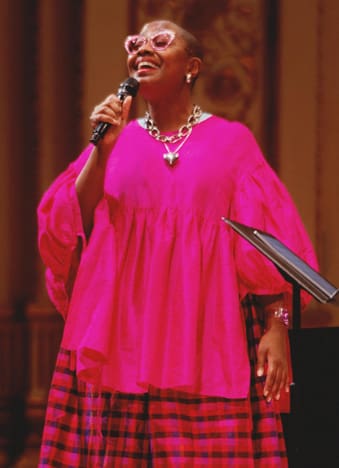
Cécile McLorin Salvant
And what a storyteller. Salvant doesn’t merely interpret songs; she seems to crawl inside them, inspect their architecture and then hand them back to us altered. Her enormous range and startling command are almost beside the point. There are singers who show you what their voices can do. Salvant shows you what a song can do. A change of color, a syllable held an instant longer than expected, a phrase that suddenly retreats to almost nothing—and a song you’ve known for decades becomes vaguely dangerous because you no longer know where she is going to take it.
“Lush Life” demonstrated the extraordinary intelligence of the collaboration. Salvant begins with her familiar jazz musicians, Argue withholding the orchestral forces until late in Billy Strayhorn’s bruised confession. When the strings finally enter, they don’t gild the song; they deepen the wound. “Send in the Clowns,” which I wouldn’t have thought needed another interpretation in this lifetime, becomes hushed and haunting. “Barbara Song” from The Threepenny Opera turns into miniature theater, while the title song from City of Angels—Cy Coleman and David Zippel’s aching “With Every Breath I Take”—reminds us that Salvant’s relationship with musical theater is as profound as her relationship with jazz. Carnegie Hall’s own archive confirms just how wildly this program ranged: Ellington, Sondheim, Strayhorn, Weill, Coleman and Zippel, Michel Legrand, Paul Simon, Noël Coward, Burt Bacharach and Irving Berlin all occupied the same evening without ever making it feel like a miscellany.
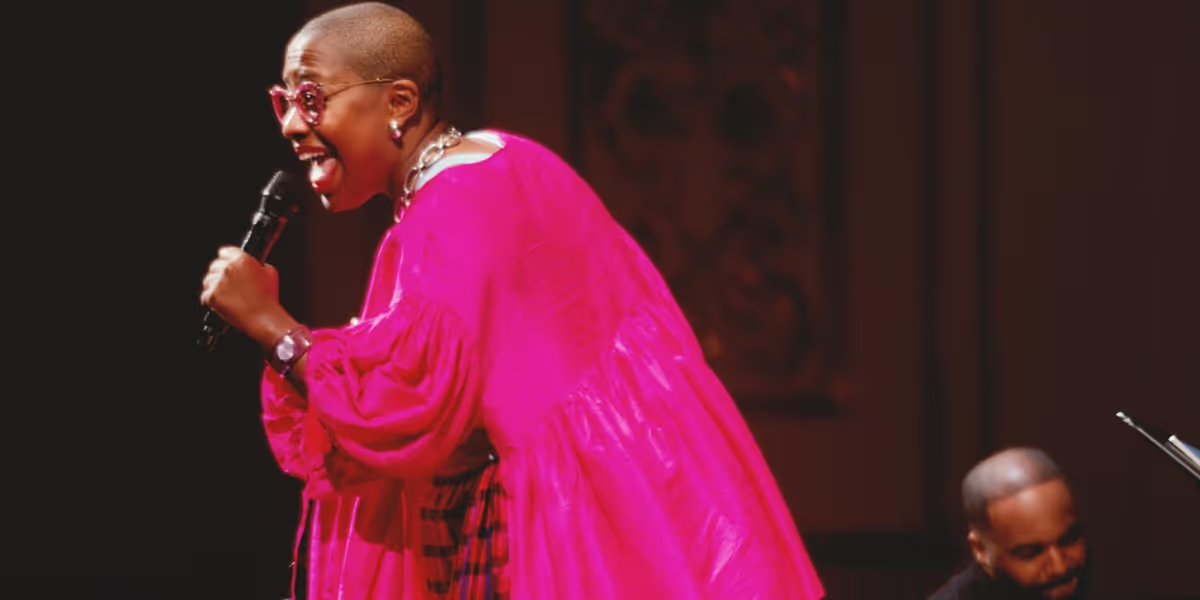
Sullivan Fortner and Cécile McLorin Salvant
Then there is Fortner. I have seen him up close, where the proximity allows you to watch his hands and practically climb inside his musical brain. At Carnegie Hall, his partnership with Salvant remained just as astonishing. The two don’t seem to accompany one another so much as think together. When Salvant sings “Alfie” with Fortner alone for the first encore, the enormous hall seems to shrink around them. This was precisely what made the evening so remarkable: it could expand to orchestral proportions and, moments later, make Carnegie Hall feel like the world’s most luxurious jazz club.
Salvant herself moved between grandeur and vulnerability with disarming ease. Dressed in vivid magenta, she admitted early on that she was nervous. Later, for her own “Left Over,” she sat at the piano and confessed to another bit of stage fright before accompanying herself, with strings behind her. There was no diva posturing to any of it. Her command of the room was absolute, yet she could be funny, shy, eccentric and completely unguarded. That contradiction—supreme artistry without the need to continually advertise it—is part of what makes her so riveting.
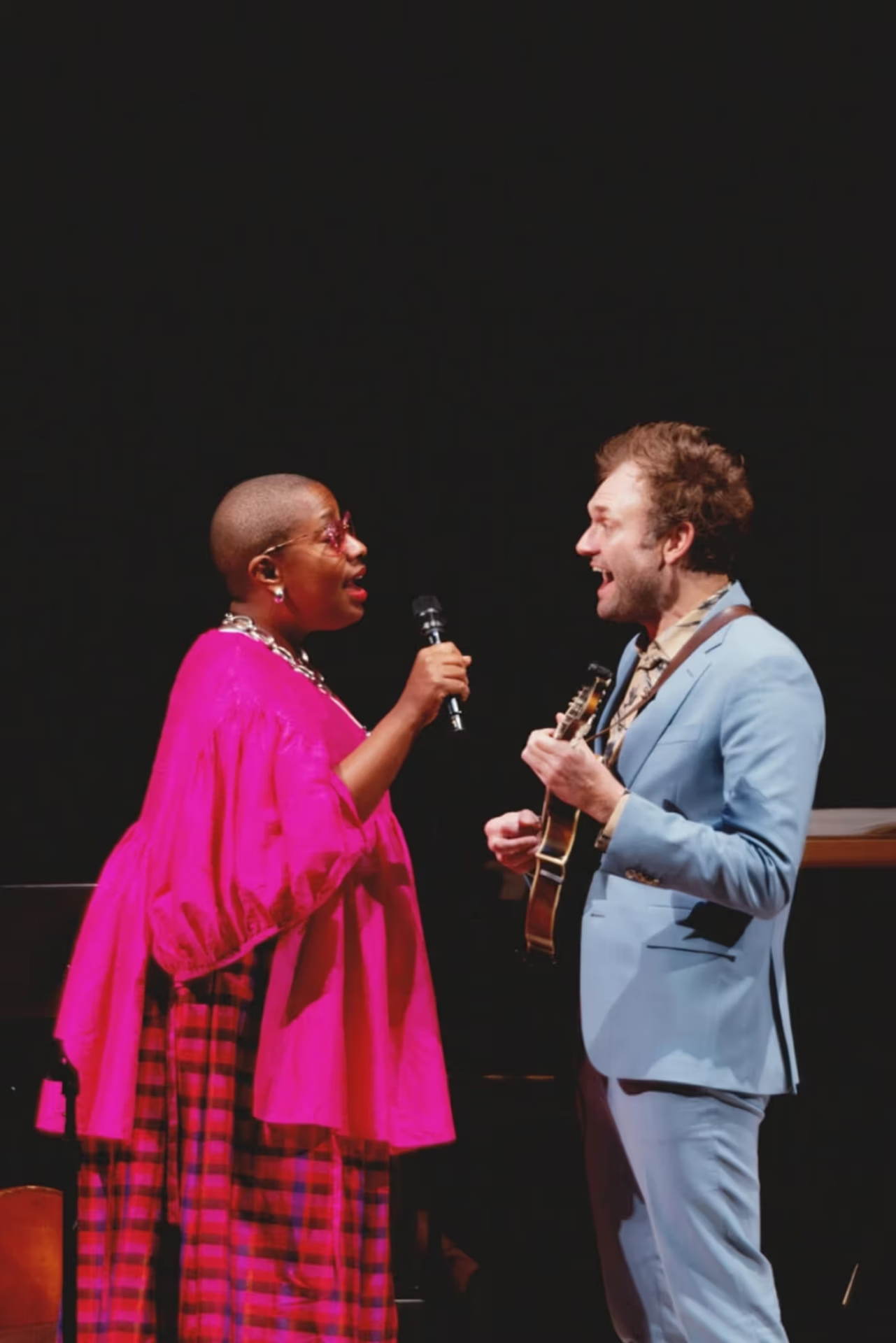
Cécile McLorin Salvant and Chris Thile
Mandolin virtuoso Chris Thile opened yet another door. He joined Salvant for Connie Converse’s “Talkin’ Like You (Two Tall Mountains)” and Paul Simon’s “American Tune,” his bright, searching mandolin creating a completely different sound world from the orchestra. In “American Tune,” the combination of Salvant’s melancholy and Thile’s spare Americana made Simon’s familiar song sound newly unsettled. Again, that was the miracle of the evening: nothing seemed selected merely because it was beautiful. Each song had something to reveal.
Perhaps the most audacious arrangement was “Being Alive.” Salvant begins Sondheim’s song alone; gradually, almost imperceptibly, instruments join her until the full ensemble surrounds her. The musical architecture becomes the dramatic argument: isolation giving way to connection. It’s the sort of arrangement that could become terribly clever in lesser hands. Here, the idea and the emotion were inseparable.
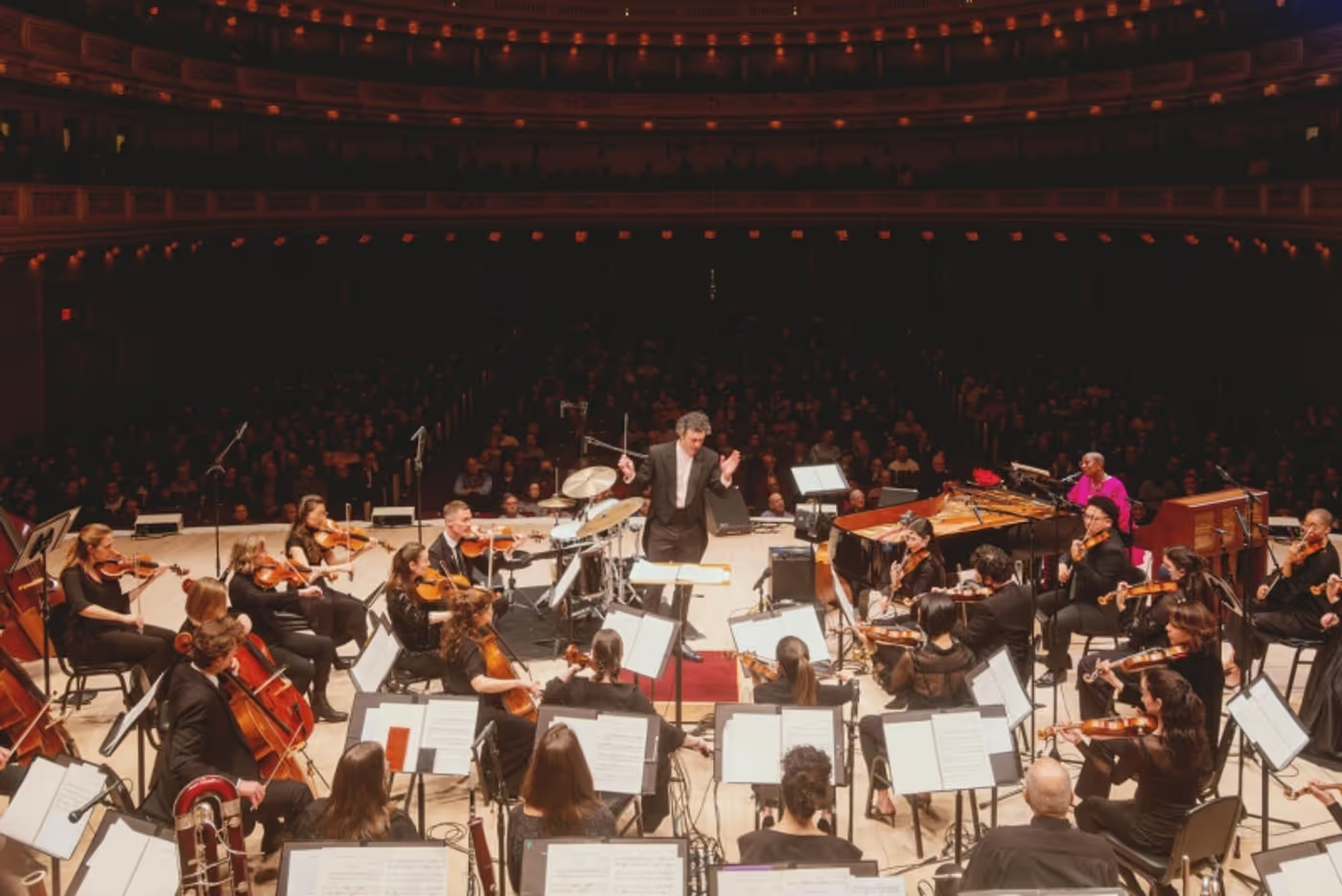
The Knights and Cécile McLorin Salvant
The evening was also a reminder of how inadequate the label “jazz singer” has become for Salvant. She can inhabit Strayhorn, Sondheim, Weill, Simon and Legrand without homogenizing any of them into a house style. French comes as naturally as English; cabaret, jazz, folk, classical music and musical theater aren’t categories she visits but languages she speaks. Carnegie Hall had programmed this concert as part of her season-long Perspectives residency, and the collaboration with The Knights was conceived specifically around new orchestral arrangements. Yet for all the ambition surrounding her, Salvant remained the still point at its center.
By the end, the audience simply refused to let her go. There were three encores: Noël Coward’s “I’ll See You Again,” the aforementioned Bacharach and David’s “Alfie,” and finally Irving Berlin’s “Let’s Face the Music and Dance.” After the third, the applause continued until Salvant returned once more—not to sing, but to take a final bow and gently make clear that, yes, we really did have to go home.
I didn’t want to.
I have attended more concerts than I could possibly count, and calling any one of them “the greatest” ought to make me nervous. But more than a year later, this one hasn’t diminished in memory; if anything, it has grown. I went in already knowing how great Cécile McLorin Salvant could be. I knew what Sullivan Fortner could do. I knew the songs. And somehow, for 100 or so minutes at Carnegie Hall, none of that knowledge mattered. I heard familiar music as though I had never heard it before. The scale was enormous, the artistry staggering, yet what remains with me is something intensely personal: that increasingly rare sensation of sitting in a theater and realizing, while it is still happening, that I am experiencing something I will remember for the rest of my life.
✦ ✦ ✦ ✦ ✦ ✦ ✦ ✦ ✦ ✦
photos by Lawrence Sumulong
An Evening with Cécile McLorin Salvant: With Every Breath I Take
Cécile McLorin Salvant, vocals
The Knights
Colin Jacobsen, artistic director
Eric Jacobsen, artistic director and conductor
Sullivan Fortner, piano
David Wong, bass
Kush Abadey, drums
Chris Thile, special guest
arrangements by Darcy James Argue
Stern Auditorium / Perelman Stage at Carnegie Hall in New York City
March 27, 2025
✦ ✦ ✦ ✦ ✦ ✦ ✦ ✦ ✦ ✦
