


Areas We Cover
Categories

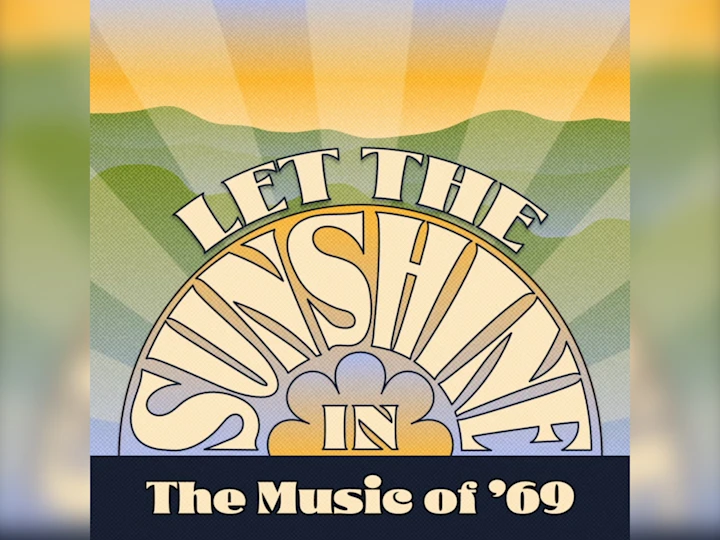
Concert Review: LET THE SUNSHINE IN: THE MUSIC OF ’69 (Hollywood Bowl)
by Tony Frankel | August 26, 2026
in Concerts / Events, Los Angeles
YOU SAY YOU WANT A REVOLUTION
Ted Sperling and the Hollywood Bowl
Orchestra find new life in the music
of a year that changed everything
The summer of 1969 gave us Woodstock, the Harlem Cultural Festival, Vietnam War protests, the moon landing, and an astonishing collision of rock, soul, folk, gospel and funk. At the Hollywood Bowl, Ted Sperling somehow packed the sound of that turbulent year into one exhilarating new program. Let the Sunshine In: The Music of ’69 was no oldies concert with an orchestra attached. Sperling, making his Bowl conducting debut, treated these songs as material worth reconsidering, with imaginative new arrangements that could be haunting, driving, funky and downright explosive.
The Hollywood Bowl Orchestra announced that intention immediately, invoking Jimi Hendrix’s incendiary Woodstock treatment of “The Star-Spangled Banner” before launching into Joe Cocker’s famously soulful reworking of the Beatles’ “With a Little Help From My Friends.” Noah J. Ricketts, Morgan James and Bryonha Marie Parham handled the lion’s share of the evening’s vocals, frequently backing one another when they weren’t out front. It was a lot of singing and a lot of stylistic territory to cover, but the three proved remarkably adaptable.
James tore into Janis Joplin’s “Piece of My Heart,” while Parham became the evening’s powerhouse connection to the Harlem Cultural Festival. Sperling used the occasion to recall the 1969 celebration of Black music and culture before Parham unleashed “I Heard It Through the Grapevine,” based on the version Gladys Knight performed at the festival. Later, Parham brought a completely different temperament to “Here Comes the Sun,” honoring Nina Simone’s interpretation rather than simply revisiting the Beatles.
Ricketts found the aching simplicity in Bob Dylan’s “I Shall Be Released,” accompanied by an expressive Sal Lozano saxophone solo, before the other singers joined him in harmony. That constant reshuffling of musical combinations was one of Sperling’s smartest choices. These weren’t isolated star turns. Voices, orchestra and instrumentalists kept changing relationships as the music moved among rock, folk, soul and psychedelia.
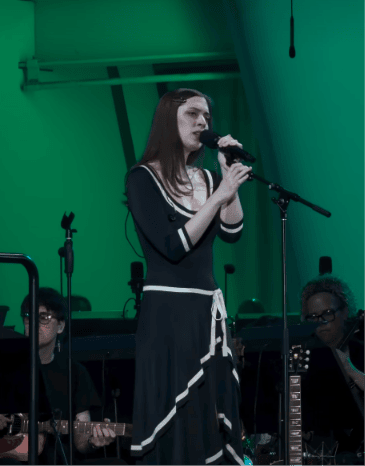
Lizzy McAlpine
Then came Lizzy McAlpine, whose quiet presence provided an effective contrast to the three Broadway belters. She brought an appropriately introspective quality to Joni Mitchell’s “Woodstock,” then stayed for “You’ve Made Me So Very Happy.” McAlpine, who appeared on Broadway in Floyd Collins earlier this year with Sperling as music director, later stepped completely outside the 1969 conceit to introduce “The Light in the Painting,” a new song of her own. With Mason Stoops on guitar and Taylor Mackall at the piano, she followed it with a spare, haunting “House of the Rising Sun,” the acoustic texture set against the sweep of the orchestra.
Some of the evening’s greatest pleasures came from hearing what Sperling and his arrangers could do with familiar material. James’s “America” was a knockout. Simon & Garfunkel’s searching song began almost eerily before gathering force in a haunting, propulsive orchestral arrangement. Blood, Sweat & Tears’ “Spinning Wheel” let the funk loose, while Crosby, Stills, Nash & Young’s “Suite: Judy Blue Eyes” captured those unmistakable late-’60s harmonies. “The Weight” brought Ricketts, James and Parham together, proving again how much muscle three voices could add without overwhelming the songs.
After intermission, Ricketts (who was astounding in Broadway’s The Great Gatsby), came roaring back for Jimi Hendrix’s “Purple Haze,” while Parham’s “Here Comes the Sun” provided one of the program’s gentler surprises. Ricketts later turned to the Grateful Dead for “Ripple,” and a gospel-infused medley of “O-o-h Child,” “Oh Happy Day” and “People Get Ready” gave singers and Hollywood Bowl Orchestra alike room to cut loose. Wayne Bergeron on trumpet, Justin Smith on guitar and Mark Vanderpoel on bass were among the musicians who repeatedly reminded us that this was not merely symphonic nostalgia.
The concept was conceived by Sperling with his husband, Noah Waxman, and its real accomplishment was breadth without randomness. Woodstock and the Harlem Cultural Festival supplied the obvious historical anchors, but Sperling also drew connections among protest music, gospel, psychedelia, folk and soul. The arrangements didn’t preserve 1969 under glass; they showed how wildly adventurous popular music could be when all of those sounds were rubbing against one another.
James returned in blazing form for Curtis Mayfield, while the full company eventually converged on “Aquarius/Let the Sunshine In.” By then there was only one sensible place for the evening to go: onto its feet. “Everyday People” and “Dance to the Music” became the encore, with Sperling himself joining the harmony as the Bowl turned into one enormous dance party.
What made Let the Sunshine In so satisfying was not simply hearing great songs from a great year. It was hearing them rearranged rather than embalmed. Sperling and the Hollywood Bowl Orchestra found the orchestral possibilities already hiding inside this music: the sweep in Simon & Garfunkel, the rhythmic punch in Blood, Sweat & Tears, the colors in Hendrix, the grandeur in gospel. More than half a century later, the music of ’69 didn’t need rescuing. It just needed musicians willing to mess with it.
✦ ✦ ✦ ✦ ✦ ✦ ✦ ✦ ✦ ✦
Let the Sunshine In: The Music of ’69
Hollywood Bowl Orchestra
Ted Sperling, conductor
Lizzy McAlpine, Morgan James, Noah J. Ricketts and Bryonha Marie Parham
Hollywood Bowl, 2301 N. Highland Ave. in Los Angeles
reviewed on July 17, 2026
✦ ✦ ✦ ✦ ✦ ✦ ✦ ✦ ✦ ✦
