


Areas We Cover
Categories

Theater Review: TOPDOG/UNDERDOG (Steppenwolf Theatre Company / Chicago)

by Emma S. Rund | September 29, 2026
in Chicago, Theater
THE HOUSE ALWAYS WINS
Kenny Leon finds new layers in Suzan-Lori Parks’s
riveting battle between two brothers trapped
by history, rivalry, and the roles they perform

Namir Smallwood and Glenn Davis in Steppenwolf Theatre Company’s revival of Topdog/Underdog
Topdog/Underdog by Suzan-Lori Parks is lauded as one of the greatest American plays of the 21st century, and it’s earned that label through blistering and rhythmic language, tension so thick you could choke on it, and layers upon layers of meaning. On one level, this is a play about two brothers pitted against each other since birth by way of their names, Lincoln and Booth, their father’s idea of a joke. On another level, it’s an indictment of systemic racism and the myth of the American Dream. But Steppenwolf’s production, directed by Kenny Leon, who also directed the 2022 Broadway revival, emphasizes something I’ve never really considered in this play before: the themes of performance and perception.
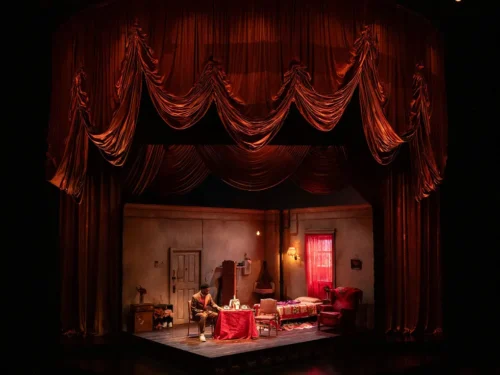

For those unfamiliar with this Pulitzer Prize-winning play, Topdog/Underdog is the story of two Black brothers, Lincoln (Steppenwolf artistic director Glenn Davis) and Booth (ensemble member Namir Smallwood), seen through snapshots of their lives as they share Booth’s seedy apartment. Booth is trying to learn three-card monte, a hustle Lincoln has left behind for honest work at an arcade, where he dresses as Honest Abe while paying customers shoot blanks at him, reenacting President Lincoln’s assassination. Booth considers the job degrading, but Lincoln has vowed never to go back to throwing cards and is determined to forge a new life for himself. At least he gets to sit down all day.


We progressively learn more about the brothers’ troubling childhood; they were not set up for success. We also hear about the women they apparently love, particularly Booth’s girlfriend, Grace, who is ever-present even though she never appears onstage. Power continually switches hands, each brother cutting the other down when the opportunity presents itself.


Under Leon’s direction, the brotherly love between the two is also clear. Davis brings a weary restraint to Lincoln, while Smallwood gives Booth a volatile swagger. While they certainly take many jabs at each other, there are playful and lighthearted exchanges as well, defusing some of the text’s ever-present tension and bringing the comedy to the forefront. Their contrasting energies make the affection and competition between the brothers equally convincing.


Where things get really interesting, though, is in the design. The set by Arnulfo Maldonado hangs a shimmering velvet curtain printed with a sepia-toned American flag around the stage, hiding the rest of the set from view until the show begins. When the curtain pulls up, it becomes a kind of valance, bathed in blue light by lighting designer Lee Fiskness, with a second inner valance framing the seedy apartment in an image that calls to mind Ford’s Theatre, where President Lincoln was shot. Fiskness also bathes the set in red light pouring through the apartment’s window, creating a color palette evocative of the American flag.


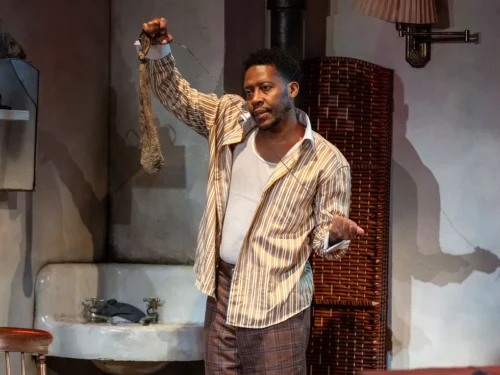
This image of Ford’s Theatre first suggests the idea of performance. Justin Ellington’s sound design develops it further. There are a few sequences in which Booth or Lincoln performs a kind of dance to carefully chosen musical selections. In one, Booth enters his apartment wearing a bulky winter puffer coat and, over the length of a song, reveals Dede Ayite’s costume surprise: a boosted suit. Actually, two boosted suits, complete with shoes, socks, and ties. Every flourish in which a new article is revealed seems choreographed and dance-like. Later in that same scene, Lincoln shares the words one of his regulars whispered in his ear: “Does thuh show stop when no ones watching or does thuh show go on?” Taken together, these choices make me wonder what the production is pointing toward. Are Lincoln and Booth doomed to perform their tragic story for our (America’s) entertainment? Would the tragedy play out if we weren’t watching?
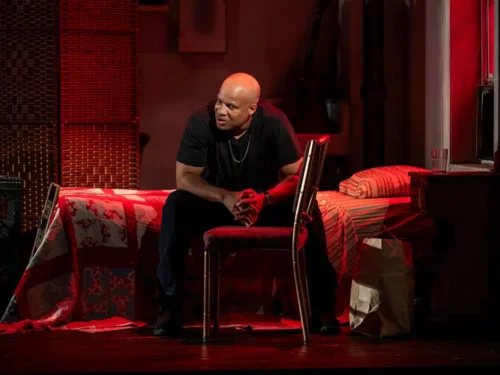

There’s one other element, highlighted in this production’s design, that raises this question for me. The brothers continuously refer to their family photo album, and on one occasion, Booth takes a photo of Lincoln with a Polaroid camera to add to it. The idea of a camera flash returns in the final moment, when light and sound capture a freeze-frame of the final tableau. Admittedly, in the day that I’ve spent mulling over this design, I haven’t been able to work out what the camera flash in that final moment might mean, but to me, there’s a clear emphasis on performance and perception. Is the camera flash an indictment of our society’s willingness to watch through a screen as Black lives are destroyed? Maybe I’m imposing that idea on the production, or maybe the ambiguity is precisely the point. What I do know is that Leon’s production made me see Topdog/Underdog differently, turning our act of watching into part of the play’s unsettling equation.

✦ ✦ ✦ ✦ ✦ ✦ ✦ ✦ ✦ ✦
photos by Michael Brosilow
Topdog/Underdog
Steppenwolf Theatre Company
Downstairs Theater, 1650 N. Halsted St. in Chicago
Tue–Fri at 7:30; Sat at 3 & 7:30; Sun at 3; Wed at 2 (Oct. 21)
ends on Nov. 1, 2026
2 hours and 25 minutes, including intermission
for tickets, call 312.335.1650 or visit Steppenwolf
for more shows, visit Theatre in Chicago
✦ ✦ ✦ ✦ ✦ ✦ ✦ ✦ ✦ ✦
