


Areas We Cover
Categories hhhh

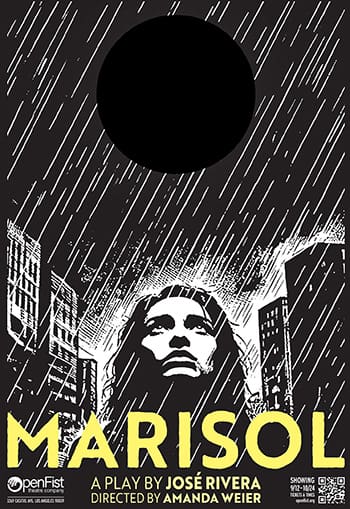
Theater Review: MARISOL (Open Fist Theatre Company / Los Angeles)
by Lawrence Lucero | September 18, 2026
in Los Angeles, Theater
WHEN THE APOCALYPSE
LOSES ITS MAGIC
José Rivera’s surreal vision of a world
coming apart demands theatrical daring
that this earthbound revival rarely delivers

Jade Santana and Hutchins Foster
What would you do if you lived in the Bronx, God went senile, and your guardian angel left you to fight him with the other angels? This is the scenario of José Rivera‘s Marisol, the current offering by the Open Fist Theatre Company at Atwater Village Theatre in Los Angeles.

Chima Rok, Carmella Jenkins, Mara Michelle, Jade Santana and Matthew Goodrich
Born in Puerto Rico and raised in New York, Rivera wrote Marisol at a time when the city was confronting homelessness, violent crime, and deep economic and social divisions—conditions he pushed into an apocalyptic extreme. First produced in 1992, the play won a 1993 Obie Award. Rivera later earned an Academy Award nomination for his screenplay for The Motorcycle Diaries and wrote such acclaimed plays as References to Salvador Dalí Make Me Hot and Cloud Tectonics, a 1996 Pulitzer Prize finalist. Three decades later, the urban anxieties that fed Marisol hardly seem confined to the New York of its time.

Hutchins Foster and Jade Santana
The theater’s press release promises “a dreamlike blend of magical realism, Theatre of the Absurd and Rivera’s powerfully poetic language.” We get the absurd and the language, but the magic is missing.

Jade Santana and Taylor Scott
Marisol Pérez is a young Puerto Rican professional living alone in a dangerous section of the Bronx. After narrowly escaping an attack by a deranged, golf club-wielding man on the subway, she returns to her cramped apartment, where her guardian angel appears with alarming news: God has grown senile, the universe is falling apart, and the angels are abandoning their earthly charges to wage a celestial revolt. Marisol is now on her own.

Jade Santana and Grace Soens
The next morning, the angel’s warning begins to come true as New York descends into an increasingly surreal nightmare. Marisol encounters the homeless and wounded, a wealthy woman who claims she has been tortured for exceeding her credit limit, and Lenny, the unstable brother of her friend June, whom he has attacked with a golf club. Obsessed with Marisol, Lenny later reappears pregnant, and she helps him deliver a stillborn baby that they bury beneath the pavement. As the boundaries of reality collapse around her, Marisol struggles simply to survive. Now that’s a lot!

Jade Santana and Chima Rok
Director Amanda Weier and her cast aren’t up to the gargantuan challenges this play demands. The actors deserve credit for navigating Rivera’s torrents of dialogue, much of it approaching stream of consciousness, but the production rarely allows the poetry to emerge. The staging is too busy and often looks labored, particularly during the clumsy fight choreography. Marisol cries out for a less-is-more approach that could heighten its surrealism and absurdity. Matt Richter’s lighting might have been used more boldly, isolating actors’ faces in tight spotlights and allowing the surrounding darkness to explode in sudden bursts of shocking color—more Kandinsky and Marvel than Chagall.

Jack Sharpe, Jade Santana, Grace Soens
Even Brad Bentz’s minimalist scenic design could go further. A bare stage anchored by a single piece such as Marisol’s bed might better serve the play than the cumbersome table carried in and out and the two practical locations—the train and Marisol’s apartment—that remain throughout.

Barbara Lee Bragg and Jade Santana
Worthy of note are Hutchins Foster as Man With Scar Tissue, Jack Sharpe as Lenny, and Jade Santana, who, as Marisol, manages to maintain focus and believability throughout the chaotic turns of the plot. Both she and Sharpe are especially effective in their emotionally truthful scene together with the baby.

Jack Sharpe and Jade Santana
This production is promoted as a “rare revival,” which is very enticing to this avid theatergoer. The question I am inclined to ask is the same one director Weier asks in the program note: “Why Marisol?” Yes, the oppression of the marginalized and disenfranchised is certainly relevant to the present politics of our nation, as are a call to action and a message of hope, as Weier has noted. Intellectually, these sound like good enough reasons for the revisit, but the vehicle itself is not theatrically worthy of dusting off and tuning up. The resulting ride is a jaunty one at best. The play’s dystopian vision of New York City, with its homelessness, acts of random homicide, and angry, spouting, mentally ill denizens wandering the streets, can be seen in most any big city in the United States, including here in Los Angeles. I have doubts about the necessity of sitting inside a theater to see it.
Additionally, the play’s symbolic payoff gives me pause. A crown hovers over the stage, representing the power of the remote, mad, uncaring, senile, and insensitive God. At the end, Marisol’s onetime guardian angel presents the crown, suggesting that the remedy for these social maladies should come from the people rather than an outside omnipotent authority. While the solution itself is socially viable, the crown as a visual representation of authority in this age of “NO KINGS” protests, can and should be up for debate.
✦ ✦ ✦ ✦ ✦ ✦ ✦ ✦ ✦ ✦
photos by John Dlugolecki
Marisol
Open Fist Theatre Company
Atwater Village Theatre, 3269 Casitas Ave.
100 minutes with intermission
Fri & Sat at 8; Sun at 4; Mon at 8 (Oct 5) (dark Oct. 3)
ends on October 24, 2026
for tickets ($26–$40), call 323.882.6912 or visit Open Fist
free parking in the ATX lot one block south of the theater
for more shows, visit Theater in LA
✦ ✦ ✦ ✦ ✦ ✦ ✦ ✦ ✦ ✦
